

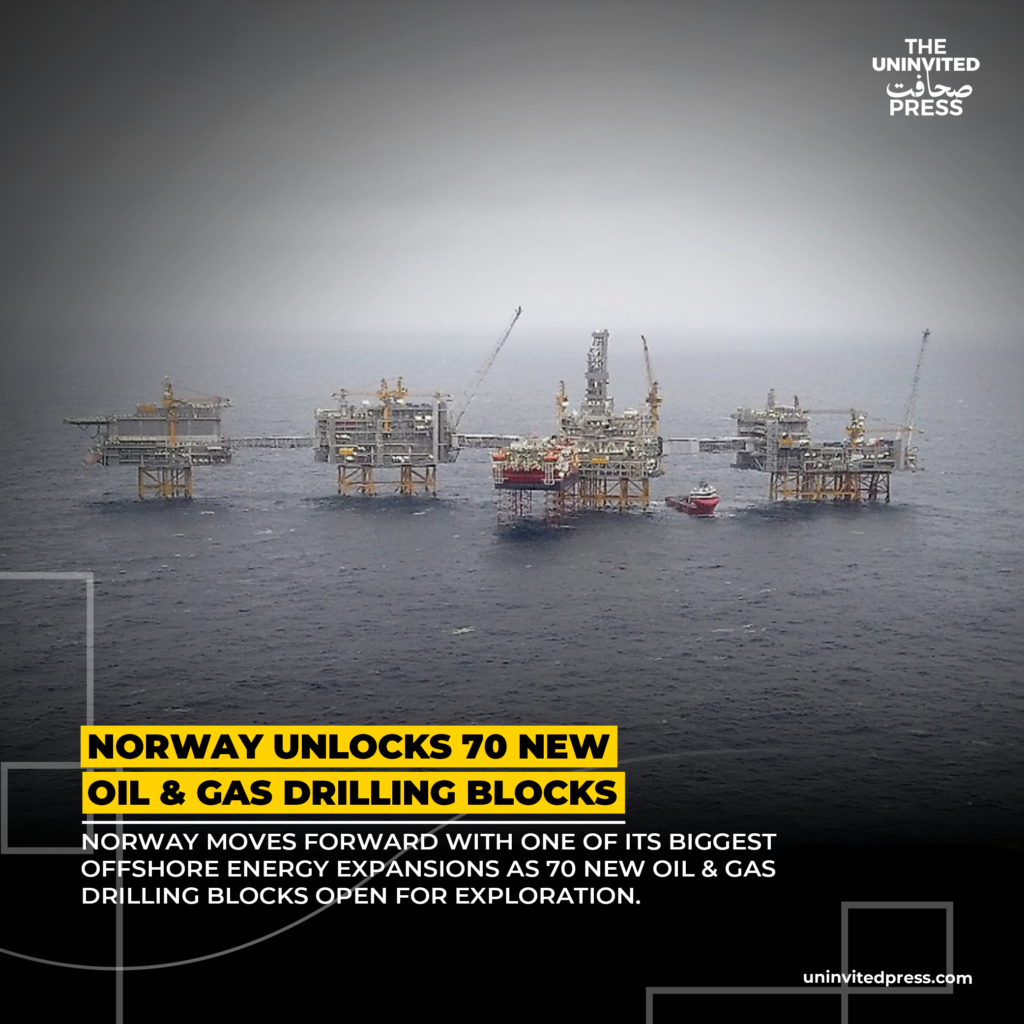
Oslo moves to extend petroleum era despite global climate commitments and shifting energy landscape.
Norway has announced the opening of up to 70 new offshore blocks for oil and gas exploration, marking one of its largest recent expansions of petroleum acreage on the Norwegian Continental Shelf.
The move, part of the annual Awards in Predefined Areas (APA) 2026 licensing round, was revealed by the Norwegian Ministry of Energy on May 5. It includes 38 blocks in the Barents Sea, 10 in the Norwegian Sea, and 22 in the North Sea. Applications are due by September 1, 2026, with awards expected in early 2027.
Sustained use of fossil fuels:
The decision underscores Norway’s strategy to sustain its oil and gas industry, which remains a cornerstone of its economy and a key supplier to Europe. Officials argue the expansion is necessary to maintain production levels as existing fields mature and overall output is projected to decline in the coming decades.
Prime Minister Jonas Gahr Store has framed the licensing round as essential for the long-term development of the country’s petroleum sector, particularly amid current global energy market uncertainties.
Norway is one of the world’s largest exporters of oil and gas. While it has positioned itself as a leader in renewable energy and electric vehicle adoption domestically, it continues to bank heavily on fossil fuel revenues, which fund its sovereign wealth fund-the world’s largest.
Environmental concerns and criticism:
The announcement is likely to draw criticism from environmental groups and climate activists, who argue that new fossil fuel exploration contradicts Norway’s international climate pledges under the Paris Agreement.
Critics point out that while European nations push for a rapid transition away from fossil fuels, Norway’s continued expansion of drilling-especially in the sensitive Arctic-adjacent Barents Sea-risks accelerating global warming and threatening fragile marine ecosystems.
“There has never been more acreage” available, according to Norwegian authorities, reflecting an aggressive approach to opening new areas, including some closer to the coast than in previous rounds.
Norway Expands Offshore Energy Exploration:
The licensing round comes against a backdrop of volatile global energy markets. Recent tensions in the Middle East, including disruptions in key shipping routes, have highlighted Europe’s reliance on Norwegian gas as a stable alternative to other suppliers.
Supporters of the policy emphasise that Norwegian production adheres to high environmental and safety standards compared to many other producers, and that the gas, in particular, plays a role in Europe’s energy transition by displacing dirtier coal and providing backup for intermittent renewables.
The APA rounds have historically been central to Norway’s petroleum policy, offering predictable access to mature and near-mature areas for major companies and smaller explorers alike.
Whether the 70 new blocks yield significant discoveries remains to be seen. Exploration success rates vary, and many analysts expect overall Norwegian production to peak and gradually decline towards 2030 and beyond, even with new licences.
Norway’s balancing act-between its lucrative fossil fuel present and its stated climate ambitions-continues to define its energy policy, with implications not only for its economy but for global efforts to curb emissions.