

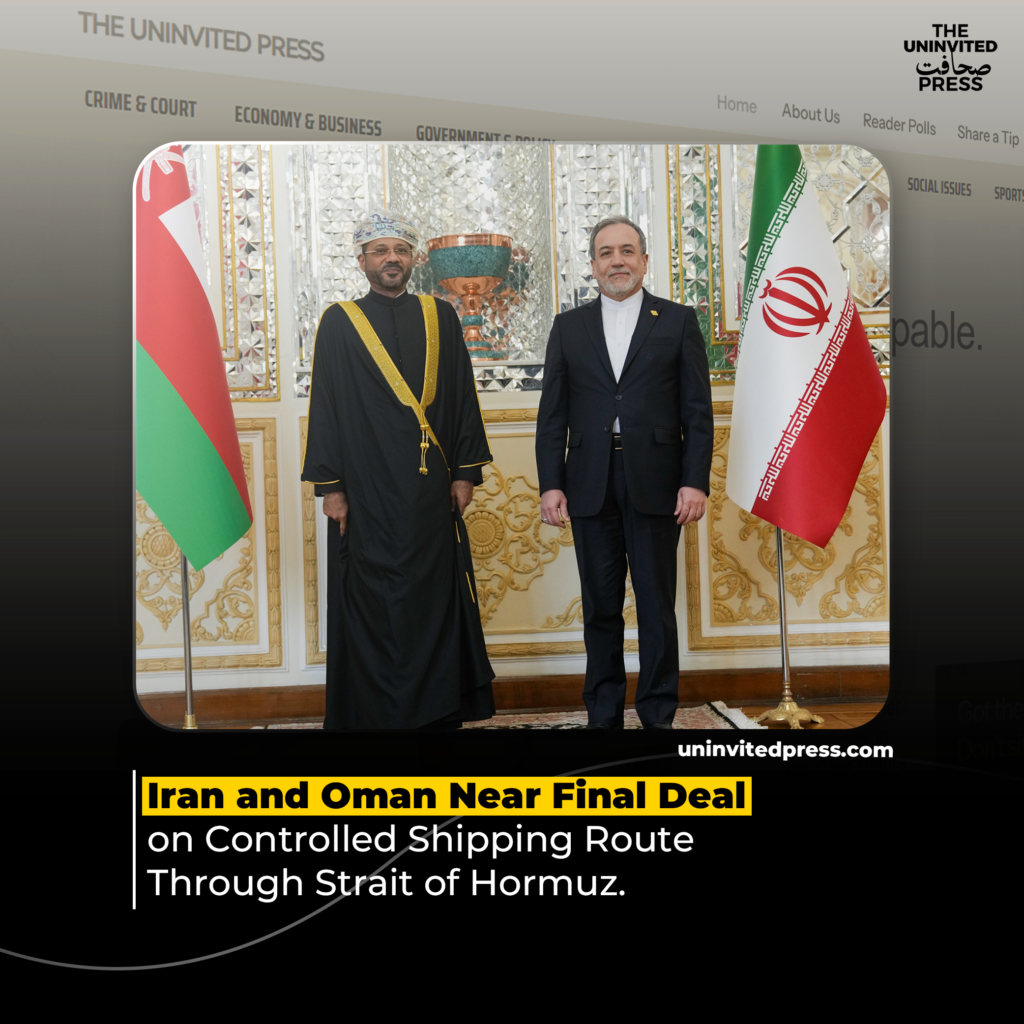
Tehran says geographic coordinates agreed and joint statement in final drafting stage, as both sides seek temporary arrangements for the vital energy chokepoint.
Iran and Oman are close to finalising an agreement on a designated shipping route through the Strait of Hormuz, Iranian officials said on Wednesday, marking a potential step toward restoring commercial traffic through one of the world’s most critical energy corridors after months of disruption.
Foreign Ministry spokesman Esmaeil Baghaei said the two countries had reached a mutual understanding on the geographic coordinates of the proposed route. “If certain third parties do not obstruct the process, a joint statement by the two countries, containing the principal considerations and points of agreement, is currently in the final stages of review and drafting,” Baghaei was quoted as saying by Iranian state media.
Iran, Oman Near Strait of Hormuz Shipping Deal:
The talks, described by Baghaei as “professional” and “moving forward,” have focused on establishing a temporary navigation corridor to replace earlier temporary northern and southern routes. According to Iranian Deputy Foreign Minister Kazem Gharibabadi, the sides have reached in-principle agreement on almost all relevant issues, including entry and exit points. Under the emerging arrangement, a significant portion of the route would pass through Iranian territorial waters, with vessels heading into the Persian Gulf expected to transit a channel close to Iran’s coast.
Sources familiar with the discussions have indicated that Iran would exercise primary control over inbound traffic, while outbound vessels would use a route involving Omani waters, with coordination or notification requirements involving Tehran. The arrangement is expected to last two to four months, or potentially longer, during which naval mines in central sections of the strait would be cleared and further negotiations on longer-term management would continue.
Iranian officials have said no formal tolls would be imposed, though a “service fee” covering environmental impacts, security and staffing costs has been discussed, with revenues potentially shared equally between the two countries. A US official has disputed elements of the Iranian account, stating that any temporary routes would not involve Iranian approvals or permissions and would not include tolls.
Hormuz Shipping Talks Boost Market Optimism:
The Strait of Hormuz, a narrow waterway between Iran and Oman, handles roughly one-fifth of global oil supplies and significant volumes of liquefied natural gas. Commercial shipping through the strait was severely disrupted following the outbreak of conflict involving the United States, Israel and Iran earlier in 2026. Iran tightened controls in late February, restricting passage for vessels linked to the United States and Israel, while subsequent military actions and a US naval presence further constrained traffic. Daily vessel movements, which previously averaged around 130, fell sharply at the height of the tensions.
The current negotiations build on earlier understandings, including a joint Iranian-Omani working group established in June and references to arrangements under a broader memorandum of understanding involving the United States. Oman, which has long played a mediating role in regional diplomacy, has reaffirmed the importance of safe passage in line with international law while emphasising the sovereignty of the two coastal states over their territorial waters.
Baghaei stressed that an agreement between Iran and Oman alone would not guarantee security in the waterway, linking the overall safety of navigation to the wider regional security environment and the implementation of other commitments. Iranian officials have insisted that any final arrangement must respect their sovereign rights and security interests.
As of Wednesday, the Omani government had not issued a detailed public confirmation of the latest Iranian statements. Diplomats and shipping analysts are watching closely to see whether the joint statement materialises without external interference and whether the temporary corridor can restore predictable traffic while longer-term questions of management, fees and security remain under discussion.
The potential reopening carries significant implications for global energy markets, which have faced elevated prices and supply uncertainties since the strait’s disruption. Any durable arrangement would also test the balance between coastal-state sovereignty and the traditional status of the waterway as an international passage under maritime law.