

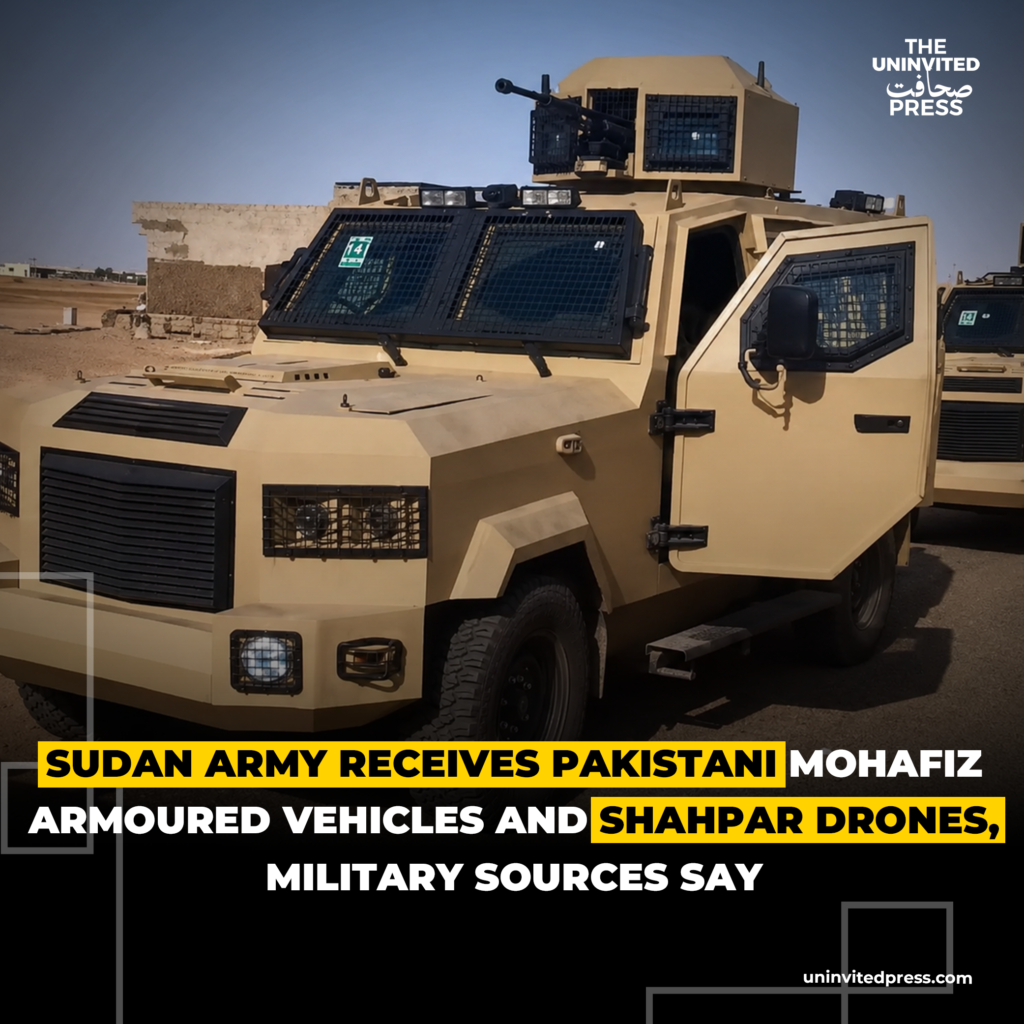
Delivery aimed at strengthening operations against RSF in Kordofan and Darfur amid prolonged civil war.
Sudan’s army has received a consignment of Pakistani-made Mohafiz armoured vehicles and Shahpar drones, military sources said, as the Sudanese Armed Forces (SAF) seek to reinforce their positions in ongoing fighting against the paramilitary Rapid Support Forces (RSF).
Pakistan-Sudan Defence Cooperation Deepens:
According to reports citing military sources, the equipment is intended to boost SAF capabilities particularly in the regions of Kordofan and Darfur, where intense clashes continue. The Mohafiz armoured security vehicles, produced by Pakistan’s Heavy Industries Taxila (HIT) and based on a Toyota Land Cruiser chassis, are designed for reconnaissance, troop transport and protection against small-arms fire. The Shahpar series unmanned aerial vehicles, developed by Global Industrial and Defence Solutions (GIDS), include combat and reconnaissance variants capable of extended endurance and precision strike missions.
The deliveries form part of broader defence cooperation between Sudan and Pakistan that has developed over the past year. Earlier reports detailed multi-hundred-million-dollar agreements covering armoured vehicles, various drone types including Shahpar-2 models, light attack aircraft and other systems. Some accounts linked larger packages, valued in the region of $1.5 billion, to facilitation by regional partners, though details of financing and exact quantities remain unconfirmed by official statements from either government.
Reports indicate that the Sudanese military has received newly arrived Mohafiz armoured vehicles, with open-source observers noting that the reported deliveries appear consistent with the announced defence package.
Sudan Conflict Fuels Demand for Military Equipment:
The acquisition comes more than three years into Sudan’s civil war, which erupted in April 2023 between the SAF, led by General Abdel Fattah al-Burhan, and the RSF under Mohamed Hamdan Dagalo. The conflict has devastated large parts of the country, displaced millions and caused a severe humanitarian crisis. Both sides have increasingly relied on drones for reconnaissance, strikes and disruption of supply lines, turning parts of the battlefield into a technological contest that has contributed to high civilian casualties.
Pakistan’s role as a supplier reflects Islamabad’s expanding defence export efforts, offering relatively affordable and combat-tested systems. For the SAF, the new platforms are expected to improve mobility and aerial surveillance in difficult terrain across western and central Sudan. Analysts note that armoured vehicles such as the Mohafiz can provide better protection for infantry in urban and desert operations, while the drones add to an existing mix of Iranian, Turkish and other unmanned systems already in use.
Neither the Sudanese military nor Pakistani authorities have issued formal public statements confirming the latest shipment. Regional and international efforts to mediate an end to the fighting have so far failed to produce a lasting ceasefire, leaving both parties to continue seeking external military support. The introduction of additional equipment risks further intensifying the conflict, even as calls grow for greater protection of civilians and unimpeded humanitarian access.