

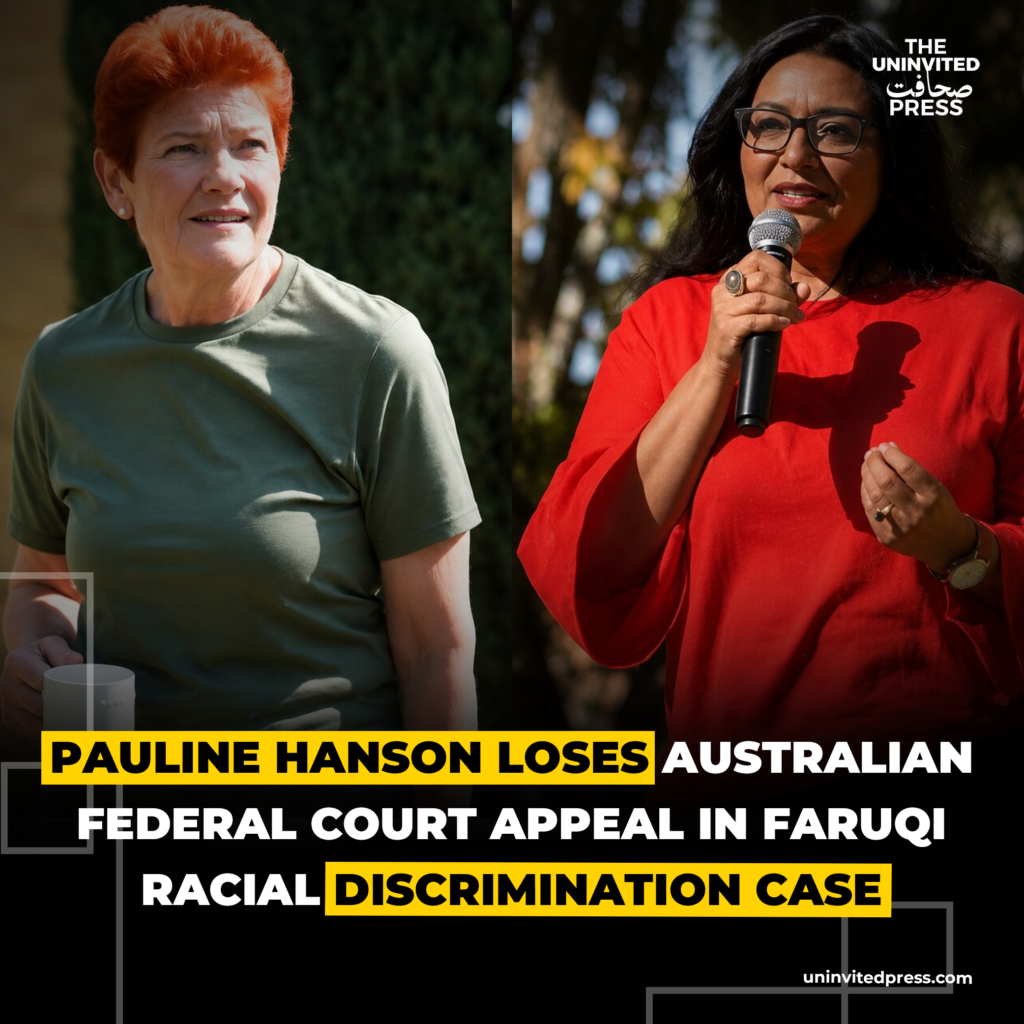
Full Federal Court dismisses One Nation leader’s appeal over 2022 tweet telling Mehreen Faruqi to ‘piss off back to Pakistan’.
Australia’s Full Federal Court has unanimously rejected an appeal by right-wing politician Pauline Hanson against a finding that she racially discriminated against Greens Senator Mehreen Faruqi in a social media post.
In a decision delivered on 27 July 2026, Justices Melissa Perry, Geoffrey Kennett and Elizabeth Bennett dismissed all seven grounds of Hanson’s appeal. The three-judge panel upheld a 2024 ruling by Justice Angus Stewart that Hanson’s 2022 tweet telling Faruqi to “pack your bags and piss off back to Pakistan” breached section 18C of the Racial Discrimination Act 1975.
The original post was made on the day Queen Elizabeth II died. Faruqi, a Muslim woman of Pakistani heritage and deputy leader of the Australian Greens, had written that she could not mourn “the leader of a racist empire built on stolen lives, land and wealth of colonised peoples.” Hanson replied that Faruqi’s attitude “appals and disgusts me,” accused her of taking “every advantage” of Australia after immigrating, and told her to leave the country.
Hanson Loses Appeal Over Racist Tweet:
Justice Stewart found the tweet was an “angry personal attack” that amounted to a “strong form of racism.” He characterised the phrase as a variant of the long-standing racist trope “go back to where you came from,” noting it carried particular resonance for people of colour, migrants and Muslims in Australia. The post was held to be reasonably likely to offend, insult, humiliate and intimidate Faruqi and members of those groups, and was made because of her race, colour and national or ethnic origin. Hanson was ordered to delete the tweet and pay Faruqi’s legal costs.
On appeal, Hanson argued that the comments were protected political communication, that the Racial Discrimination Act improperly restricted free speech, and that the primary judge had erred in his assessment of the tweet’s meaning and effect. The Full Court rejected those arguments in full. It agreed that the post contained an anti-Muslim and Islamophobic message and that the law, as qualified by the free-speech defences in section 18D, remains constitutionally valid.
Faruqi, who attended the Sydney court for the judgment while Hanson did not, described the outcome as a victory for those targeted by racism. “Today, justice has prevailed,” she told reporters. “Today’s win is for every single person who has been made to feel that their belonging in this country is conditional… who has been told to go back to where you came from. This case was always about holding to account racism and holding to account those who perpetrate racism.”
Hanson issued a statement expressing disappointment and signalling that her legal team would review the decision with a view to seeking special leave to appeal to the High Court of Australia. She has long criticised racial discrimination laws as constraining ordinary Australians’ ability to express personal opinions.
Racism Verdict Against Hanson Stands:
The case has been closely watched as a test of the balance between anti-vilification protections and political speech in Australia. Section 18C makes it unlawful to do an act that is reasonably likely to offend, insult, humiliate or intimidate another person or group because of their race, colour or national or ethnic origin. Defences exist for fair comment, artistic works and certain public-interest discussions conducted reasonably and in good faith-defences the courts found Hanson failed to establish.
Australia’s Race Discrimination Commissioner welcomed the ruling, describing it as a landmark decision that provides greater clarity on how the law applies when people experience discrimination through overlapping aspects of their identity, including race, migrant status and religion.
Hanson, founder and leader of the One Nation party, has built a political career on opposition to high immigration and multiculturalism. She has previously called for a ban on Muslim immigration and has faced repeated accusations of racism, which she rejects. Faruqi, one of the first Muslim women elected to Australia’s federal parliament, has been a prominent voice on issues of racism, colonialism and First Nations justice.
The Full Court’s lengthy judgment leaves the original declaration intact: Hanson’s conduct was unlawful under the Racial Discrimination Act. Whether the matter proceeds further to the High Court remains to be seen, but for now the finding that a sitting senator engaged in racial discrimination against a parliamentary colleague stands confirmed.