

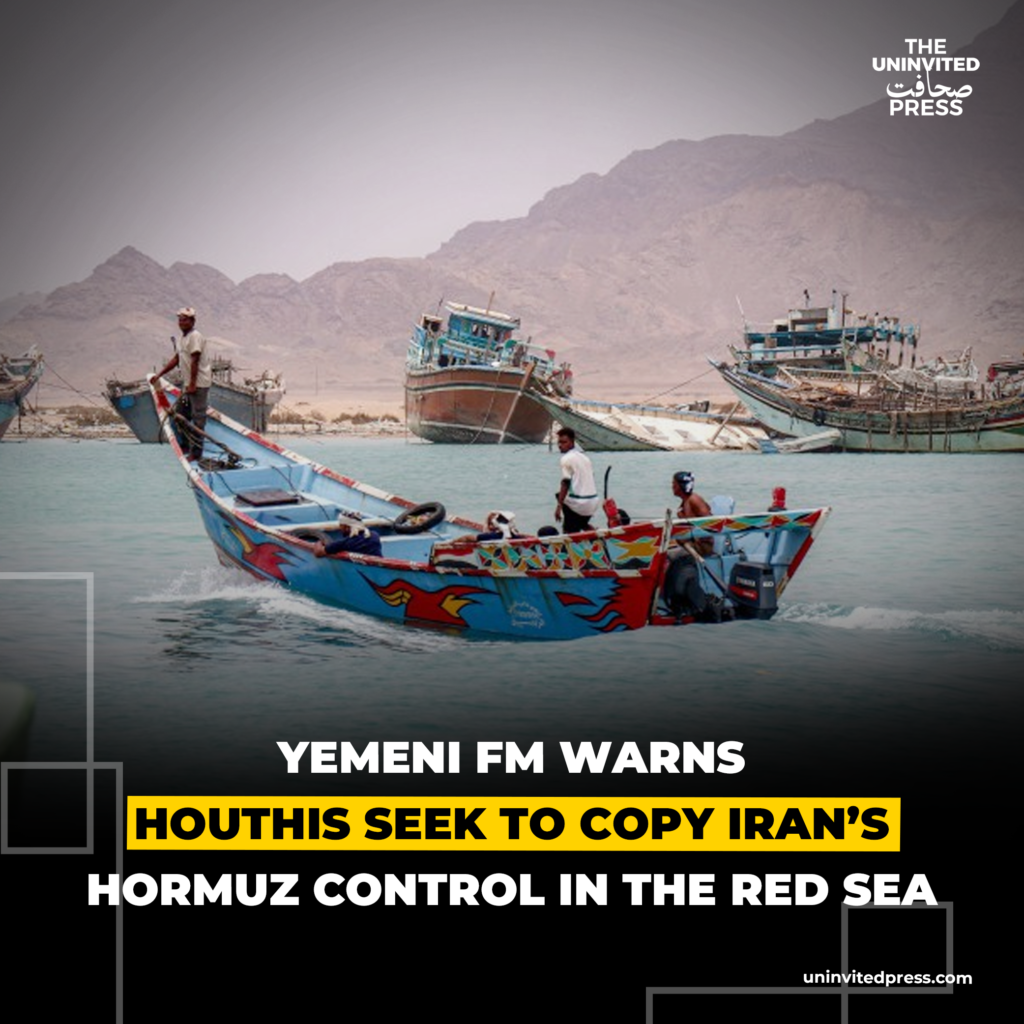
Official says Iran-backed group aims to control Bab al-Mandeb Strait, emboldened by limited international response.
Yemen’s internationally recognised government has issued a stark warning that the Houthi movement is seeking to replicate Iran’s approach to the Strait of Hormuz by asserting control over shipping through the Red Sea’s Bab al-Mandeb Strait.
Speaking to journalists at the Yemeni embassy in Riyadh on Monday, Foreign Minister-designate Afrah al-Zouba said the Houthis “want to copy the Iranian model, and this will shut down two main straits, the gateways into the Gulf and Red Sea.” She argued that the group has been emboldened by what she described as an insufficient international response to its activities.
Bab al-Mandeb Tensions Raise Global Alarm:
Bab al-Mandeb, the narrow waterway linking the Red Sea to the Gulf of Aden and the Indian Ocean, is a critical chokepoint for global trade. Approximately 30 percent of the world’s container traffic and 12 to 15 percent of overall global trade passes through the Red Sea. Control of Yemen’s western coastline gives any force holding that territory significant influence over vessels transiting the strait.
Al-Zouba’s comments come amid rising tensions between the Houthis and Saudi Arabia. The Iran-aligned group has launched missile and drone attacks against the kingdom and declared a blockade on Saudi shipping. Saudi Arabia has responded with airstrikes on what it says are Houthi military facilities and has pledged to protect commercial vessels, accusing the Houthis of serving foreign agendas.
The Red Sea has become a new theatre in the broader regional confrontation involving Iran. Shipping data already indicates a decline in traffic, with only a handful of commodity vessels reported passing through on a recent day. Analysts note that simultaneous pressure on both Hormuz and Bab al-Mandeb would place two of the world’s most vital energy and trade arteries under threat.
The Yemeni government, which enjoys strong Saudi backing, said it is prepared for further escalation. Al-Zouba noted that exchanges of fire continue along the frontline stretching from the Red Sea coast to the Saudi border in Yemen’s northwest, though neither side has yet launched a full-scale offensive. She stressed that the conflict must ultimately be resolved, whether through peaceful means or otherwise.
Red Sea Emerges as Strategic Flashpoint:
The Houthis, who seized Sanaa in 2014 and control large parts of northern and western Yemen, have for years used their coastal positions to threaten maritime traffic. Their campaign intensified in late 2023 in the context of the Gaza war and has continued to evolve amid shifting regional dynamics. Iranian support has long been a key factor in the group’s military capabilities, including access to missiles, drones and expertise that enable operations far beyond Yemen’s shores.
For the internationally recognised Yemeni government and its Saudi allies, the Houthi strategy is viewed as an extension of Iranian influence designed to pressure the international community and disrupt energy markets. For the Houthis and their backers, the actions are framed as legitimate resistance and solidarity within a wider regional confrontation.
The warning from Riyadh underscores growing concern that the Red Sea could become a second strategic pressure point alongside the Strait of Hormuz. With global supply chains already strained by disruptions in key waterways, any sustained effort to control or severely restrict traffic through Bab al-Mandeb would carry significant economic and security consequences well beyond the Arabian Peninsula.