

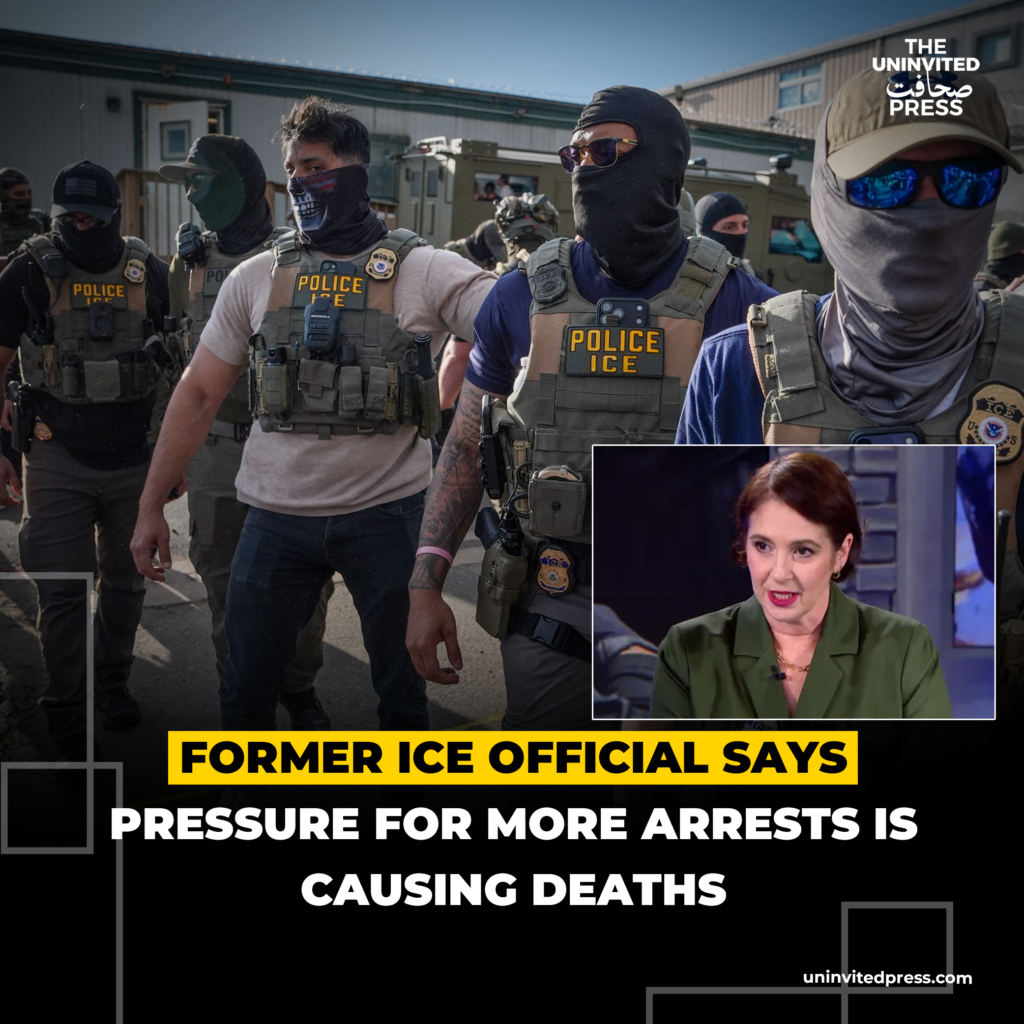
Ex-deputy director warns relentless quotas under Trump administration are driving agent mistakes amid surge in fatal shootings and custody deaths.
A former senior official at US Immigration and Customs Enforcement has warned that intense pressure from the White House to increase arrests is leading to fatal mistakes by agents, as the agency intensifies its role in President Donald Trump’s mass deportation campaign.
Deborah Fleischaker, who served as ICE’s deputy director of policy during the Biden administration, told Media this week that the demand for higher numbers is compromising operational safety. “The real problem is the pressure to do more arrests and do them more quickly. And when there’s relentless pressure to do more, more, more and more, agents make mistakes,” she said.
In early July, Mexican national Lorenzo Salgado Araujo was shot and killed by an agent in Houston during a traffic stop; witnesses disputed official claims that he had used his vehicle as a weapon, and reports indicated he was not the intended target. Less than a week later, Colombian national Johan Sebastián Durán Guerrero was fatally shot by an ICE agent in Biddeford, Maine. Additional deaths have been reported in custody transfers and during pursuits.
ICE Arrest Push Faces Growing Scrutiny:
These field encounters form part of a broader pattern. Human Rights Watch and Physicians for Human Rights documented at least 52 deaths in ICE custody in the first 500 days of Trump’s second term, with the mortality rate more than doubling compared with previous periods and reaching its highest level in over a decade. Analysts note that the increase outpaces the expansion of the detained population, which has risen to record levels above 70,000 at times. Causes have included medical emergencies, suicides, and trauma, with critics pointing to overcrowding, understaffing of medical teams, and reduced releases on bond or parole.
Internal pressures have intensified. Confidential documents and accounts from current and former officials describe targets approaching or exceeding 2,000 arrests per day. In late June, more than 10,000 arrests were recorded in a five-day span. Leave has been cancelled, field offices stretched thin, and leaders held accountable for failing to meet numerical goals. One senior ICE official, speaking anonymously, described a “toxic environment” in which agents are pushed “to the breaking point,” with vehicle stops becoming a primary and increasingly confrontational method of enforcement.
The Trump administration has framed the expansion as necessary to address irregular migration and remove individuals with criminal records, arguing that previous policies were too lenient. Deportation numbers have risen significantly since January 2025, though they have fallen short of the president’s stated goal of one million removals in the first year. Officials have also pointed to increased funding for hiring and detention capacity.
Former ICE Official Warns of Enforcement Risks:
Immigrant rights groups, members of Congress, and some former law enforcement voices argue that the focus on volume over careful targeting has elevated risks for both agents and the public. Several of those killed or injured in recent operations were not the primary subjects of the investigations, and questions have been raised about training standards amid rapid recruitment drives. Families of the deceased have called for independent investigations, while governments of countries such as Mexico have sought accountability for their nationals who have died in encounters or custody.
Fleischaker’s intervention adds a rare insider perspective to a debate that has grown sharper as videos of street arrests circulate widely and the human cost becomes more visible. The former official’s warning underscores a central tension in the current enforcement strategy: whether the political imperative to deliver high arrest numbers can be reconciled with the operational realities of safe, precise policing.
As ICE continues its expanded operations across US cities and communities, the consequences of that pressure-measured in both detention fatalities and street-level shootings-remain under intense scrutiny from rights organisations, lawmakers, and the families left behind.