

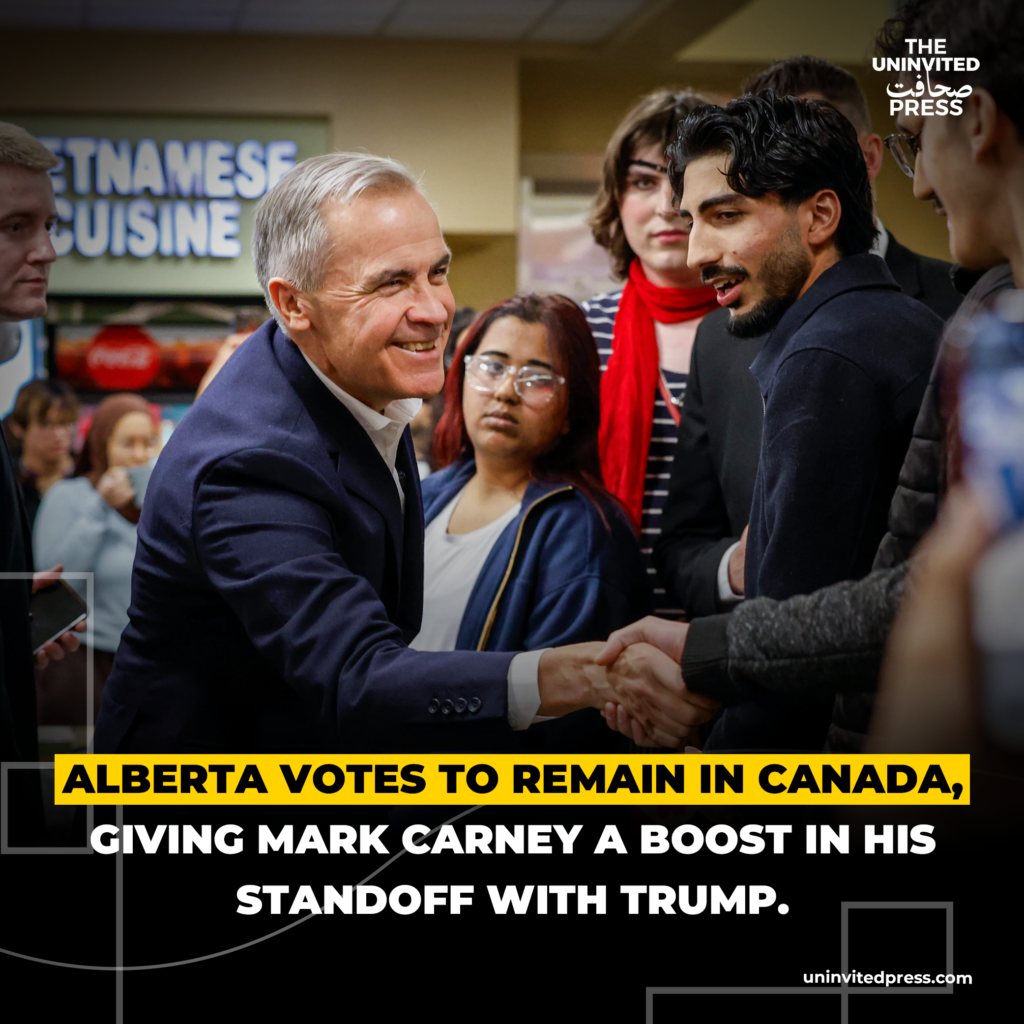
Oil-rich province rejects path to separation in non-binding referendum as Canadian prime minister consolidates national unity amid US trade war and annexation rhetoric.
Voters in Canada’s energy heartland of Alberta have overwhelmingly chosen to remain part of the country, rejecting a push toward a future independence referendum in a decisive result that strengthens Prime Minister Mark Carney’s hand as he confronts a deepening economic and political confrontation with US President Donald Trump.
Unofficial results from the October 19, 2026, non-binding referendum showed approximately 75 to 76 percent of Albertans supporting the option to stay within Canada, while about 24 to 25 percent backed beginning the legal process for a binding vote on separation. With most ballots counted, the outcome marked the first time the western province had held such a vote and delivered a clear repudiation of a separatist campaign that had drawn attention-and some reported assistance-from elements aligned with Trump’s political circle.
Carney, who grew up in Edmonton, Alberta’s capital, hailed the result as a “great result for Canada.” In a statement and remarks to reporters ahead of a cabinet meeting, he said Albertans had “made a clear choice” for “unity, to build together, and to take care of each other.” “Above all, Albertans chose Canada,” he declared, adding that the province and the country would now “move forward together with renewed purpose and high ambition.”
The referendum question asked whether Alberta should remain a province of Canada or whether the provincial government should commence the constitutional process required to hold a binding referendum on separation. It was one of 10 questions on the ballot, which also covered immigration and the division of powers between Ottawa and the provinces. The separation question was non-binding, meaning even a different outcome would not have triggered immediate secession. Canadian courts have long held that any province seeking to leave the federation would need to negotiate with the federal government.
Alberta Votes to Remain in Canada Amid Trump’s Tariff Dispute:
Alberta Premier Danielle Smith, a conservative who called the vote after a petition gathered hundreds of thousands of signatures, welcomed the early results. She said she was “very pleased” that Albertans had shown “widespread support for remaining in Canada” and that the province had “voted for a stronger Alberta in a united Canada.” Smith was scheduled to address the province on the path forward.
The vote unfolded against a backdrop of heightened Canadian nationalism triggered by Trump’s return to the White House. Since taking office for a second term, Trump has imposed heavy tariffs on Canadian goods, repeatedly suggested that Canada should become the 51st US state, and escalated a trade dispute that has prompted Ottawa to retaliate. Carney has responded with a mix of defiance and efforts to diversify Canada’s trade relationships beyond its southern neighbour, framing national unity as essential to economic resilience.
Supporters of the pro-Canada “Forever Canadian” campaign celebrated the results in Edmonton and elsewhere, waving flags and cheering as the numbers came in. Thomas Lukaszuk, a former Alberta politician who helped lead the unity effort, said the outcome would send a strong message: “Canada is not up for grabs.” “We are a solid country that’s united from coast to coast to coast and we stick up for each other,” he told a cheering crowd.
Alberta Rejects Separatism, Backs Canadian Unity:
Separatist organisers, whose movement has long drawn on grievances over federal energy policies, equalization payments and perceived cultural distance from Ottawa, said the conversation was not over. Some had met with US officials in the lead-up to the vote, prompting concerns in Canada about foreign interference. Polls before the referendum had consistently shown majority support for remaining in Canada, though a significant minority expressed frustration that the vote channelled into the separatist option.
Analysts noted that Carney’s personal ties to Alberta and his campaigning in the final days-warning that separation would be “a dangerous bluff” that could invite external forces seeking to “break us so they can own us”-helped solidify the remain vote. The result removes a potential domestic distraction at a moment when Carney is seeking to position Canada as more independent of the United States, investing in infrastructure, energy exports and new international partnerships.
While the separatist movement is unlikely to disappear entirely, the scale of the rejection has given Carney political capital to press ahead with his agenda of national cohesion and economic diversification. For a province that supplies a large share of Canada’s oil and gas exports-much of it historically destined for the United States-the decision to stay firmly inside the federation underscores the limits of fragmentation even amid deep policy disagreements with the federal government.
As Canada continues its standoff with Washington, the Alberta result stands as a rare moment of clarity: a wealthy, often restive province has chosen the federation, at least for now, and in doing so has reinforced the prime minister’s claim to speak for a more unified country.