

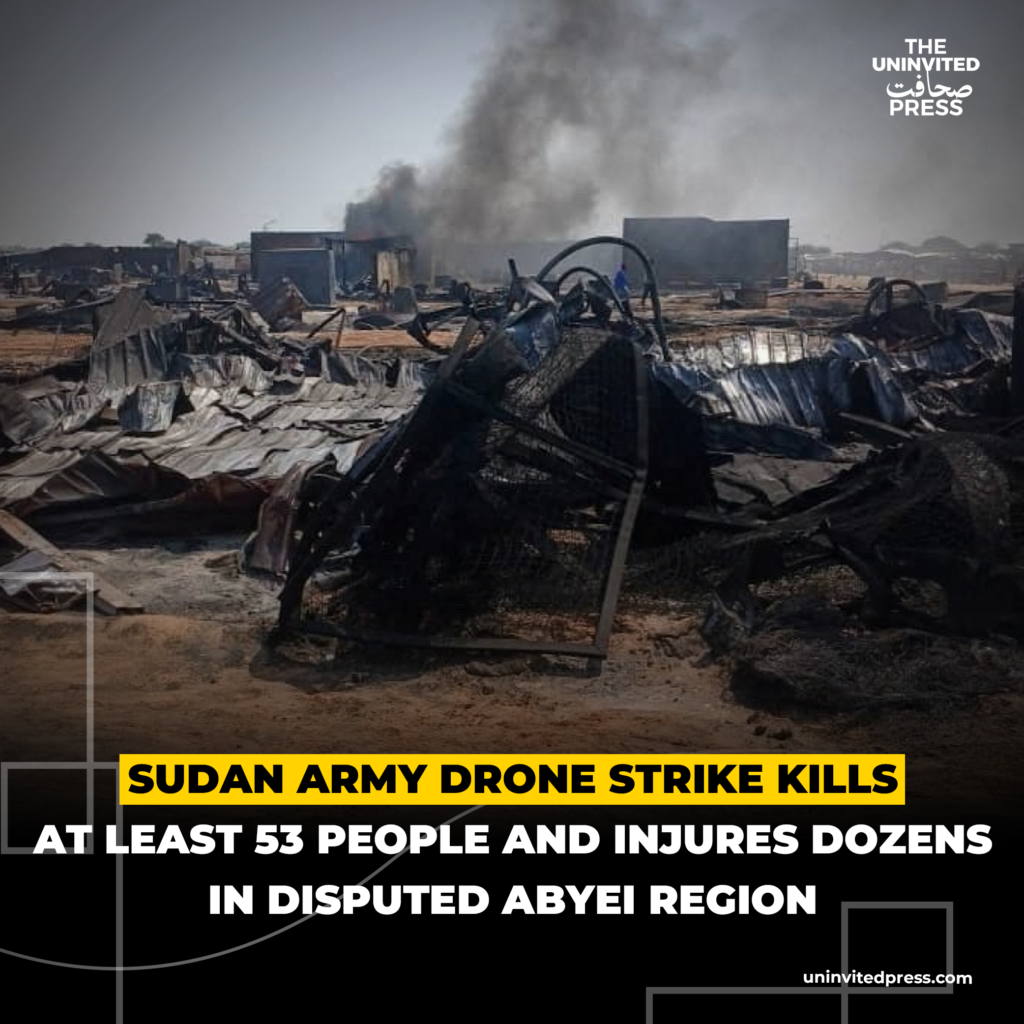
Attack on busy market in oil-rich border area between Sudan and South Sudan leaves dozens wounded as conflict continues to spill across frontiers.
A drone strike attributed to the Sudanese Armed Forces has killed at least 53 people and injured dozens more in the disputed Abyei region along the Sudan-South Sudan border, local officials and reports said, in one of the deadliest recent incidents to hit the contested territory.
The attack struck the Amiet Common Market, a busy commercial hub north of Abyei town, on Monday. Officials in the Abyei Special Administrative Area said the death toll later rose significantly as rescue workers recovered more bodies from the smouldering site, with some accounts putting the number of fatalities above 150. Many of the victims were civilians, including traders and shoppers, according to witnesses and local authorities. At least 19 to 27 people were reported injured in initial tallies, with some suffering severe burns.
Yohana Akol Ngor, the caretaker information minister for Abyei, said Sudan’s military carried out the drone strikes. “The fire is still burning. So the recovery process of the dead ones is still continuing. The situation is terrible,” he told reporters, noting that some bodies had been burned beyond recognition. An eyewitness described hearing multiple large explosions that set a fuel section of the market ablaze. “People started evacuating the casualties. They had injuries from shrapnel on their stomach and legs… In one site, I saw 28 bodies that were burnt,” the witness said.
Drone Strike on Abyei Market Kills Civilians, Displaces Thousands:
The Sudanese Armed Forces did not immediately comment on the incident. Officials in Sudan’s military-led government have previously said the paramilitary Rapid Support Forces (RSF) maintain a presence in parts of Abyei, a claim denied by local Abyei authorities. Diplomatic sources and conflict analysts told news agencies the strike hit a fuel depot that had previously been used in RSF supply networks, though no independent verification of military targets at the market was immediately available. A civilian witness said no uniformed fighters were visible in the area at the time.
Abyei is a resource-rich territory jointly claimed by Sudan and South Sudan since the latter’s independence in 2011. It remains under temporary administration and hosts a United Nations Interim Security Force for Abyei (UNISFA). The area has long been a flashpoint for ethnic tensions and resource disputes, and has grown more volatile as Sudan’s civil war-which erupted in April 2023 between the Sudanese army and the RSF-has expanded into neighbouring regions, including South Kordofan and West Kordofan.
South Sudan’s foreign ministry summoned the Sudanese ambassador in protest after the attack. The ministry confirmed drones had struck a market north of Abyei town but did not release its own casualty figures. Some 8,000 people were displaced by the bombing, according to local officials.
The United Nations strongly condemned the series of drone attacks across Sudan and Abyei. Spokesperson Stephane Dujarric said the world body remained “alarmed by the relentless drone attacks… taking a devastating toll on communities already struggling with the consequences of more than three years of conflict.”
MSF Treats Wounded After Deadly Drone Strike in Abyei:
Medical charity Médecins Sans Frontières (MSF) said it was treating more than 20 wounded patients, some with burns, at Ameth Bek Hospital near the site. “We are providing surgical services and wound dressing, along with other emergency care,” said Christian Lindauer, an MSF medical activities manager.
The strike forms part of a broader escalation in drone warfare in Sudan’s conflict. In recent days, attacks have hit markets, transport hubs and other civilian areas in West Kordofan, Nyala and Khartoum, killing scores more people. Both the Sudanese army and the RSF have been accused of using drones against each other’s positions and of causing heavy civilian casualties. The war has already displaced millions, triggered famine conditions in parts of the country, and drawn in regional actors through supply lines and proxy support.
Residents of Abyei staged peaceful protests following the attack, marching to demand accountability and greater protection. The incident underscores how the fighting in Sudan continues to endanger civilians far beyond the main battlefronts, including in territories whose final political status remains unresolved more than a decade after South Sudan’s independence.
As recovery efforts continued amid ongoing fires and limited medical resources, local and international calls grew for restraint and for greater protection of civilian infrastructure in one of Africa’s most fragile border regions.