

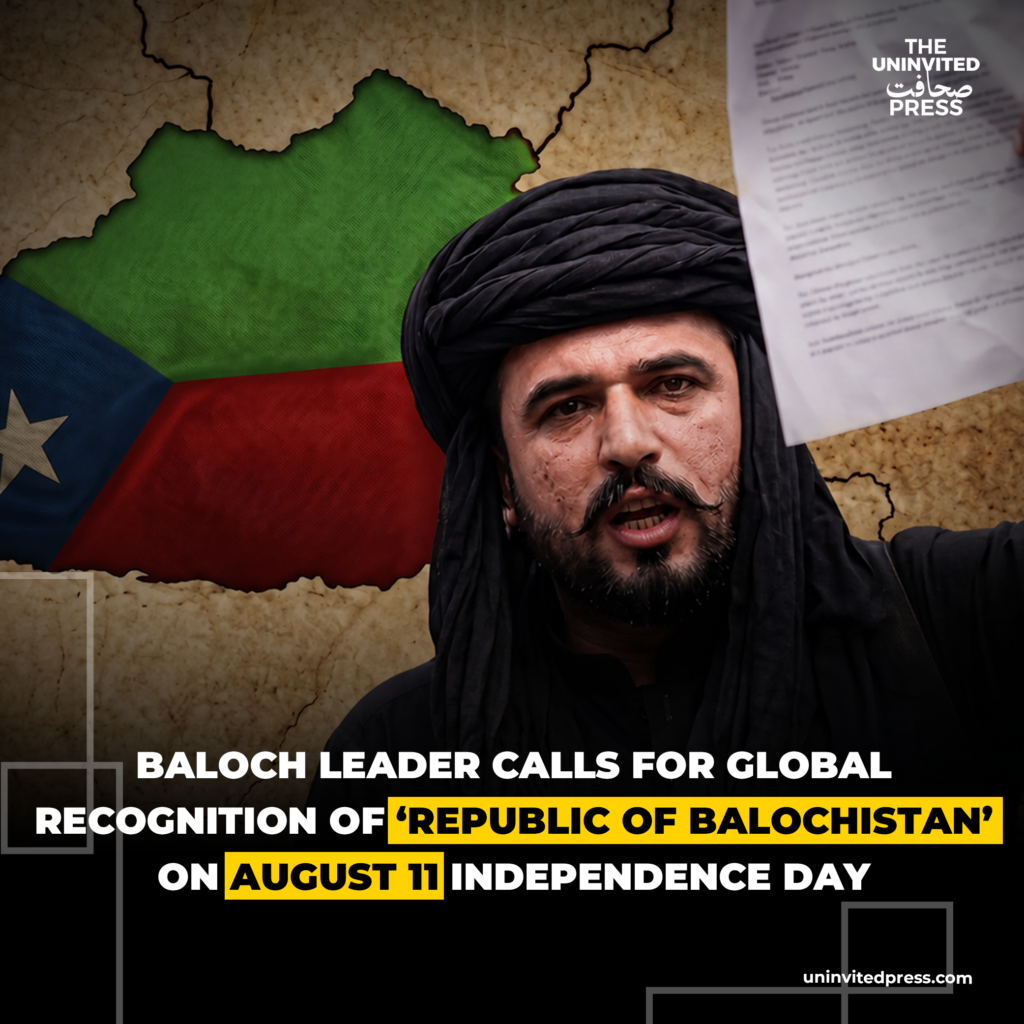
Separatist figure urges UN and other bodies to acknowledge sovereignty claims as activists observe August 11 anniversary of 1947 declaration.
A Baloch nationalist leader has called on the international community to formally recognise a self-declared “Republic of Balochistan,” marking what separatist groups observe as the region’s independence day on August 11.
In a statement shared on social media platform X, Mir Yar Baloch said the people of Balochistan-whom he put at six crore, or 60 million-had moved beyond simply commemorating the date and now demanded legal, political, diplomatic and moral recognition of independence. He urged the United Nations, ASEAN, the African Union, the Organisation of Islamic Cooperation and European countries to stop referring to Balochistan as a province of Pakistan and instead treat it as a sovereign country.
Fresh Call for an Independent ‘Republic of Balochistan’:
“The Republic of Balochistan demands from the entire world that from this day onwards, instead of calling, writing or referring to Balochistan as a province of Pakistan, it should be written, read and called an independent country,” the statement said. Baloch claimed the proposed republic would soon assume responsibility for its own foreign policy, defence, economy and diplomacy, and would introduce passports, currency, media outlets, trade institutions and embassies at dates to be announced later. He also asserted that the “Republic of Balochistan” had prepared an army of 500,000 personnel.
The appeal coincided with annual observances by Baloch nationalist groups of August 11 as Independence Day. The date is linked by these groups to events in 1947, when the Khanate of Kalat-a princely state covering much of present-day Balochistan-asserted a distinct status as British rule over the Indian subcontinent ended. Nationalists cite a standstill agreement and contemporary reports, including in international media and broadcasts, as evidence that Kalat briefly existed as an independent entity before its accession to Pakistan in March 1948, which they describe as forced. Pakistan regards Balochistan as an integral province and marks its own Independence Day on August 14.
Mir Yar Baloch thanked mainstream media, particularly in India, along with think tanks, researchers, civil society and others for amplifying Baloch voices. He described Pakistan’s presence as “cancer-like” and called for continued moral support to end it. He alleged that more than 50,000 Baloch remain in detention under “inhuman atrocities” and that Pakistani authorities had shut down mobile and internet services in parts of the province to hinder celebrations, while deploying surveillance.
Balochistan’s Unresolved Sovereignty Dispute Continues:
Balochistan, Pakistan’s largest province by area, is rich in natural resources including minerals, gas and a long coastline that includes the strategically important port of Gwadar, a key node in the China-Pakistan Economic Corridor. Despite this, it remains one of the country’s least developed regions, with long-standing grievances over resource distribution, political marginalisation and security force operations. Armed groups have waged a low-level insurgency for decades, citing enforced disappearances, extrajudicial killings and economic exploitation. Pakistani authorities reject systematic rights abuses claims and frame the conflict as a challenge from militants, sometimes alleging foreign interference.
No state currently recognises a “Republic of Balochistan,” and the international community treats the territory as part of Pakistan. The latest call forms part of a broader effort by diaspora activists and nationalist organisations to internationalise the issue, often highlighting human rights concerns while advancing a full sovereignty agenda.
For many Baloch nationalists, August 11 remains a potent symbol of a lost or interrupted sovereignty. For the Pakistani state, such declarations are viewed as challenges to territorial integrity. As the statement circulates, it underscores the enduring and unresolved tensions in a resource-rich but restive province whose future continues to be contested both within Pakistan and on the global stage.