

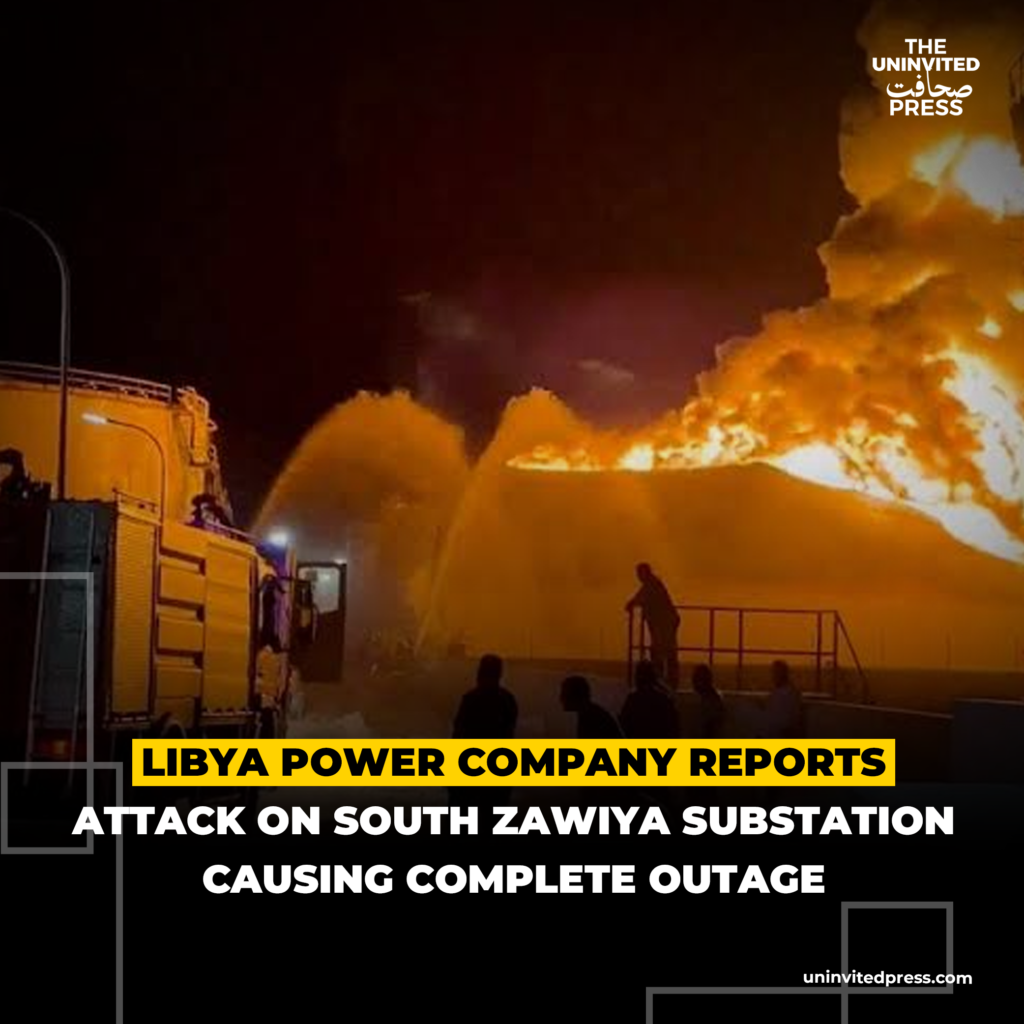
Power company warns of further delays as violence hits critical energy infrastructure in strategic coastal city.
Libya’s state electricity company has reported that an attack on the South Zawiya substation caused a complete power outage affecting wide areas south of the city, compounding an already severe electricity crisis in the oil-rich North African nation.
South Zawiya Substation Burned in Fresh Attack:
The General Electricity Company of Libya (GECOL) said on Wednesday that the assault on the 30/11 kV South Zawiya substation left it completely burned and out of service. The incident followed a series of explosive-laden drone strikes on fuel storage tanks at the nearby Zawiya oil complex, which houses the country’s largest operating refinery.
GECOL stated that repeated attacks and security disturbances in Zawiya have inflicted severe damage on power infrastructure and components of the national grid. The company said the violence forced it to withdraw technical teams from the area and prompted US firm GE (General Electric/GE Vernova) to halt all work at the Zawiya power station and pull its personnel pending improved security conditions. More than 700 megawatts of the plant’s total 1,300 MW generation capacity remained unavailable, raising the prospect of further delays in maintenance and restoration of electricity services.
The outage is the latest blow to a grid already struggling under the weight of chronic underinvestment, fuel shortages, militia interference and years of political fragmentation. Libya, an OPEC member that produces more than a million barrels of oil per day, has endured widespread blackouts lasting many hours daily through the summer, sparking protests in Tripoli, Zawiya, Misrata and elsewhere. Residents have reported spoiled food, disrupted water supplies and shuttered businesses as temperatures soar.
Drone Attacks Deepen Libya’s Power and Oil Crisis:
Zawiya, a strategic coastal city about 40-50 km west of Tripoli, has long been a flashpoint for armed groups competing for control of revenue-generating assets. The recent drone attacks on the oil complex-including a strike that destroyed a gasoline tank holding roughly 4.5 million litres-prompted Libya’s National Oil Corporation (NOC) to warn that continued assaults could force it to declare force majeure and suspend operations at the refinery. No group has publicly claimed responsibility for the strikes.
The targeting of both power and oil infrastructure underscores how Libya’s unresolved conflicts continue to threaten civilian life and the country’s economic lifeline. Since the 2011 overthrow of Muammar Gaddafi, rival governments, militias and external powers have vied for influence, leaving critical services vulnerable. Electricity generation relies heavily on natural gas, making the system particularly sensitive to disruptions at power plants, pipelines and related facilities.
GECOL has repeatedly appealed for security guarantees so that engineers can safely access damaged sites. Earlier incidents this year saw armed groups storm power stations, open fire on equipment and loot facilities in Zawiya, causing further losses of generation capacity. United Nations and local authorities have called for an end to the clashes and accountability for those responsible, while Prime Minister Abdul Hamid Dbeibah’s Government of National Unity has condemned the attacks as a dangerous escalation.
For ordinary Libyans, the latest blackout is more than a technical failure. It is another reminder that more than a decade after the uprising, basic services remain hostage to the country’s fractured politics and the predatory behaviour of armed actors. As technical teams remain sidelined and restoration timelines stretch, the lights in southern Zawiya and surrounding areas are likely to stay off for some time-a costly symptom of a deeper national crisis.