

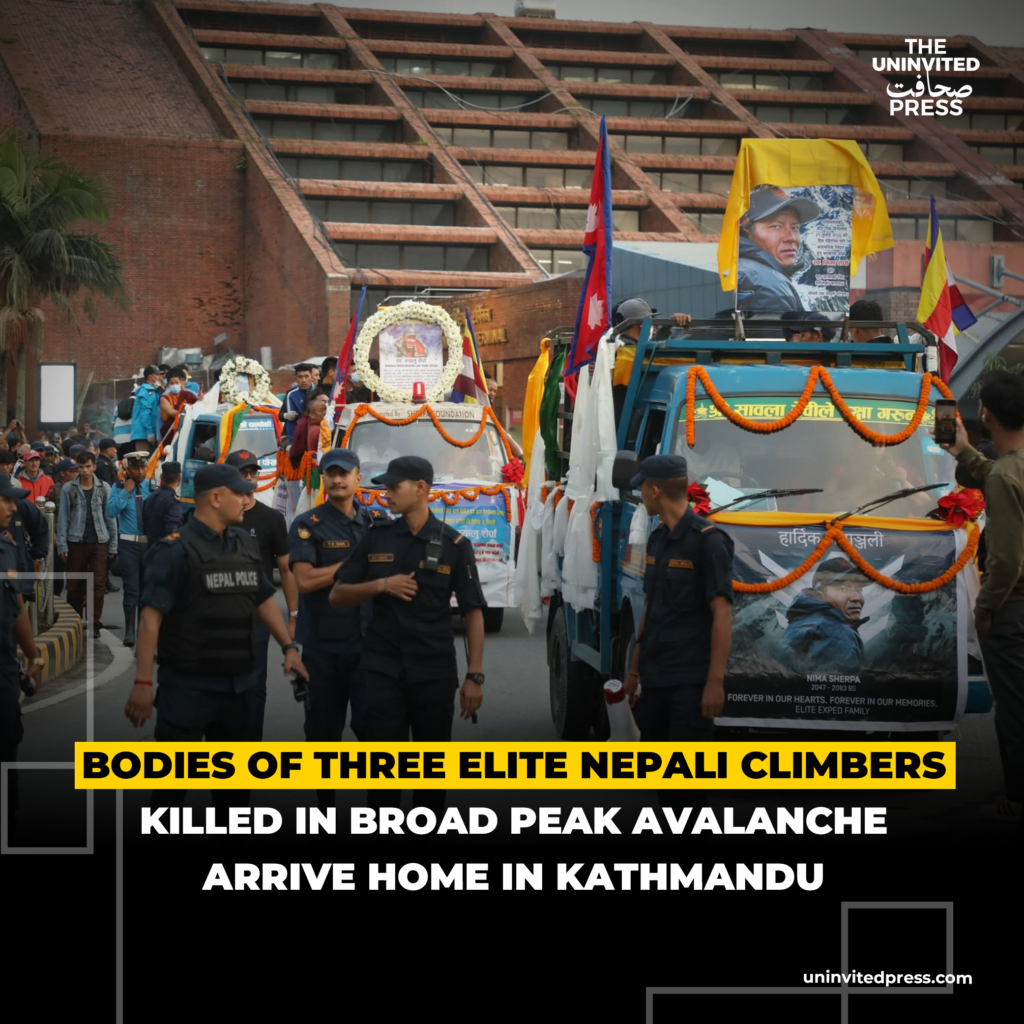
Grieving families and mountaineering community receive remains of high-altitude guides more than 10 days after deadly slide on world’s 12th-highest peak.
The bodies of three highly experienced Nepali mountaineers killed in a catastrophic avalanche on Pakistan’s Broad Peak have arrived in Kathmandu, bringing a wave of national mourning for climbers who represented the backbone of global high-altitude guiding.
Kili Pemba Sherpa, widely known as Kilu, along with Gyalu Sherpa and Nima Sherpa, were among 10 climbers who died when an avalanche struck their international expedition on July 30. Their coffins arrived at Tribhuvan International Airport on Tuesday aboard a Qatar Airways flight from Doha, where emotional scenes unfolded as officials transferred the remains to a hearse amid weeping relatives and colleagues.
Nepal Mourns Loss of Elite Mountaineering Guides:
The three men were elite Sherpa guides whose careers spanned dozens of summits on the world’s highest peaks. They formed part of a 10-member team that included renowned British-Nepali climber Nirmal “Nimsdai” Purja, who led the group, as well as fellow Nepalis Pur Bahadur Gurung (Yukta) and Nawang Thindu Sherpa, Pakistani guide Sohail Sakhi, Omani climber Nadhira Al Harthy, American climber Mallory Geis and Chinese climber Wang Zhong. All perished when the avalanche hit around 9:30am local time as the party moved between Camp 2 and Camp 3 at approximately 6,600 metres on the 8,051-metre peak in the Karakoram range.
Nepal’s Foreign Ministry and the Nepal Mountaineering Association coordinated the repatriation. The remains will be placed at the association’s headquarters in Naxal on Wednesday to allow the public to pay respects before being handed over to the families. The body of Pur Bahadur Gurung had already been returned to Nepal earlier and cremated. Purja’s remains were flown to the United Kingdom, where his family resides. Recovery efforts for the remaining bodies-including those of one Nepali, one Pakistani and one American-have been hampered by dangerous terrain and further avalanche risk.
The disaster has been described as one of the heaviest single losses for Nepal’s mountaineering sector in recent years. Sherpa guides and Nepali climbers have long formed the backbone of commercial expeditions on the world’s highest mountains, often taking the greatest risks while enabling clients from around the globe to attempt summits. Kili Pemba Sherpa had recently completed all 14 of the 8,000-metre peaks. Gyalu Sherpa held records including multiple rapid ascents of Kanchenjunga. Their deaths, alongside those of other accomplished guides, represent not only personal tragedies but a significant depletion of institutional knowledge and leadership within the community.
Nepal Grieves Loss of Three Mountaineers:
Broad Peak, located near K2, is regarded as one of the more technically demanding 8,000-metre mountains. The avalanche occurred during a summit push in a narrow weather window, sweeping climbers hundreds of metres down the mountain. Rescue and recovery teams, including Nepali climbers led by figures such as Mingma G and Pakistani colleagues, faced extreme conditions, additional slides and logistical challenges while retrieving bodies from high on the peak.
In Kathmandu and mountain communities across Nepal, the return of the three climbers has deepened a sense of collective grief. Local leaders and fellow mountaineers have spoken of the irreplaceable loss to families, villages and the national tourism industry that depends heavily on high-altitude expertise. Vigils and tributes have also been held in Pakistan, reflecting the international nature of the tragedy.
The incident once again highlights the inherent dangers of extreme-altitude climbing, even for the most skilled practitioners. As the coffins of Kili Pemba, Gyalu and Nima Sherpa return to their homeland, Nepal mourns not only individual heroes but a generation of guides whose skill and courage helped define modern mountaineering on the world’s highest peaks.