

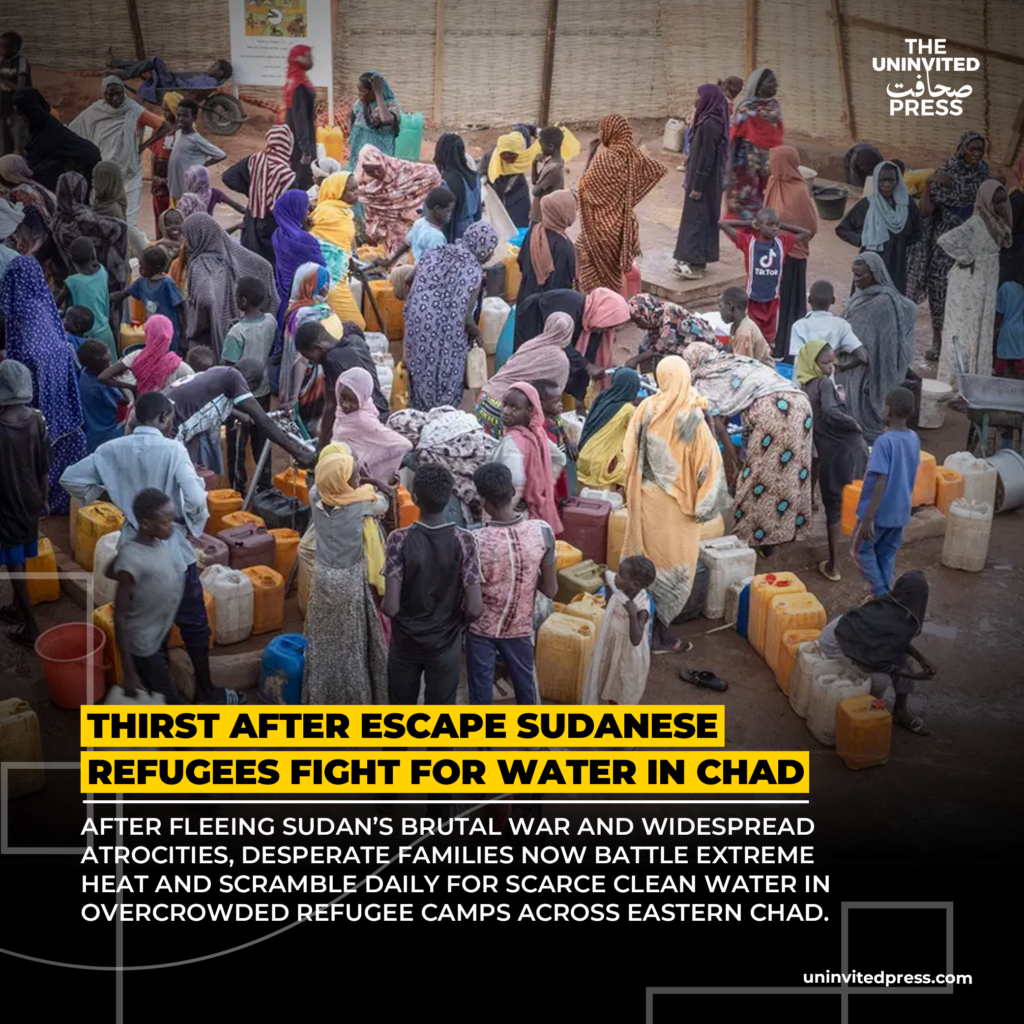
After fleeing war and atrocities in Sudan, families now battle extreme heat and daily shortages of clean water in overcrowded camps across eastern Chad.
In the scorching heat of eastern Chad, the arrival of a water truck can spark a desperate scramble. At Goudrane refugee camp, home to around 50,000 Sudanese refugees, residents have watched tanks run dry for days at a time. When a truck finally appears, hundreds of people rush across the sand, jerrycans in hand, fighting for a share of the limited supply.
Within minutes the 6,000 litres can disappear. Women fall in the crush. Children climb over adults. Some walk away empty-handed. Rokhia Ibrahim, a 43-year-old schoolteacher from Sudan, has watched her former pupils leave with nothing. “It was less than a year ago when I saw children like them die of thirst while escaping el-Fasher,” she said. “And now we have almost no access to water again.”
Chad Struggles to Support Sudan Refugees:
More than 938,000 Sudanese refugees have crossed into Chad since the war between the Sudanese Armed Forces and the Rapid Support Forces erupted in April 2023. Most have settled in the arid eastern provinces of Ouaddaï, Wadi Fira, Sila and Ennedi Est. Camps and spontaneous settlements are severely overcrowded. In some locations, people receive less than half the minimum daily water allocation recommended by the United Nations refugee agency.
Temperatures regularly climb above 40 degrees Celsius, and in the peak of the hot season can approach 50 degrees. Women and children often spend hours in queues under the sun. Many families rely on infrequent water trucking because existing boreholes, pipelines and treatment systems cannot keep pace with the growing population. Aid organisations report that continuous new arrivals are rapidly outstripping the capacity of current infrastructure.
“We are doing everything we can to improve access to clean water in the camps, but current funding is not enough to ensure everyone has access to safe water,” said Thibault Henry, country director for Solidarités International. The shortfall affects not only drinking water but also cooking, hygiene and sanitation, raising the risk of disease outbreaks in already fragile conditions.
The refugees’ ordeal began with violence and atrocities in Sudan, particularly in Darfur. Many fled mass killings, sexual violence and the destruction of homes and water sources. Those who survived the journey across the border now face a different kind of existential struggle in Chad’s remote desert landscape. Host communities, themselves among the poorest in the country, also feel the strain as shared resources dwindle.
Aid Struggles to Meet Refugees' Water Needs:
Humanitarian agencies, including UNHCR, UNICEF, Médecins Sans Frontières and local partners, have drilled boreholes, installed solar-powered pumps and organised water trucking. Yet funding shortfalls and the sheer scale of need mean many people still survive on far less than the emergency standard of 15 to 20 litres per person per day. In some camps the figure drops below eight litres.
The crisis is compounded by limited food assistance, inadequate shelter and the approach of the rainy season, which can bring flooding and heighten the risk of waterborne disease. Relocations from overcrowded border areas to more organised sites continue, but progress is slow. Hundreds of thousands remain in temporary or makeshift conditions with uncertain prospects of returning home while fighting and insecurity persist in Sudan.
For the families who escaped one catastrophe only to confront another, the daily search for water has become the defining reality of exile. Each empty jerrycan is a reminder that survival remains precarious long after the crossing into Chad.