

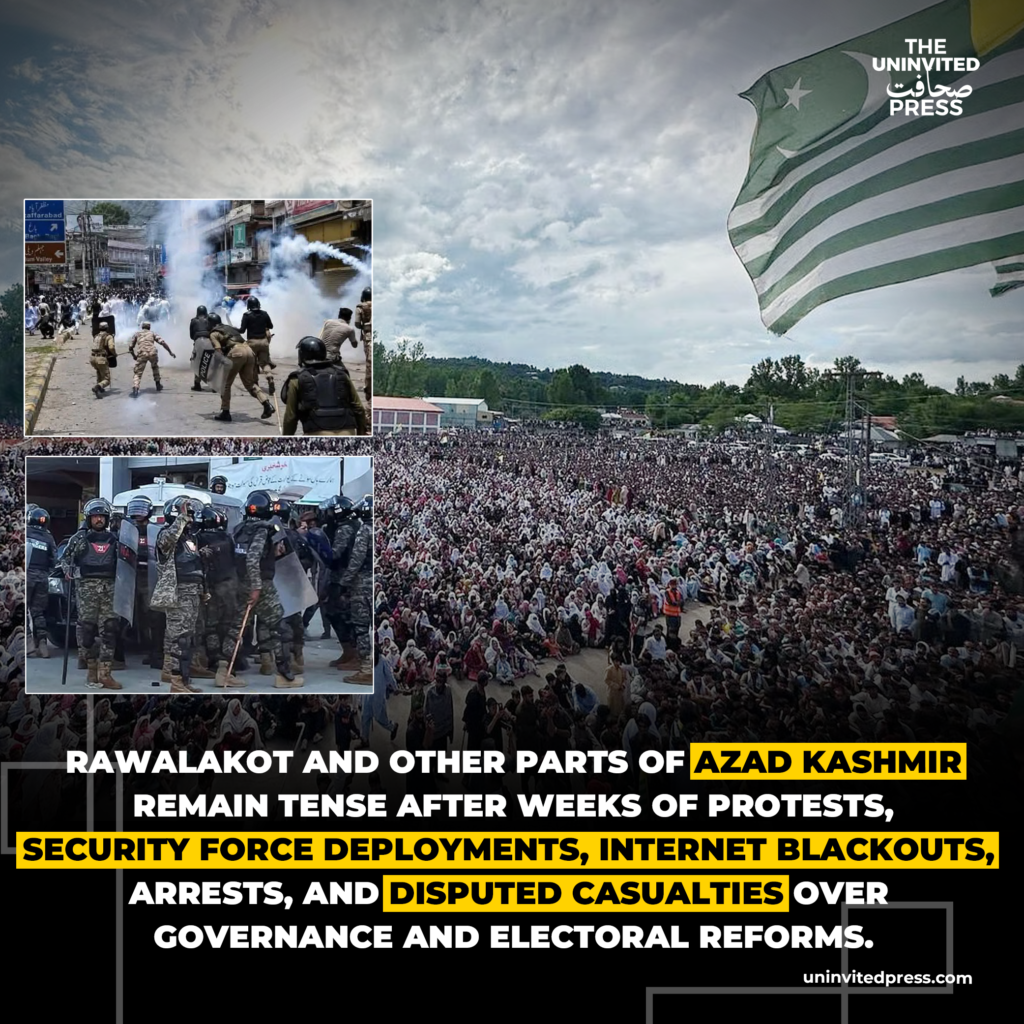
Disputed death tolls, internet blackouts and heavy security deployments mark weeks of unrest over electoral reforms and governance in Pakistan-administered Kashmir.
In the hill town of Rawalakot, the administrative centre of Poonch division in Azad Jammu and Kashmir (AJK), the air has been thick with tension for weeks. Large crowds have filled open grounds and roads, Pakistani flags have fluttered above gatherings of thousands, and security forces in riot gear have repeatedly faced off against demonstrators. Tear gas has drifted through the streets. Internet and mobile services have gone dark for days at a stretch. Arrests have mounted. And the number of people killed remains bitterly contested.
What began as localised anger over electricity tariffs and the price of subsidised flour has grown into a sustained challenge to the political architecture of Pakistan-administered Kashmir. At its centre stands the Jammu Kashmir Joint Awami Action Committee (JAAC), a coalition of traders, lawyers, transporters and civil society activists that the regional authorities banned under anti-terrorism legislation in early June 2026. The group’s core demand is the abolition of 12 seats in the 45-member AJK Legislative Assembly reserved for refugees from Indian-administered Kashmir who settled elsewhere in Pakistan after 1947.
Those seats, JAAC argues, give outsiders disproportionate influence over a territory whose residents lack full control of their own legislature. The government and the AJK Supreme Court maintain that the arrangement is constitutionally protected and can only be altered through a formal amendment. With phased elections under way, the dispute has produced one of the most serious internal crises the region has seen in years.
Why the 12 Reserved Seats Matter?
The reserved seats date back decades. Of the assembly’s elected members, 33 represent constituencies inside AJK while 12 are set aside for refugees living in Punjab, Sindh, Khyber Pakhtunkhwa and Balochistan. Elections for those seats are conducted by the Election Commission of Pakistan rather than AJK’s own commission. Protesters say many of the seat-holders and voters have little connection to daily life in Muzaffarabad, Rawalakot or Mirpur, yet the seats can prove decisive in government formation.
JAAC’s campaign did not begin with this constitutional question. In 2023 and 2024 the group mobilised around economic demands: cheaper electricity, reliable supplies of subsidised wheat, reduced perks for elected officials and greater local benefit from hydropower projects. Agreements were reached with successive AJK governments, including commitments in 2024. Implementation lagged. By 2025 the list of demands had expanded to 38 points. When the electoral commission announced July 2026 polls, the refugee seats moved to the forefront.
On 5 June 2026, days before a planned major demonstration, the AJK home department declared JAAC a proscribed organisation. Arrests followed. Internet services were restricted. Sit-ins took root, particularly in Rawalakot. On 7 June the AJK Supreme Court ruled that the 12 seats could not be abolished without a constitutional amendment. JAAC rejected the decision and announced a long march toward the regional capital, Muzaffarabad.
AJK Elections Marred by Violence and Boycott:
Clashes intensified through June and July. Authorities reported that protesters attacked security posts, torched vehicles and fired on personnel. JAAC leaders and local residents described security forces using live ammunition, tear gas and baton charges against largely unarmed crowds. Casualty figures diverge sharply.
JAAC has claimed at least 30 deaths among its supporters over the course of the unrest, with some statements in late July putting the toll at 31 after fresh violence around the first phase of voting. Authorities have confirmed far lower numbers of civilian deaths while reporting the deaths of several police and paramilitary personnel. Independent verification has been hampered by communications blackouts and restricted access for journalists. Hospitals in Rawalakot have at times been difficult to reach. Bodies and injured people have been moved to neighbouring towns.
Rawalakot has been the epicentre. Tens of thousands gathered at sites such as Eidgah Ground. Protesters blocked roads and staged continuous sit-ins. Security forces, including police, Rangers and other units, were heavily deployed. In mid-July, ahead of a planned march, additional personnel were rushed in and movement restricted. Similar scenes of confrontation, though on a smaller scale, were reported in parts of Mirpur, Kotli and Muzaffarabad divisions.
The legislative elections, originally scheduled for a single day on 27 July, were split into three phases for security reasons. Voting began in the Mirpur division. Polling in the protest-affected Poonch division was postponed until mid-August. Turnout in the early phase was described by local observers as low in some areas. JAAC called for a boycott, arguing that any assembly elected under the current seat arrangement would lack legitimacy.
Mainstream political parties continued campaigning. Federal and regional officials insisted the vote must proceed and that those disrupting it would be treated as rioters rather than protesters. JAAC leaders, some operating from underground or from the Rawalakot encampment, maintained that their demands remained peaceful and that the use of force against demonstrators had only deepened public anger.
Rawalakot Unrest Raises Questions Over AJK Governance:
The unrest exposes deeper questions about governance in AJK. The territory is administered by Pakistan but does not have the status of a province. Its interim constitution and political arrangements have long reflected the unresolved status of the wider Kashmir dispute. Residents have repeatedly complained of limited control over resources, development budgets and political decision-making. Successive waves of protest in 2023, 2024 and 2025 followed a similar pattern of economic grievances hardening into political demands, followed by crackdowns, temporary concessions and renewed mobilisation.
Internet blackouts, mass arrests and the proscription of a popular civil society platform have drawn criticism from rights groups and some opposition voices inside Pakistan. Officials counter that the state has a duty to maintain order and that elections cannot be held hostage to a single demand that requires constitutional change.
As of late July 2026, Rawalakot and other towns remain tense. Security forces stay deployed. Communications restrictions continue in places. The disputed death toll and the unresolved question of the 12 seats hang over the phased voting. Whether the elections produce a government capable of addressing the underlying grievances, or merely postpone another round of confrontation, will shape the political atmosphere in Pakistan-administered Kashmir for months to come.
The crowds in Rawalakot have made one point clear: for a significant section of the population, the existing balance of political power is no longer acceptable.