

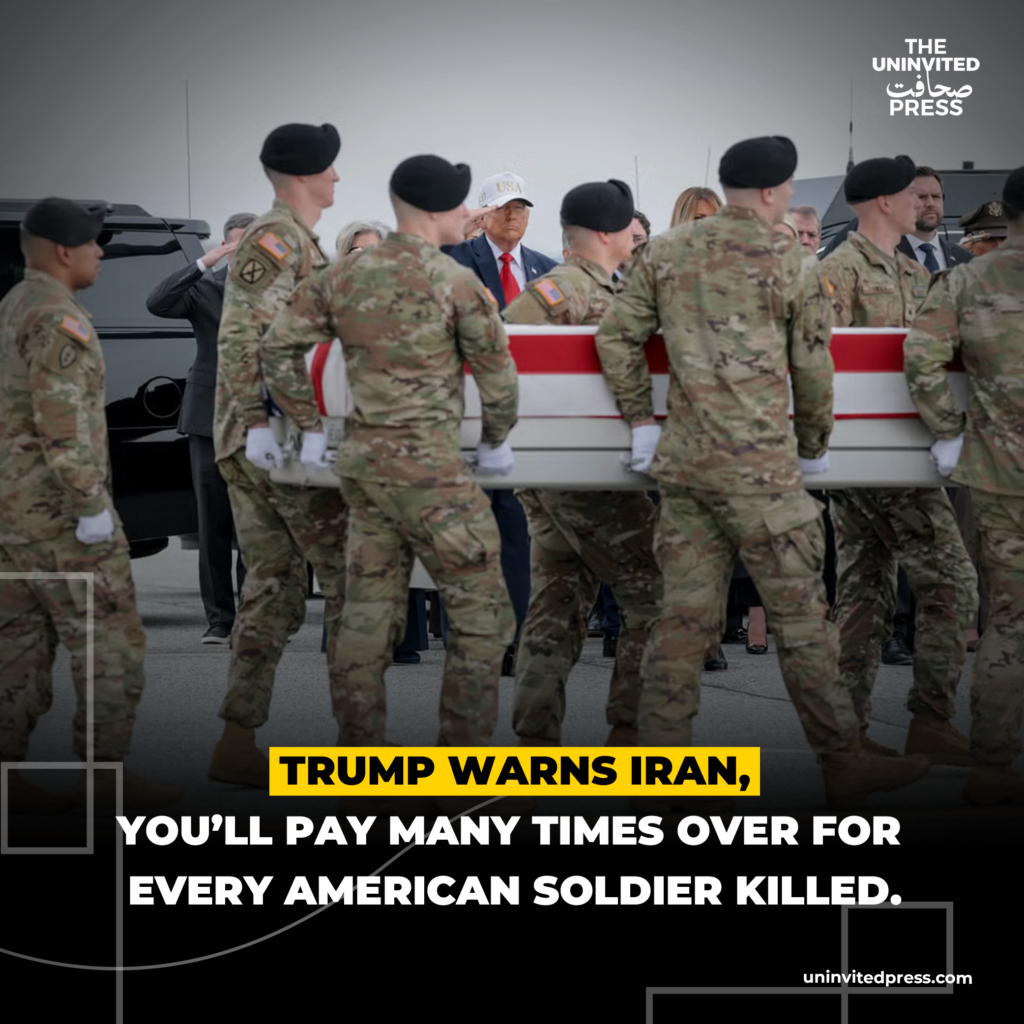
President’s warning comes amid mounting US casualties and fears of wider regional conflict.
US President Donald Trump has issued a stark warning to Iran, declaring that Tehran will “pay many times over” for the death of every American soldier, as the United States intensifies its military campaign in the Middle East.
The statement, posted on Trump’s Truth Social platform, followed the confirmation of additional US military fatalities, bringing the total number of American troops killed in the conflict to at least 17. It coincided with fresh US strikes on Iranian targets and images circulating of solemn military ceremonies honouring the fallen.
In his post, Trump wrote: “Every time Iran kills an American Soldier they will pay for that killing many times over!” He added that the directive had been conveyed to Defence Secretary Pete Hegseth, Chairman of the Joint Chiefs of Staff Daniel Caine, and other senior military leaders.
US Strikes Continue After Troop Deaths:
US Central Command (CENTCOM) reported that two soldiers were killed in Jordan during Iranian ballistic missile and drone attacks on a US base. A third service member died in northern Iraq while handling unexploded ordnance from a downed Iranian drone. The victims included 19-year-old Pvt. Isabella Gonzales from Texas and 25-year-old 1st Lt. Tyler James Feehan from Hawaii.
President Trump is expected to attend the dignified transfer of remains at Dover Air Force Base in Delaware, a ceremony that has become a grim ritual in the ongoing conflict.
The latest deaths occurred as the US conducted what officials described as its ninth consecutive night of strikes, targeting Iranian missile and drone launch sites, communication networks, and capabilities linked to attacks on commercial shipping in the Strait of Hormuz. Trump described the operations as being carried out “in honour” of the fallen troops.
Conflict Raises Fears of Wider War:
The current round of hostilities follows the breakdown of a fragile ceasefire and reflects a broader war that erupted earlier in 2026. Iran has retaliated with strikes on US interests in the region, including reported attacks affecting Kuwait and Bahrain, and incidents involving oil tankers in the Strait of Hormuz, which has driven up global oil prices.
Iranian officials have described the situation as a “full-scale war,” with President Masoud Pezeshkian and the foreign ministry noting ongoing diplomatic efforts through mediators even as fighting continues. Tehran has reported significant civilian and military casualties from US and allied strikes.
The conflict has roots in long-standing US-Iran tensions, including efforts to curb Iran’s nuclear programme and its support for regional proxies. Analysts warn that the cycle of strikes and counter-strikes risks drawing in more actors, further destabilising the Middle East and impacting global energy markets.
Trump’s rhetoric underscores a policy of decisive retaliation, consistent with his administration’s approach since the early stages of the conflict. However, critics and regional observers question whether intensified military action will achieve lasting stability or instead fuel further escalation.
As families mourn their loved ones and images of flag-draped caskets circulate, the human cost of the confrontation is becoming increasingly visible. With both sides showing little sign of de-escalation, the coming days may prove critical in determining whether diplomacy can gain ground or if the region slides deeper into war.