

Tehran escalates retaliation amid spiralling regional conflict, raising fears of wider Gulf instability.
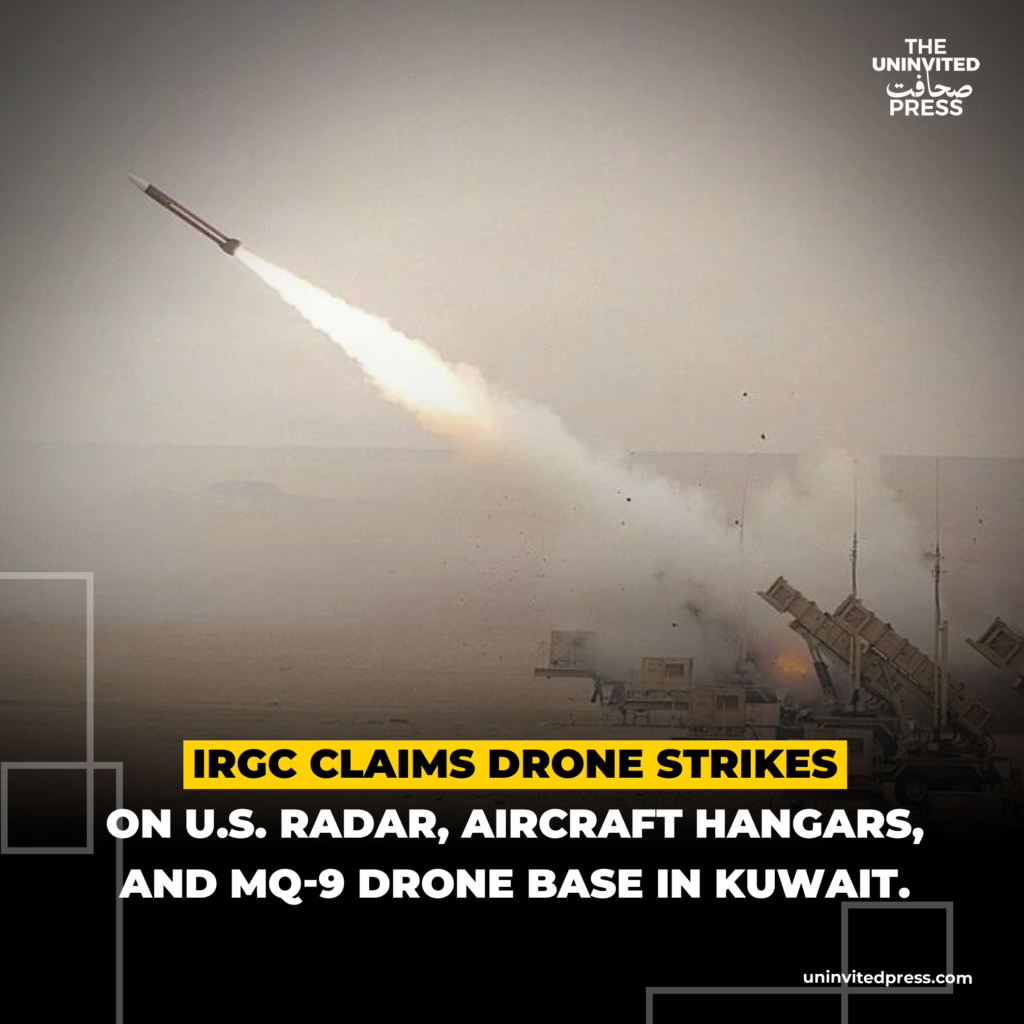
Iran’s Islamic Revolutionary Guard Corps (IRGC) has announced a fresh wave of drone strikes targeting US military infrastructure at Kuwait’s Ali Al Salem Air Base, claiming to have destroyed an early-warning radar system, aviation equipment warehouses, and hangars housing MQ-9 Reaper drones.
The announcement, issued on Monday, forms part of what the IRGC describes as “Operation Nasr 2” or related retaliatory phases, responding to repeated US airstrikes on Iranian territory, particularly along the southern coast and areas linked to the Strait of Hormuz.
In a statement addressed directly to the Kuwaiti people, the IRGC said its forces “completely destroyed” a US early-warning radar and struck facilities storing aviation spare parts and MQ-9 drone hangars, setting several drones ablaze. It urged Kuwait not to allow its territory to be used as a launchpad for attacks killing Muslims across the region, referencing past US operations in Iraq, Afghanistan, and Palestine.
IRGC Claims Fresh Strikes on US Assets:
The latest claims come against the backdrop of months of intensifying confrontation between Iran and the United States, punctuated by fragile ceasefires and repeated violations. US Central Command (CENTCOM) has conducted multiple rounds of strikes on Iranian coastal defences, missile sites, and naval assets, often citing Iranian attacks on commercial shipping in the Strait of Hormuz.
Iran, in turn, has accused Washington of breaching understandings, including references to an “Islamabad Memorandum,” and has responded with missile and drone barrages aimed at US-linked bases across the Gulf-in Bahrain, Jordan, and Kuwait. Ali Al Salem Air Base, a key hub for US and coalition air operations including MQ-9 drones used for intelligence, surveillance, and reconnaissance, has featured repeatedly in these exchanges.
Independent verification of the damage claimed by the IRGC remains limited, as is typical in such fast-moving conflicts. US and Kuwaiti officials have not immediately confirmed the extent of any impacts, though Kuwait has previously reported intercepting incoming threats and occasional debris-related incidents.
Gulf Security Risks Continue to Grow:
Kuwait, a close US ally that hosts significant American military presence, finds itself increasingly vulnerable. Past incidents have included reports of damage to infrastructure, injuries from falling debris, and temporary airspace closures. The country has condemned attacks on its sovereignty while navigating delicate diplomatic ties with both Tehran and Washington.
The IRGC’s direct appeal to the Kuwaiti public highlights Tehran’s strategy of framing its actions as defensive while pressuring Gulf states to distance themselves from US operations.
Analysts warn that continued strikes on third-country territory risk drawing more Gulf states deeper into the conflict and disrupting critical energy routes. The Strait of Hormuz, through which a significant portion of global oil passes, has seen reduced tanker traffic amid the volatility.
The use of relatively low-cost drones against high-value assets like MQ-9 Reapers and radar systems underscores the evolving asymmetric nature of the confrontation. Both sides continue to project strength: Iran emphasises its retaliatory reach, while the US highlights its ability to degrade Iranian military capabilities.
As mediators, including regional powers and international actors, call for de-escalation, the latest IRGC claims illustrate how quickly fragile pauses unravel. With funerals for high-profile Iranian figures and ongoing operations cited on both sides, the cycle shows little sign of abating.