

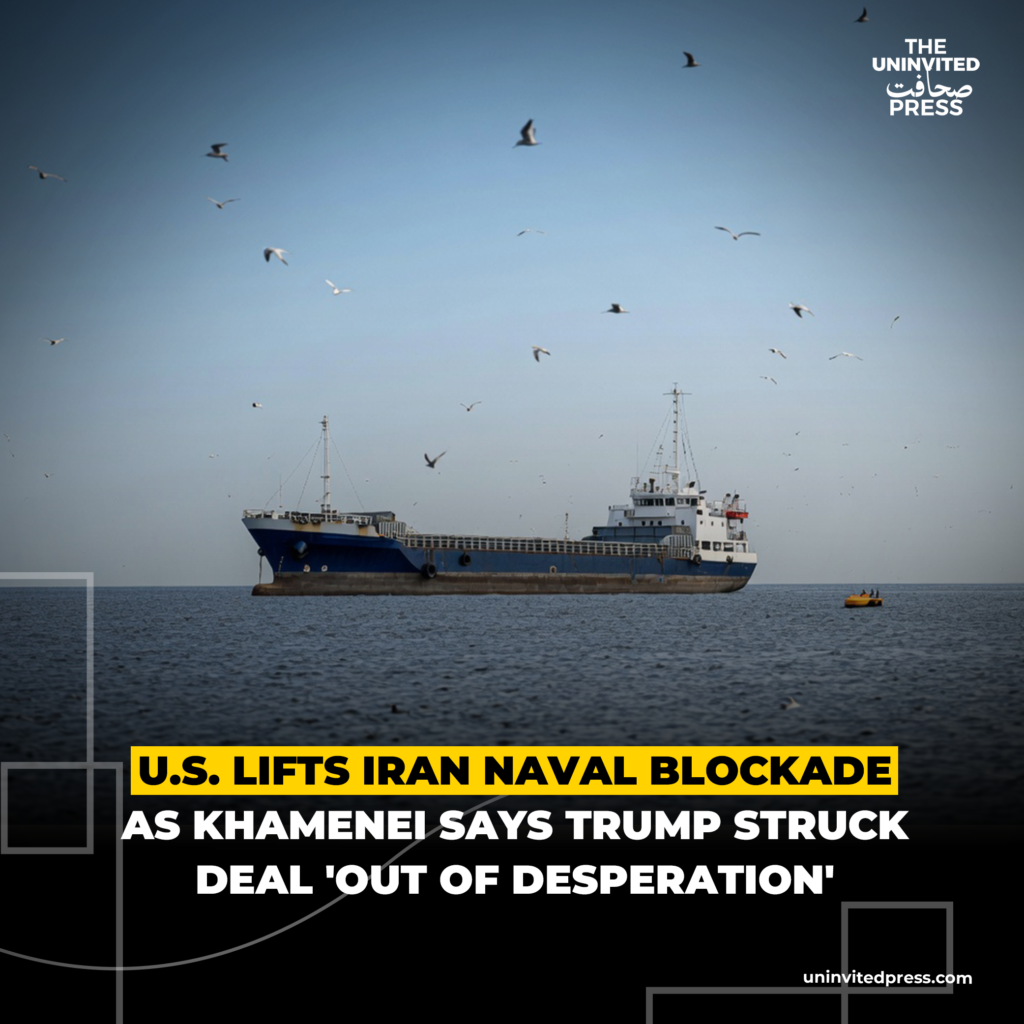
Tehran and Washington move to de-escalate after a preliminary agreement, with the Islamic Republic’s supreme leader framing the US decision as a sign of weakness while the Trump administration hails it as a pragmatic step to stabilise oil markets and regional security.
The United States has lifted its naval blockade on Iran, easing restrictions on shipping through the Strait of Hormuz, following a preliminary deal aimed at ending recent hostilities, US officials confirmed on Friday.
The move comes days after the signing of a memorandum of understanding between Washington and Tehran. It includes a 60-day window for broader negotiations on Iran’s nuclear programme and immediate steps to restore safe passage for commercial vessels in the strategically vital waterway.
Khamenei's Strong Criticism:
Iran’s Supreme Leader Mojtaba Khamenei described the US decision as a sign of American weakness, stating that President Donald Trump “struck the deal out of desperation” to prevent further economic fallout and regional instability.
“America was forced to retreat because of the resistance of the Iranian people and the high costs of confrontation,” Khamenei said in a public address. He portrayed the lifting of the blockade as a victory for Iran while maintaining a defiant tone toward future negotiations.
Trump administration’s perspective:
US officials, including Vice President JD Vance, have defended the agreement as a necessary pragmatic measure. They argue it reopens critical shipping routes, stabilises global energy prices, and creates space for longer-term talks on curbing Iran’s nuclear ambitions and regional proxy activities.
The administration has emphasised that the deal does not remove all sanctions and that strict verification mechanisms will be in place. President Trump has reportedly told aides that keeping the Strait of Hormuz open serves American economic interests and those of its allies.
Middle East Reacts to US-Iran Deal:
The development has drawn mixed responses across the Middle East. Israel has expressed strong reservations, with some officials warning that the agreement could embolden Iran without dismantling its nuclear infrastructure. JD Vance recently warned Israeli leaders against criticising the deal, reminding them that the Trump administration remains their “only powerful ally” at this juncture.
Saudi Arabia and other Gulf states have welcomed the easing of tensions but called for robust guarantees against Iranian-backed militias. Meanwhile, European diplomats have cautiously supported the diplomatic track while urging full transparency in the upcoming nuclear talks.
The lifting of the naval blockade is expected to allow Iranian oil exports to resume more freely, potentially easing pressure on global energy markets. However, analysts warn that the 60-day negotiation period will be decisive. Key sticking points include the scope of sanctions relief, limits on uranium enrichment, and Iran’s ballistic missile programme.
Both sides have signalled willingness to continue talks, though deep mistrust remains after years of confrontation.