

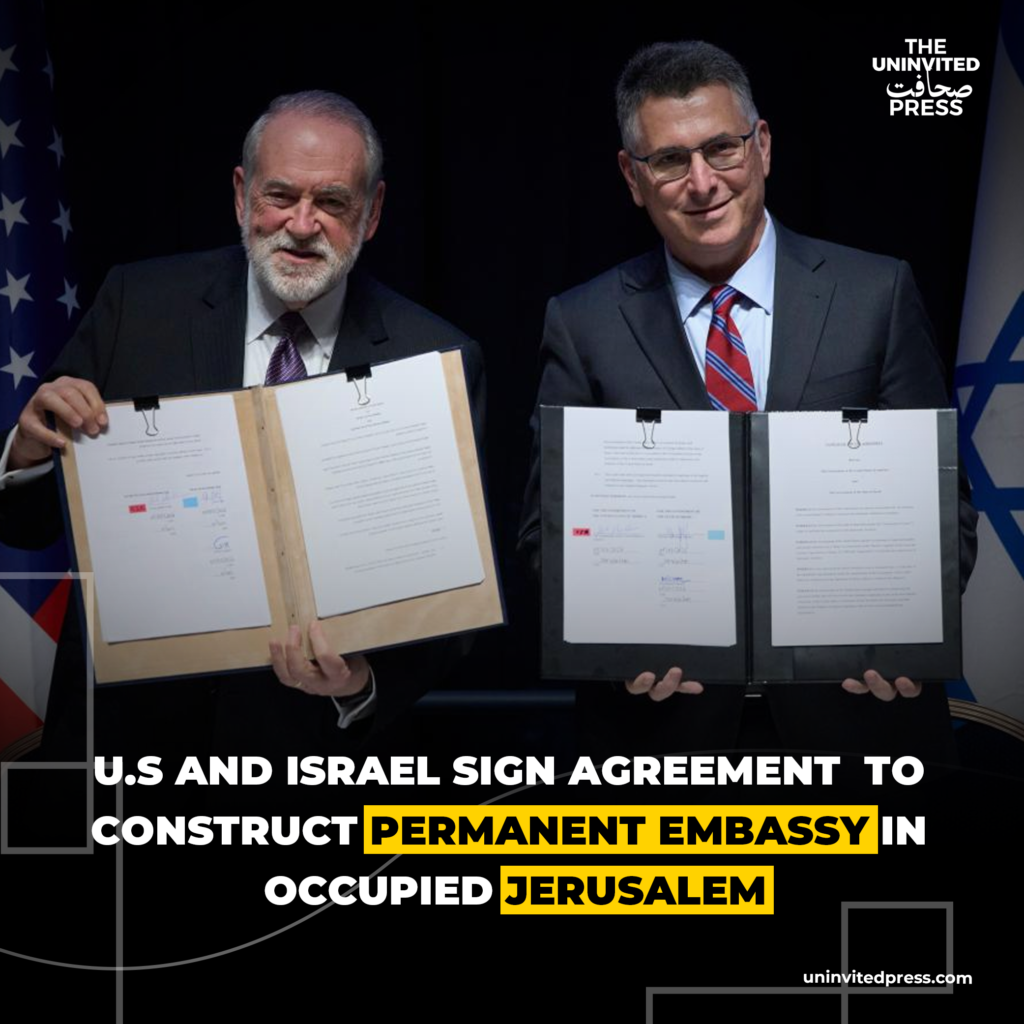
The agreement reaffirms Washington’s recognition of Jerusalem as Israel’s capital, drawing sharp criticism from Palestinians and much of the international community. It risks further complicating peace efforts and inflaming tensions over the city’s contested holy sites.
The United States and Israel have signed an agreement to construct a permanent American embassy compound in Jerusalem, formalising the relocation process that began under former President Donald Trump in 2018.
The deal, signed on Wednesday at Israel’s Foreign Ministry, allocates land at the Allenby site in West Jerusalem for a new embassy complex. Israeli officials described the 99-year lease-reportedly for a symbolic $1-as a milestone in the “unbreakable alliance” between the two countries.
US Ambassador to Israel Mike Huckabee, who attended the ceremony alongside Israeli Foreign Minister Gideon Sa’ar and Jerusalem Mayor Moshe Lion, said the agreement reflects Washington’s recognition of Jerusalem as “the eternal, indigenous, and forever capital of the Jewish people.”
“We are going to plant our flag, our American flag, on the soil of Jerusalem for a permanent and a brand new embassy compound,” Huckabee stated.
Land Agreement Deepens Jerusalem Dispute:
The move has drawn sharp criticism from Palestinian officials and rights groups, who view it as a violation of international law and a further erosion of prospects for a viable Palestinian state with East Jerusalem as its capital.
The Palestinian Authority condemned the agreement as “a dangerous escalation” that disregards Palestinian rights and historical claims to the city. “This is not a technical land deal; it is a political statement that rewards illegal occupation and annexation,” a senior Palestinian official told Al Jazeera.
Under international consensus, East Jerusalem is considered occupied territory, captured by Israel in the 1967 war. The entire city remains a core issue in the Israeli-Palestinian conflict, with the United Nations and most countries maintaining that the status of Jerusalem must be resolved through negotiations.
The site in question has added sensitivity, with reports noting that parts of the area were owned by Palestinians prior to 1948. Critics argue that building on such land, even in West Jerusalem, contributes to the broader pattern of altering the demographic and legal character of the city in defiance of UN resolutions.
New US-Israel Deal Stirs Jerusalem Debate:
The agreement builds on Trump’s 2017 decision to recognise Jerusalem as Israel’s capital and move the embassy from Tel Aviv, a step that was completed in 2018 but has operated from temporary facilities since then.
While President Trump’s administration and subsequent US policies have embraced a staunchly pro-Israel stance, the Biden administration and others had maintained some distance on the Jerusalem issue. The current development underscores the enduring bipartisan support in Washington for deepening ties with Israel, even amid ongoing tensions in Gaza, the West Bank, and regional instability.
Israeli Prime Minister Benjamin Netanyahu’s government has repeatedly pushed for more countries to follow suit and relocate their embassies to Jerusalem, framing it as “historic justice.”
The signing ceremony comes at a time of heightened regional volatility. Analysts say the move could complicate any future peace efforts and further isolate Israel and the US diplomatically in the Arab and Muslim world.
The Arab League and Organisation of Islamic Cooperation are expected to issue statements condemning the agreement. Human rights organisations have called on the international community to reaffirm the principle that no unilateral actions can change the status of Jerusalem.
For Palestinians, the development serves as another reminder of what they describe as systematic efforts to erase their presence and claims in the city they regard as central to their national and religious identity.