

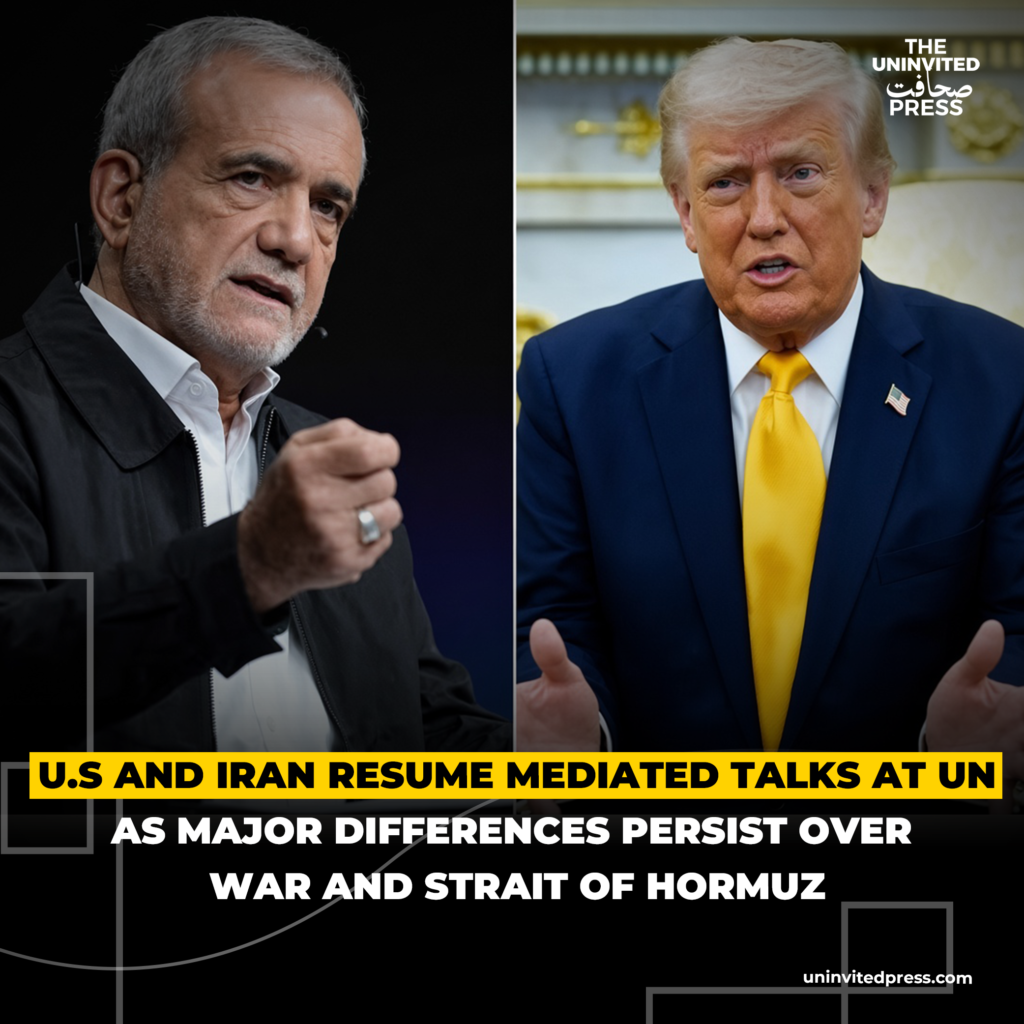
Tehran conditions progress on ending hostilities, lifting naval blockade and unfreezing assets; Washington signals momentum but no breakthrough reported.
The United States and Iran have held their first mediated talks in months on the sidelines of the United Nations General Assembly in New York, raising cautious hopes of progress toward ending their nearly seven-month war even as core disagreements over the conflict and the Strait of Hormuz remain firmly unresolved.
US special envoy Steve Witkoff said mediators “shuttled between” American and Iranian delegations throughout Tuesday, describing the exchanges as constructive and promising. President Donald Trump went further, telling reporters that Witkoff and Jared Kushner had held a three-hour meeting with Iranian officials that was “very good” and “very productive.” He claimed there was “a lot of momentum” toward a deal and indicated further talks could follow soon.
Iranian officials confirmed contacts took place through Qatari mediation but stressed that Tehran had simply conveyed its longstanding conditions rather than offered new concessions. Foreign Ministry spokesman Esmail Baghaei said the interaction aimed at delivering Iran’s demands, including an end to the war “in all its dimensions,” a halt to what Tehran calls American “acts of aggression,” the lifting of the US naval blockade on Iranian ports, and the release of frozen Iranian assets. Iranian state media reported that Foreign Minister Abbas Araghchi participated in the discussions, which Tehran said occurred at Washington’s request.
The talks marked the first high-level indirect engagement since an interim ceasefire agreement collapsed in the summer. That short-lived understanding, reached earlier in the year, had briefly raised hopes of de-escalation before unraveling over disputes about shipping arrangements in the Strait of Hormuz-the critical waterway through which a significant share of global oil and liquefied natural gas once passed.
Strait of Hormuz Remains Key Dispute:
Control and access to the Strait of Hormuz continue to dominate the agenda. Iranian officials have indicated that Tehran could reopen the strait to Gulf shipping within about seven days if the United States eases military pressure and lifts its blockade of Iranian ports. A senior Iranian source earlier described the UN gathering as a “golden opportunity” for Washington to return to diplomacy and noted that Iran had submitted its latest proposal through mediators in mid-September.
Washington, however, has rejected any arrangement that would give Iran effective control over the waterway or allow it to impose fees or restrictive routing. The US maintains that the strait must remain fully open to international shipping under existing international norms. Intermittent attacks and restricted commercial traffic have continued in the area, keeping shipping volumes well below pre-war levels and contributing to elevated oil prices for much of the conflict.
Trump’s address to the General Assembly earlier on Tuesday underscored the gap between the two sides’ public postures. He told world leaders he faced a “big decision” between striking a deal that would allow Iran to rebuild or moving to “annihilate” the Islamic Republic. Iranian officials and state media rejected the rhetoric as evidence of strategic weakness and reiterated Tehran’s readiness to respond forcefully to any further military action. Members of Iran’s delegation walked out during parts of the speech.
US-Iran Talks Face Key Hurdles:
The New York contacts occurred against a broader backdrop of regional diplomatic activity. Qatar, which has played a central mediating role, confirmed it was working with partners including Pakistan to reduce tensions, safeguard navigation through Hormuz, and promote stability. Qatar’s prime minister met Araghchi in New York, while Oman has continued maritime discussions with Tehran. Trump also held meetings with Gulf Cooperation Council leaders and other regional officials to discuss Iran and wider security concerns. Reports indicated consideration of a Qatari proposal for a common regional security framework involving Iran and Gulf states, though details remain private.
Iranian President Masoud Pezeshkian arrived in New York to address the assembly, becoming the first Iranian leader to do so while his country remains at war with the United States. His presence, alongside the mediated talks, has fueled speculation about possible further contacts, though both sides have downplayed the prospect of an immediate breakthrough.
Analysts caution that expectations of a comprehensive deal this week are low. Core issues-the sequencing of any ceasefire, the status of the Strait of Hormuz, the naval blockade, frozen assets, and broader regional “resistance” fronts-remain deeply contested. Any agreement would also need to satisfy hardline elements within Iran’s power structure and withstand domestic political pressures in both countries. Previous rounds of diplomacy have collapsed into renewed fighting, leaving both sides wary of appearing to concede without firm reciprocal guarantees.
Oil markets reacted to the renewed contacts with a modest easing of prices, reflecting hopes that diplomacy might eventually ease the disruption to energy flows. Yet the underlying military and economic pressures persist. US forces continue operations linked to the blockade and protection of shipping, while Iran maintains its ability to disrupt traffic and target regional assets.