

Leaders meet on sidelines of General Assembly amid sharp differences over artificial intelligence regulation.
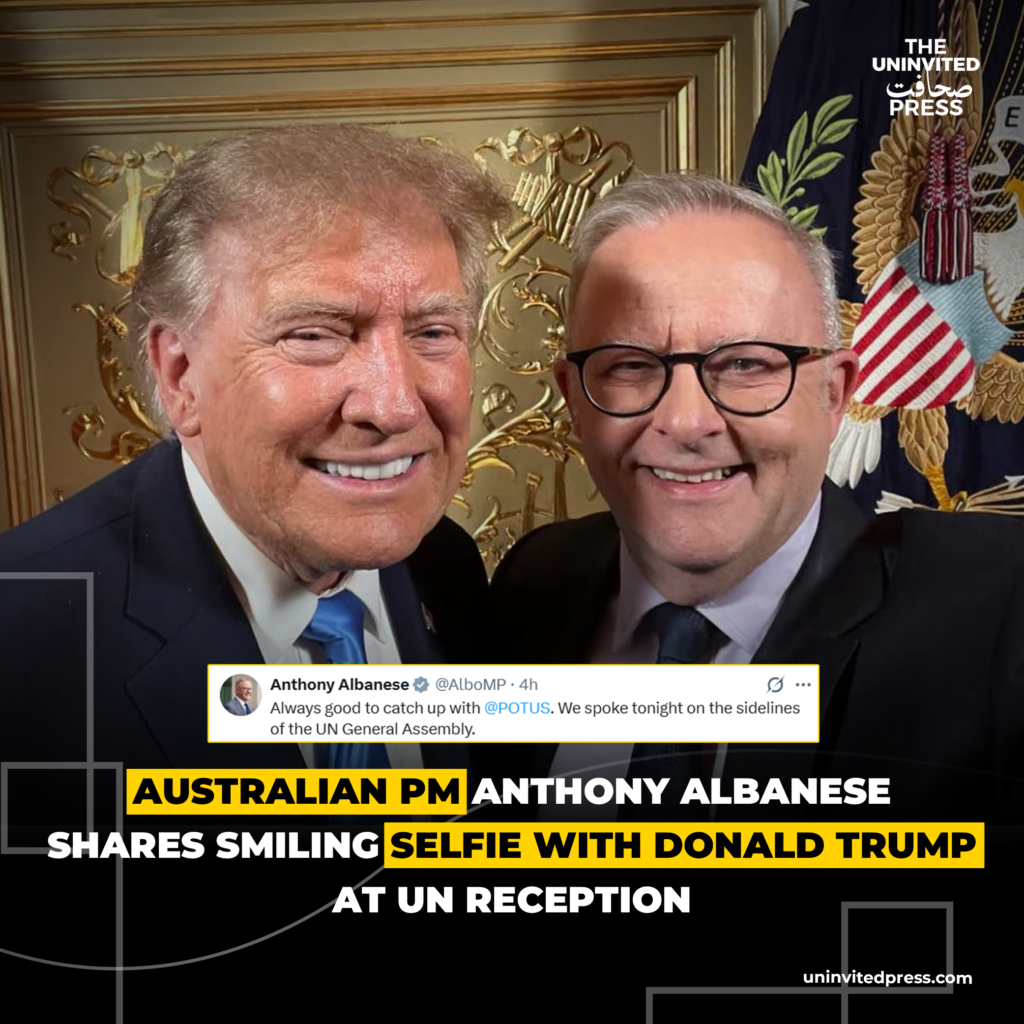
Australian Prime Minister Anthony Albanese has shared a smiling selfie with US President Donald Trump taken at a reception hosted by the White House for world leaders attending the United Nations General Assembly in New York.
Albanese posted the image on social media late on Tuesday local time, writing: “Always good to catch up with @POTUS. We spoke tonight on the sidelines of the UN General Assembly.” The photograph shows the two leaders standing close together and smiling.
Australia-US Leaders Differ on AI:
The brief encounter marked the first face-to-face meeting between the pair since a White House visit last year. Australian officials described the conversation as warm and positive. It took place at a gala reception Trump hosted for visiting leaders during the high-level week of the 81st UN General Assembly.
The friendly photo-op came hours after the two leaders publicly diverged on one of the assembly’s dominant themes: the governance of artificial intelligence. In his address to the General Assembly, Trump rejected calls for international regulation of the technology, declaring that the United States “totally rejects any attempt to construct a globalist scheme of control” for what he renamed “Super Intelligence.” He argued that AI would prove bigger than the Industrial Revolution and should not be stifled.
Albanese, by contrast, has used his time in New York to promote stronger safeguards. He joined French and Spanish leaders to launch a coalition focused on children’s rights and protection in the age of AI, and has positioned Australia as a middle power advocating for human-centred rules. Canberra’s proposed Digital Duty of Care legislation, which seeks greater accountability from social media platforms over algorithms, has drawn criticism from the US embassy in Australia.
Australia-US Ties Under Scrutiny:
The contrast between the smiling selfie and the policy disagreements underscores the complex dynamics of the Australia-US alliance under Trump’s second administration. While security cooperation remains strong-Australia is a key partner in the AUKUS pact and hosts major US military assets-differences have emerged on digital regulation, trade and multilateral approaches to emerging technologies.
Albanese’s government has sought to maintain close ties with Washington while also advancing an independent voice on issues such as climate, AI governance and regional diplomacy in the Indo-Pacific. Trump’s combative style at the UN, which included sharp criticism of the organisation itself and threats related to Iran, has highlighted the challenges middle powers face in navigating great-power politics.
The selfie quickly circulated on social media, drawing both supportive comments about the enduring alliance and sceptical reactions that noted the underlying policy gaps. For Albanese, the image offered a visible demonstration of personal rapport with the US president at a moment when Australia is also campaigning for a non-permanent seat on the UN Security Council.
As leaders continue bilateral meetings and negotiations in New York, the Albanese-Trump encounter serves as a reminder that public displays of friendship can coexist with substantive disagreements on the global stage.