

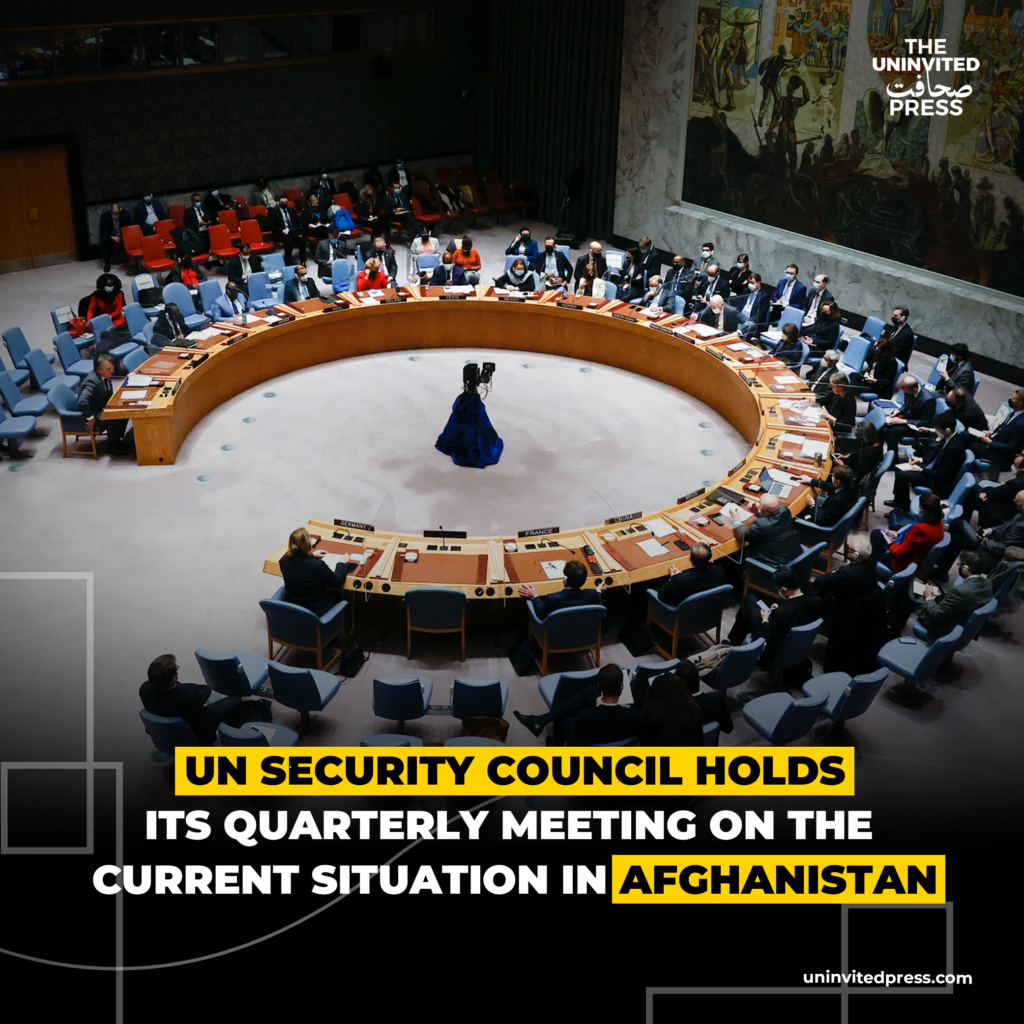
Members discuss Taliban rule, worsening humanitarian crisis and calls for greater engagement amid stalled political progress.
The United Nations Security Council convened its quarterly meeting on Afghanistan on Monday to assess the situation nearly five years after the Taliban’s return to power.
Diplomats from the 15-member body reviewed the latest developments in the country, focusing on the humanitarian emergency, restrictions on women and girls, counter-terrorism efforts, and the lack of progress towards an inclusive government.
Special envoys and senior UN officials briefed the council on the dire conditions facing millions of Afghans, with the UN warning that more than half the population requires humanitarian assistance amid economic collapse, food insecurity and severe restrictions on education and employment for women.
UN Members Divided Over Taliban Policies:
Western members, including the United States, United Kingdom and European countries, pressed the Taliban to reverse bans on girls’ secondary education and women’s work in NGOs, describing the measures as severe human rights violations that hinder international recognition and aid.
In contrast, China, Russia and some other members advocated for more pragmatic engagement with the Taliban authorities, emphasising the need for stability, counter-narcotics cooperation and preventing Afghanistan from becoming a safe haven for terrorist groups such as IS-Khorasan.
The Taliban, which is not formally represented at the UN, has repeatedly rejected external pressure on its policies, insisting they are in line with Islamic principles and calling for the unfreezing of Afghan assets and removal of sanctions.
UN Warns of Worsening Crisis in Afghanistan:
The meeting comes as Afghanistan faces one of the world’s largest humanitarian crises. According to UN estimates, 23.7 million people need aid, while the economy remains fragile and heavily dependent on international assistance.
Regional actors, particularly Pakistan and Iran, have expressed concerns over cross-border militancy and refugee movements, adding further complexity to diplomatic efforts.
UN Secretary-General António Guterres and other officials have repeatedly called for a unified international approach that balances accountability for human rights with practical engagement to address the suffering of the Afghan people.
The Security Council is expected to continue monitoring the situation closely, with the next quarterly briefing scheduled in three months.