

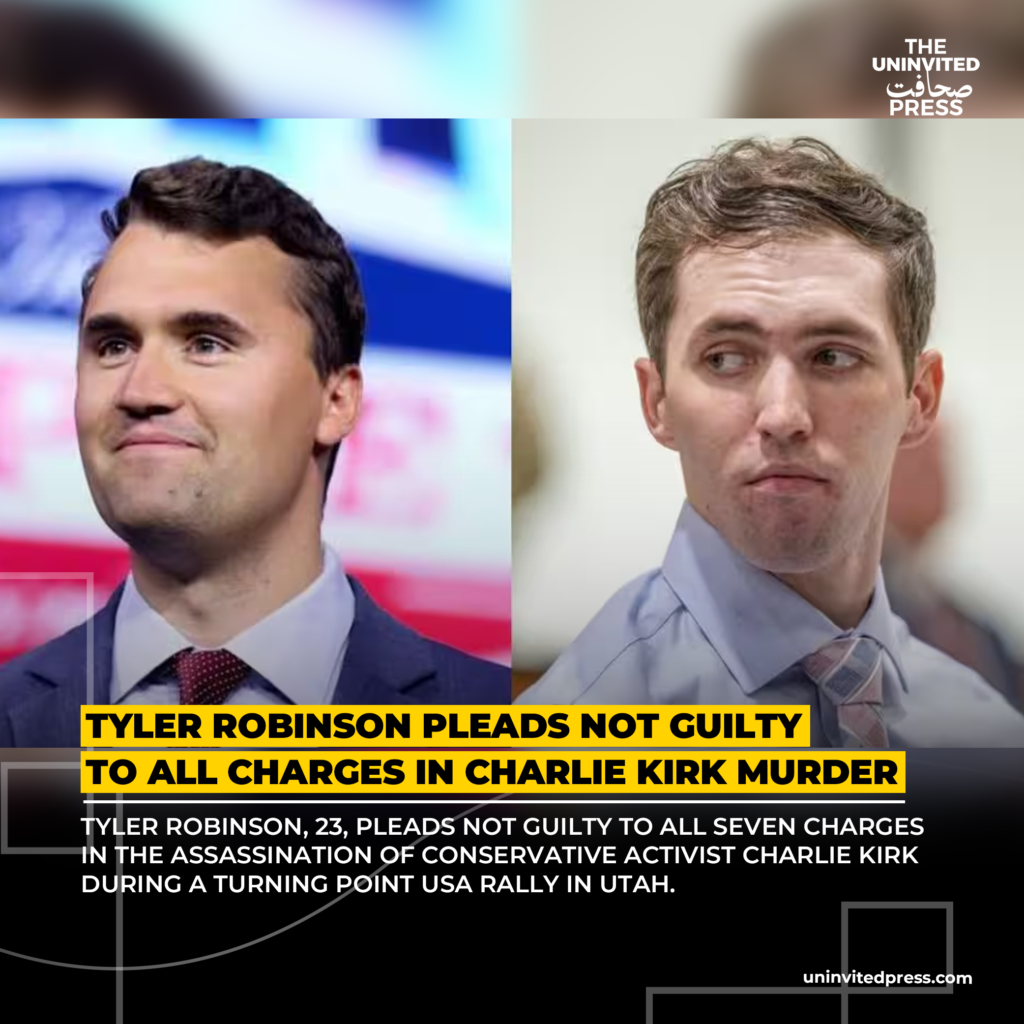
Tyler Robinson, 23, pleads not guilty to all seven charges in the assassination of conservative activist Charlie Kirk during a Turning Point USA rally in Utah.
A 23-year-old Utah man has pleaded not guilty to all charges connected to the fatal shooting of conservative activist Charlie Kirk, as a judge ruled that prosecutors can pursue the death penalty in the high-profile case.
Tyler Robinson entered the not-guilty pleas on Tuesday during a hearing in Provo, Utah, nearly a year after Kirk was killed. Judge Tony Graf determined there was sufficient evidence for Robinson to stand trial on aggravated murder and six related counts. The ruling keeps the possibility of capital punishment on the table.
Kirk, 31, a prominent right-wing activist, founder of Turning Point USA and close ally of US President Donald Trump, was fatally shot in the neck on 10 September 2025. He was speaking to a crowd of about 3,000 people at an outdoor event organised by his organisation at Utah Valley University in Orem. The single shot was fired from a rooftop roughly 130 metres away, according to prosecutors. Kirk was pronounced dead shortly afterwards at a local hospital.
Robinson, who lived hours away in Washington, Utah, and was not a student at the university, turned himself in the day after the shooting following a manhunt. Authorities said his family confronted him and persuaded him to surrender after he allegedly confessed to them.
Robinson Faces Seven Charges in Charlie Kirk Case:
Prosecutors have described the evidence against Robinson as a “mountain.” They say DNA linked him to the bolt-action rifle used in the attack, recovered items at the scene, surveillance video placing him on campus that day, and statements he allegedly made to his roommate and romantic partner, Lance Twiggs. Prosecutors also cited a note and text messages in which Robinson is said to have expressed that he had “enough of (Kirk’s) hatred” and that he had an opportunity to “take out Charlie Kirk.”
Robinson faces seven charges: aggravated murder (a capital offence in Utah), felony discharge of a firearm causing serious bodily injury, two counts of obstruction of justice, two counts of witness tampering, and commission of a violent offence in the presence of a child. The aggravated murder charge stems in part from the allegation that firing into a large crowd created a risk of death or serious injury to others, including children present at the event.
Defence lawyers had argued that the death penalty should be removed from consideration, contending there was insufficient proof that anyone other than Kirk was endangered. Judge Graf rejected that position, finding that the circumstances supported a reasonable inference that the defendant was aware others were nearby when the shot was fired.
Prosecutor Ryan McBride told the court that Robinson “shot and killed Charlie Kirk because he disagreed with him” and did so by firing a high-powered rifle into a crowd. Prosecutors have pointed to Kirk’s public opposition to same-sex marriage and transgender rights as a possible motive, noting Robinson’s relationship with Twiggs, who was exploring gender transition. Defence attorneys have disputed that the evidence establishes such a motive or that the shooting endangered bystanders beyond the intended target.
Kirk’s family, including his widow Erika Kirk and his parents, were present in the heavily secured courtroom. An attorney for the family said they would seek a speedy trial. Robinson showed little reaction as his lawyers entered the not-guilty pleas on his behalf.
Charlie Kirk Case: Trial Date Expected in October:
The case has drawn national and international attention as an instance of political violence in the United States. Kirk was widely credited with mobilising young conservative voters and played a visible role in Trump’s 2024 presidential campaign. His assassination prompted widespread condemnation from political leaders across the spectrum and renewed debate over the security of public political events.
Robinson is next scheduled to appear in court on 23 October, when a trial date is expected to be set. If convicted of aggravated murder and sentenced to death, he would face Utah’s capital punishment system, which requires a unanimous jury decision.
The killing of Charlie Kirk remains one of the most closely watched legal proceedings in the United States, highlighting ongoing tensions around political polarisation, free speech on campuses, and the boundaries of political violence.