

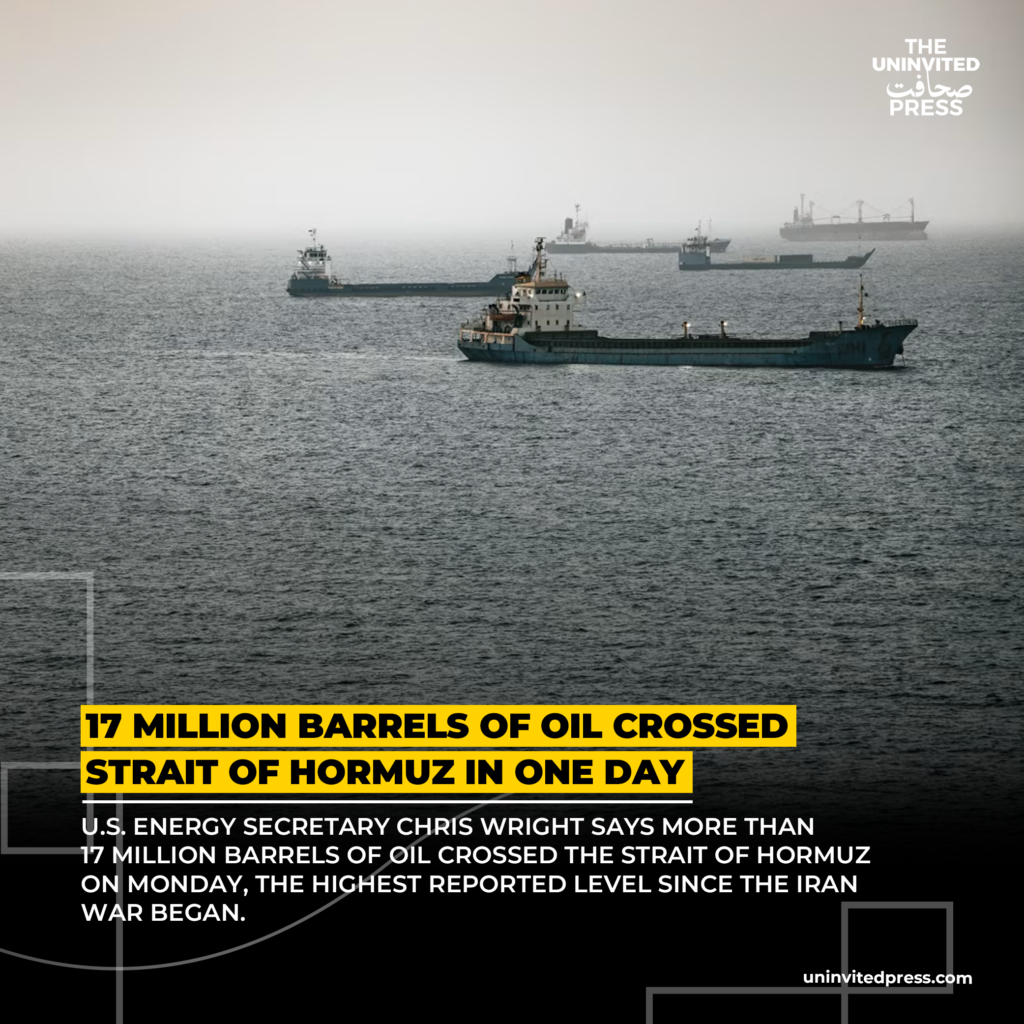
US Energy Secretary Chris Wright says more than 17 million barrels of oil crossed the strategic waterway on Monday, the highest level reported since conflict disrupted global energy supplies.
More than 17 million barrels of oil passed through the Strait of Hormuz on Monday, the highest daily volume recorded since the outbreak of war involving Iran, according to US Energy Secretary Chris Wright.
Wright made the announcement on Tuesday while on a visit to Venezuela, describing the figure as a significant milestone in efforts to restore energy shipments through one of the world’s most critical maritime chokepoints. “The United States Navy has done a simply tremendous job,” Wright said. “And I can announce right now that yesterday, through the Strait of Hormuz, over 17 million barrels of oil flowed. The record since before the conflict.”
Hormuz Strait Sees 17 Million Barrels of Oil Flow:
The Strait of Hormuz, a narrow passage between Iran and Oman that connects the Persian Gulf to the Gulf of Oman and the Arabian Sea, has long been a vital artery for global energy trade. Before the conflict began, roughly 20 million barrels of oil and petroleum products-about one-fifth of daily global demand-typically transited the waterway each day. Disruptions linked to the war sharply reduced those volumes for months, contributing to volatility in international oil markets and concerns over supply security.
Wright’s statement comes amid continued military and diplomatic tensions in the region. The United States has repeatedly asserted that its naval forces have been escorting tankers and facilitating the movement of oil and gas cargoes through the strait, even as Iran has at times sought to restrict or threaten traffic. US officials have claimed that these efforts, combined with alternative pipeline routes that bypass the strait, have helped keep overall energy flows from the Gulf region closer to pre-war levels in recent periods.
Independent shipping data and market analysts have sometimes offered more cautious estimates of daily transit volumes than those cited by US officials, noting that some vessels deactivate tracking systems and that precise figures can be difficult to verify in real time. Nevertheless, Wright presented Monday’s 17-million-barrel total as evidence that the waterway remains open and functional despite the broader conflict.
Hormuz Oil Flows Rise Amid US-Iran Tensions:
The recovery in oil shipments through Hormuz carries implications for global markets. Oil prices have fluctuated in response to developments in the Middle East, with any sustained increase in supply through the strait potentially easing pressure on prices. Conversely, renewed military exchanges or threats to shipping could quickly reverse gains. On the same day Wright spoke, oil prices edged higher in early trading amid reports of fresh US-Iran strikes, underscoring the fragility of the situation.
For energy-importing nations, particularly in Asia, which rely heavily on Gulf crude, the restoration of higher volumes through Hormuz is a welcome development after months of uncertainty. Major producers in the region, including Saudi Arabia and the United Arab Emirates, have also utilised overland pipelines to move some oil around the strait, adding further capacity beyond seaborne traffic.
Wright’s comments form part of a broader US narrative that American military presence and logistics support have prevented Iran from fully closing the waterway-a threat Tehran has long held as strategic leverage. US officials have argued that even without a comprehensive diplomatic settlement, Washington can ensure the continued flow of energy out of the Gulf.
The Strait of Hormuz remains under close international scrutiny. Any further escalation between the United States and Iran, or additional disruptions to shipping, would quickly test whether Monday’s elevated oil transit volume marks a lasting recovery or a temporary peak. For now, the reported 17-million-barrel figure stands as the highest daily throughput claimed by US authorities since the conflict began, offering a snapshot of both the resilience of global energy logistics and the persistent geopolitical risks that continue to shape them.