

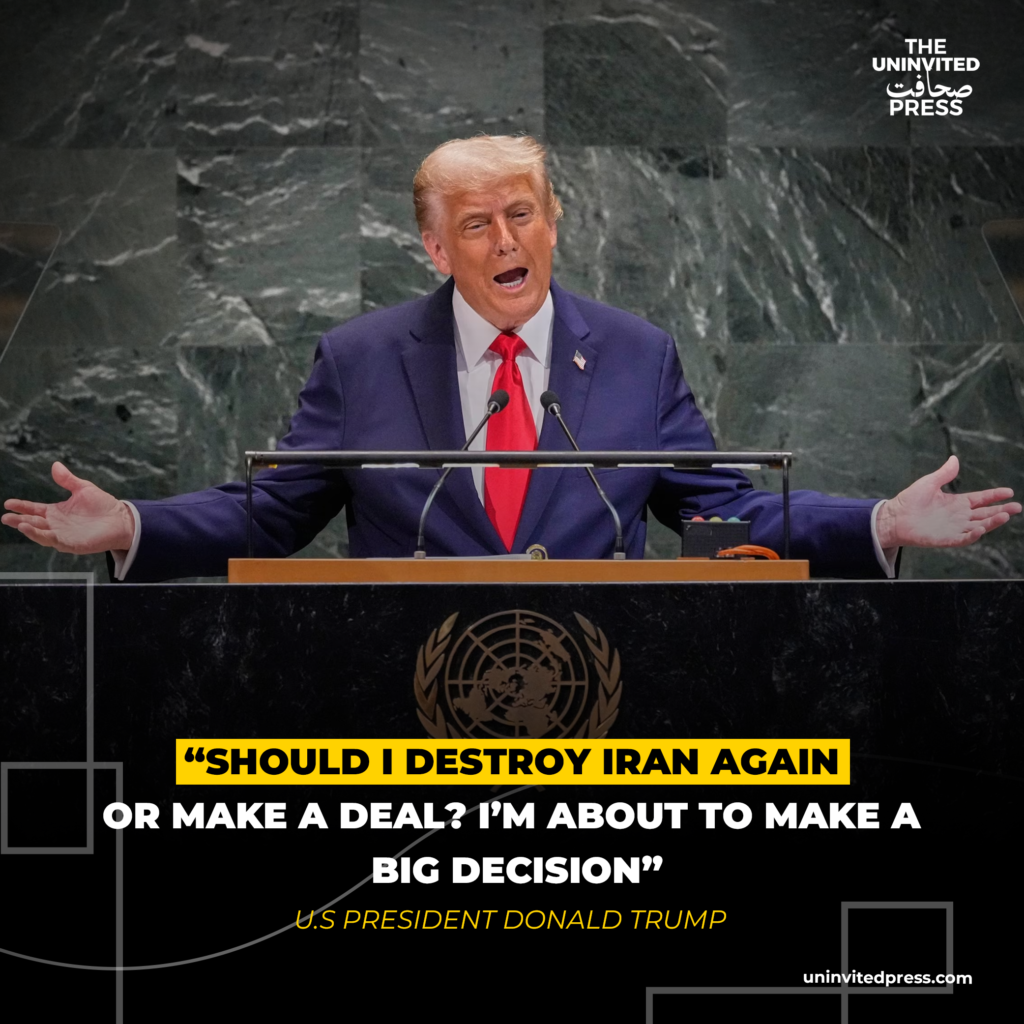
US president tells UN General Assembly he may ‘annihilate the Islamic Republic’ if no agreement is reached, as talks resume on sidelines.
US President Donald Trump has said he faces a “big decision” on Iran, framing the choice as either reaching a deal that would allow the country to rebuild or “annihilating the Islamic Republic” and driving it “into hell.”
Speaking at the United Nations General Assembly in New York on Tuesday, Trump told world leaders: “I have a big decision to make. Will a deal be made with Iran that lets them rebuild and create a far greater country than it ever was before? Maybe one of the greatest in the Middle East or even the world. Or do I annihilate the Islamic Republic and do it quickly, never giving them a chance to kill and destroy people and countries again?”
He added that he could “drive them into hell with no chance of survival and no hope of future greatness or generations,” while expressing belief that a deal would come after the US midterm elections in November. Trump suggested Iran was waiting to see the outcome of those elections, though he noted he himself is not on the ballot.
Trump Signals Possible Iran Deal:
He added that he could “drive them into hell with no chance of survival and no hope of future greatness or generations,” while expressing belief that a deal would come after the US midterm elections in November. Trump suggested Iran was waiting to see the outcome of those elections, though he noted he himself is not on the ballot.
The remarks came against the backdrop of a nearly seven-month conflict between the United States and Iran that began with joint US-Israeli strikes in February. The war has involved extensive airstrikes, disruption of shipping in the Strait of Hormuz, and significant economic and human costs. A 60-day ceasefire earlier this year was intended to create space for diplomacy but produced limited progress.
Most members of the Iranian delegation walked out during Trump’s speech. Hours later, however, Trump revealed that US envoys Steve Witkoff and Jared Kushner had held a three-hour meeting with Iranian officials on the sidelines of the UN gathering-the first direct face-to-face talks in months. He described the session as “very good” and “very productive,” with another meeting planned.
Iran Sets Conditions for Peace Deal:
Iranian Foreign Minister Abbas Araghchi reportedly presented conditions for any broader agreement, including the lifting of the US naval blockade, the release of frozen Iranian assets, and an end to fighting involving Iran-aligned forces across the region, according to Iranian state media. Iranian President Masoud Pezeshkian has previously expressed deep distrust of further negotiations.
Trump’s comments mark one of his starkest public ultimatums since the conflict began. He has repeatedly said he prefers a deal to avoid harming Iran’s 91 million people but has also threatened to “finish the job” if diplomacy fails, claiming the US could rapidly destroy key infrastructure. Tehran has rejected such threats as “delusional” and insisted Iran does not respond to intimidation.
The war has overshadowed much of Trump’s second-term foreign policy agenda and contributed to domestic political pressures ahead of the midterms. Critics argue the conflict has prolonged regional instability, driven up energy prices and strained US alliances, while supporters credit the administration with preventing Iran from acquiring a nuclear weapon and weakening its military capabilities.
Regional powers and international observers remain wary. Gulf states have been closely monitoring developments, and the disruption of oil traffic through the Strait of Hormuz continues to ripple through global markets. At the UN, Trump called on other nations to join efforts to isolate Iran economically until it abandons what Washington describes as its nuclear ambitions and attacks on shipping.