

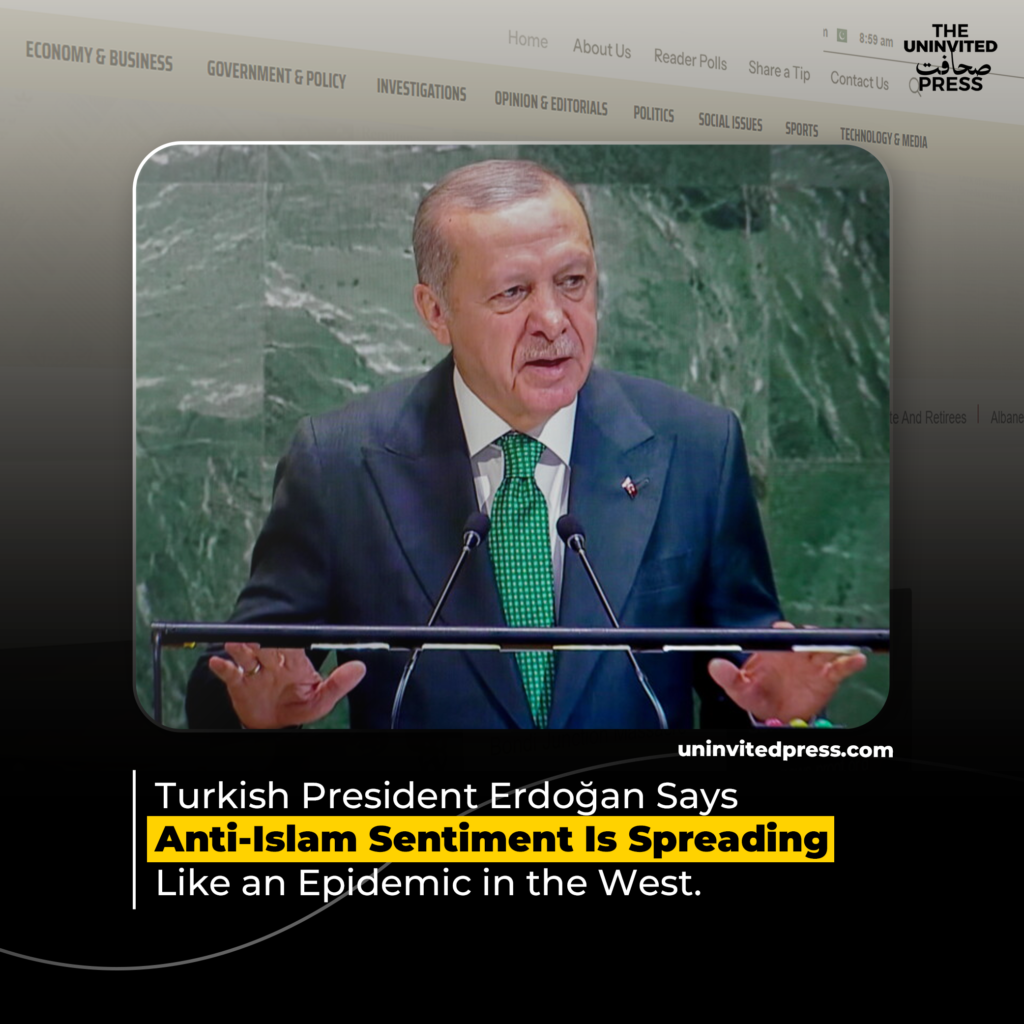
Turkish president criticises headscarf bans and rising discrimination against Muslim women during UN General Assembly address.
Turkish President Recep Tayyip Erdoğan has said Islamophobia is “spreading like the plague in the West,” describing it as one of the foremost threats to social peace alongside rising xenophobia and cultural racism.
Speaking at the 81st session of the United Nations General Assembly in New York on Tuesday, Erdoğan singled out discrimination against Muslim women and girls, which he said had intensified in recent years. He specifically condemned headscarf bans in schools in certain countries, calling them “an attack on women’s most fundamental rights.”
Erdoğan Condemns Rising Islamophobia:
“Islamophobia, which is spreading like the plague in the West, is at the forefront of these issues,” Erdoğan told the assembly. He argued that such intolerance, combined with broader trends of xenophobia, posed serious challenges to peaceful coexistence and required coordinated international action.
The Turkish leader framed the issue within a wider set of social threats emerging in a rapidly changing world. He placed Islamophobia alongside other forms of prejudice, urging stronger global cooperation to address them. Erdoğan has long positioned Turkey as a defender of Muslim communities abroad and frequently raises concerns about anti-Muslim sentiment in Europe and North America.
His remarks came amid ongoing debates in several Western countries over religious symbols, immigration and integration. France, for instance, has maintained strict secular rules that restrict conspicuous religious attire in public schools and certain public roles, measures supporters defend as upholding laïcité while critics argue they disproportionately affect Muslim women. Similar restrictions or proposed bans have surfaced in other European nations in recent years.
Turkey Highlights Global Intolerance:
Erdoğan’s speech also touched on related themes, including what he described as “global gender-neutralisation policies” that he claimed target families and children. He advocated protecting the traditional family model of a man and a woman. Those comments followed a recent Turkish government operation targeting LGBTQ+ groups, which authorities said was aimed at safeguarding family values; rights organisations condemned the raids as a crackdown on civil society.
Turkey under Erdoğan has repeatedly highlighted Islamophobia as a growing global problem, particularly after attacks on mosques and Muslim communities in places such as New Zealand and Canada in previous years. Ankara has also criticised what it sees as double standards in Western responses to conflicts involving Muslim populations, including the war in Gaza.
At the same time, Erdoğan’s government faces its own domestic and international scrutiny over religious freedom, minority rights and the treatment of political opponents. Critics argue that his emphasis on conservative Islamic values has coincided with increasing pressure on secularists, LGBTQ+ individuals and some religious minorities inside Turkey.
The Turkish president used the UN platform to call for greater international solidarity against intolerance in all its forms. Whether his latest intervention will influence policy debates in Western capitals remains unclear, but it underscores Ankara’s continued effort to frame itself as a leading voice against anti-Muslim prejudice on the world stage.