

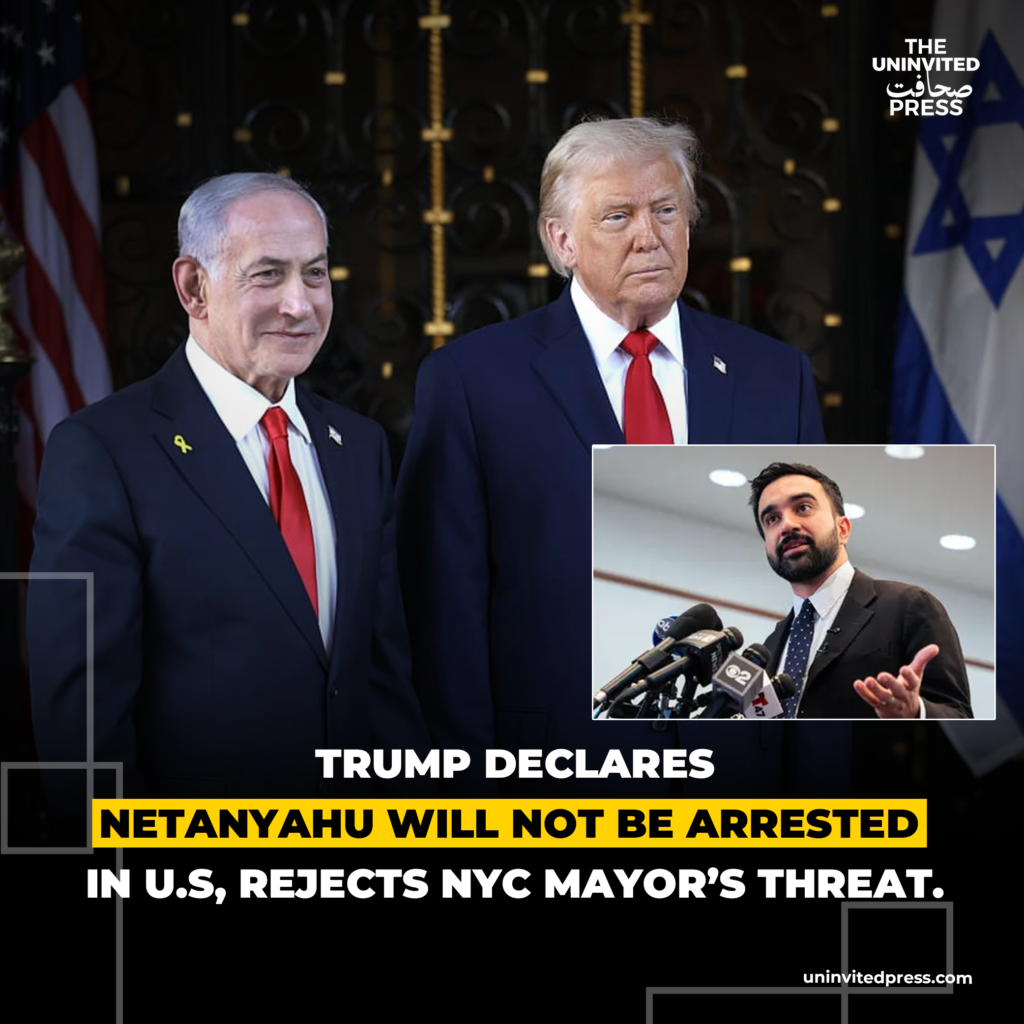
‘No way, shape or form’: US president intervenes as NYC’s Zohran Mamdani weighs enforcing ICC warrant against Israeli leader ahead of UN visit.
US President Donald Trump has firmly ruled out any possibility of Israeli Prime Minister Benjamin Netanyahu being arrested on American soil, directly countering suggestions by New York City Mayor Zohran Mamdani that local authorities could act on an International Criminal Court (ICC) arrest warrant.
Trump declared: “Benjamin Netanyahu will not be arrested, in any way, shape, or form, while in the United States of America.” He framed the Israeli leader as a key partner against Iran and said the only figures who should face arrest are Iranian officials responsible for what he described as a “spiral of death and destruction.”
The intervention comes after Mamdani, who took office earlier this year, reiterated in recent interviews that his administration is consulting with the city’s legal department about potential options should Netanyahu travel to New York for the United Nations General Assembly in September.
Campaign Promise Meets Reality:
Mamdani, a vocal critic of Israel’s military campaign in Gaza, has long described Netanyahu as a “war criminal” and pledged during his mayoral campaign to direct the New York Police Department to arrest him if he visited the city. In a recent New York Times podcast interview, he stated that Netanyahu “belongs in The Hague” and that the ICC warrant for alleged war crimes and crimes against humanity should be taken seriously.
However, legal experts widely agree that such an arrest is highly improbable. The United States is not a party to the ICC, and federal law prohibits cooperation with the court in this context. Sitting heads of government also enjoy diplomatic immunity, particularly when visiting for UN events, which are protected under international agreements.
Mamdani has emphasised that his administration would act only “within the bounds of the law” and would not create new legal avenues. Despite this, his comments have sparked intense debate over local versus federal authority and the broader US stance on international justice mechanisms.
US Divisions Over Israel-Gaza:
The exchange highlights sharp divisions within American politics over the Israel-Gaza conflict. The ICC issued arrest warrants for Netanyahu and former Defence Minister Yoav Gallant in November 2024, citing alleged war crimes including the use of starvation as a method of warfare during Israel’s military operations in Gaza following the October 7, 2023 attacks by Hamas. Israel has strongly rejected the charges as politically motivated and denies violating international law.
Trump’s strong defence of Netanyahu aligns with his administration’s unwavering support for Israel and its broader campaign against the ICC, which Washington views as overreaching its authority, particularly regarding non-member states and close allies.
Mamdani’s position reflects a growing segment of progressive Democrats who have become increasingly critical of Israeli policies and US military aid, calling for greater accountability amid the humanitarian crisis in Gaza. His stance has drawn sharp rebukes from pro-Israel groups and some mainstream Democrats, underscoring tensions within the party. Netanyahu’s office has dismissed Mamdani’s comments as political theatre aimed at diverting attention.
Trump Rejects Arrest Push:
Netanyahu is expected to attend the UN General Assembly in September, a routine visit for world leaders that typically includes high-level meetings in New York and Washington. Trump’s assurance effectively guarantees federal protection, rendering any local initiative symbolic at best.
The episode also raises questions about the limits of municipal authority in foreign policy and the enforcement of international arrest warrants in countries that do not recognise the ICC’s jurisdiction.
As the September UN gathering approaches, the incident adds another layer to the complex US-Israel relationship under Trump’s second term-one marked by close strategic alignment against Iran and other regional adversaries, even as domestic debates over Gaza intensify.