

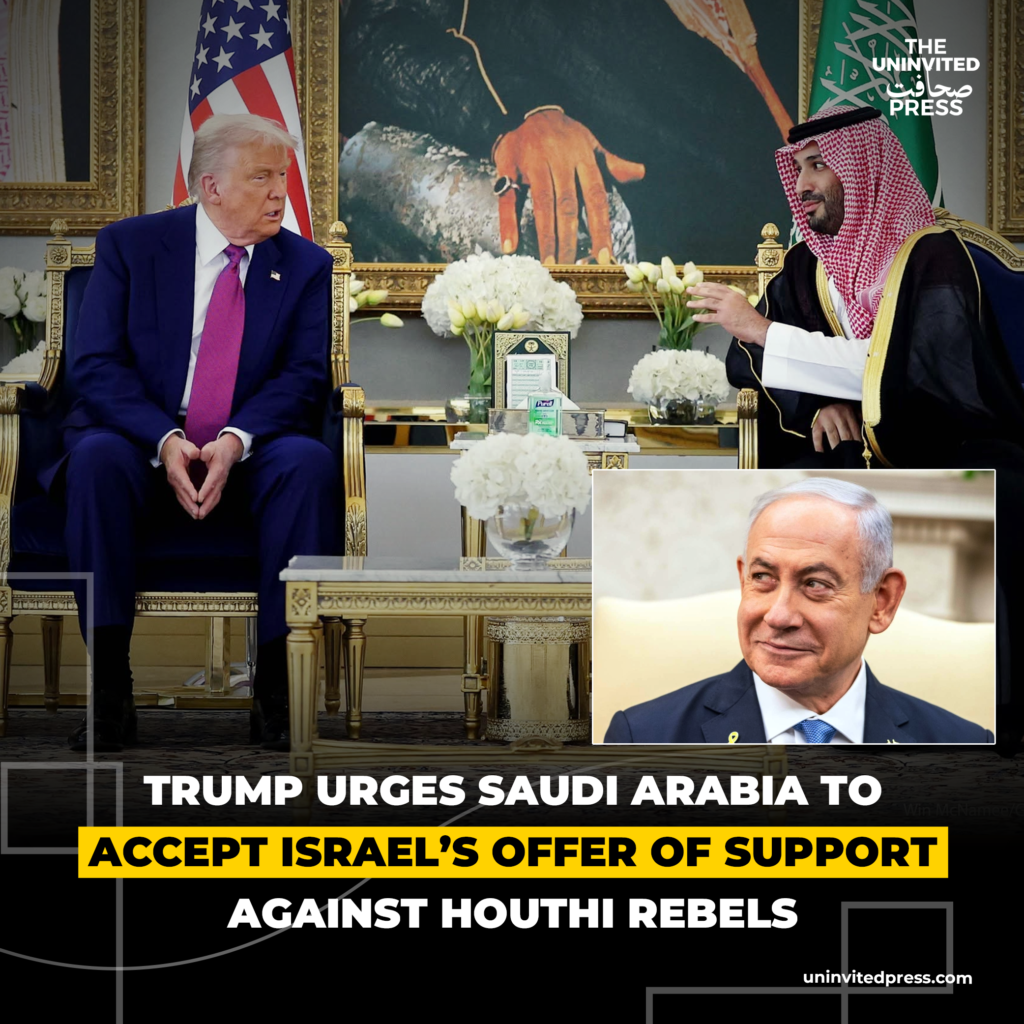
US president claims Israel has already been ‘very helpful’ to Riyadh and suggests Abraham Accords normalisation is closer than ever amid escalating attacks.
US President Donald Trump has publicly urged Saudi Arabia to accept an offer of military assistance from Israel in its confrontation with Yemen’s Houthi movement, describing Israeli support as already “very helpful” and suggesting that formal normalisation of ties between Riyadh and Jerusalem under the Abraham Accords could be nearer than at any previous point.
Speaking to reporters on the South Lawn of the White House on Friday before departing for a political event, Trump was asked whether Saudi Arabia should take up Israel’s reported offer of help against the Houthis. “Yeah, I do, sure. Israel has been very helpful to Saudi Arabia,” he replied. He added that he believed Riyadh would accept the assistance: “I think they will. Absolutely … they certainly would do that.”
Trump further claimed that Saudi Arabia was “very happy to have Israel’s support and our support.” When asked whether long-sought normalisation between the kingdom and Israel could return to the agenda, he answered: “Yeah, I think so, maybe more than ever. The Abraham Accords are one of our greatest achievements.”
The remarks come as Saudi Arabia faces a sharp escalation in attacks by the Iran-aligned Houthis. Since fighting between the group and the Saudi-backed Yemeni government reignited in the summer, the Houthis have struck targets deep inside the kingdom, including oil facilities, Red Sea shipping and, most recently, Riyadh’s King Khalid International Airport. That attack last weekend killed at least 13 people and injured hundreds, according to Saudi authorities. Iran has denied directing the latest wave of strikes, while Saudi officials have accused Tehran of encouraging the escalation.
Saudi Arabia Weighs Israel Ties Amid Houthi Threats:
Israel has itself been targeted by Houthi missiles and drones for years and has developed extensive experience intercepting such threats. Israeli Prime Minister Benjamin Netanyahu was recently reported to have offered assistance to Riyadh, conveyed through US channels, partly as a means of advancing closer ties. According to Israeli media citing diplomatic sources, Saudi Crown Prince Mohammed bin Salman initially resisted open cooperation, citing concerns over domestic public opinion in a country that has never established formal relations with Israel and continues to link any normalisation to progress on the Palestinian issue.
Trump’s comments appear designed to encourage Riyadh to overcome those reservations. The Abraham Accords, signed during his first term in 2020, saw the United Arab Emirates, Bahrain, Morocco and Sudan normalise relations with Israel. Bringing Saudi Arabia into the framework has remained a central US policy goal, though talks stalled after the Hamas-led attacks of 7 October 2023 and the subsequent war in Gaza.
Saudi Arabia intervened in Yemen’s civil war in 2015 at the head of a coalition aimed at restoring the internationally recognised government and rolling back Houthi gains. After years of inconclusive fighting and a subsequent truce, the conflict has flared again, with the Houthis consolidating control over key stretches of Yemen’s Red Sea coast and asserting greater leverage over the Bab al-Mandab Strait, a vital artery for global shipping and energy exports.
US Pushes Saudi-Israel Security Ties:
The United States has so far limited its direct involvement. Earlier this year, Trump reportedly declined Saudi requests for American airstrikes against the Houthis, offering intelligence sharing and targeting data instead while maintaining a focus on other regional priorities. Roughly 200 US personnel are already present in the kingdom providing non-kinetic support.
Analysts note that any visible Israeli military role in defending Saudi territory would mark a significant shift in the region’s security architecture and could accelerate the very normalisation Trump is promoting. It would also place additional pressure on Saudi Arabia’s traditional position that progress towards a Palestinian state remains a prerequisite for full diplomatic ties with Israel.
For now, Riyadh has not publicly responded to Trump’s call. The kingdom continues to frame its campaign against the Houthis as a defensive necessity while seeking broader international backing. Whether the combination of mounting attacks and US encouragement will overcome longstanding political and popular barriers to open Israeli-Saudi security cooperation remains an open question that could reshape alliances across the Middle East.