

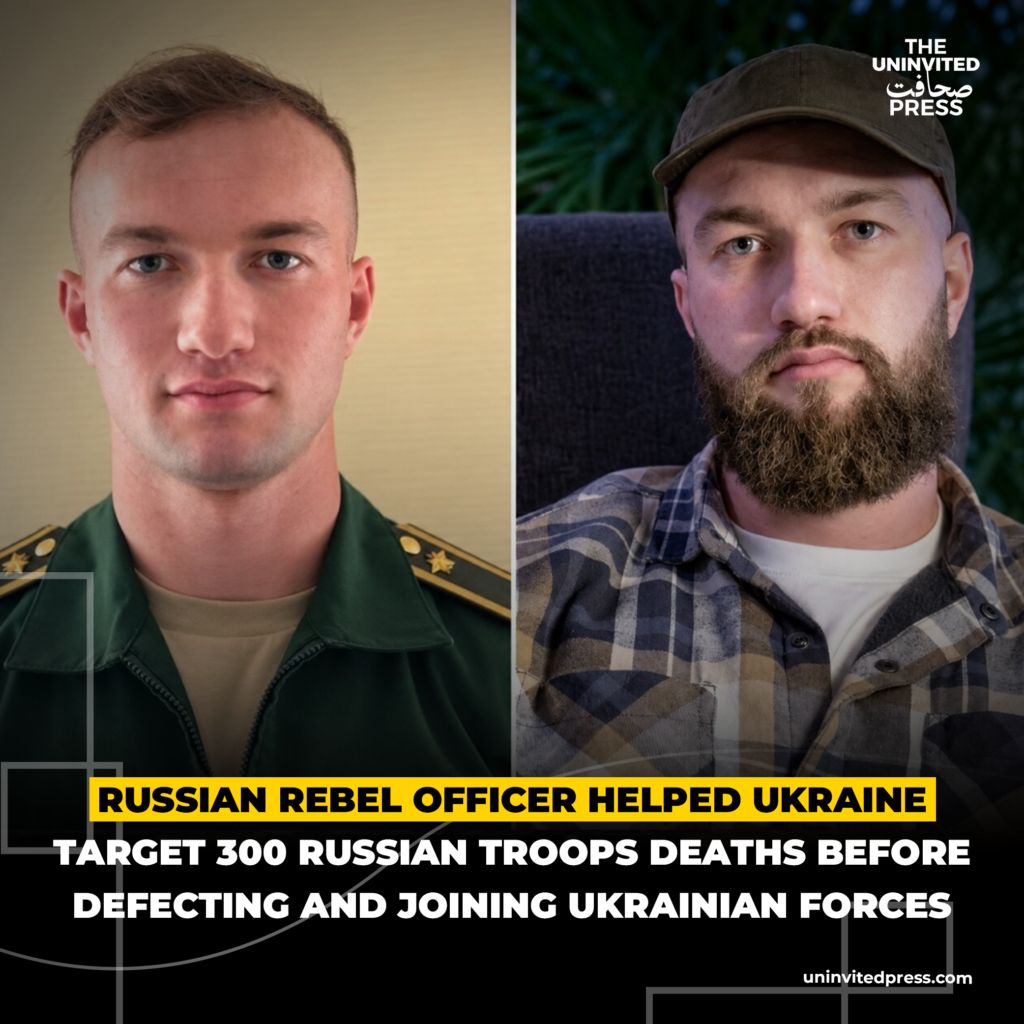
Lieutenant Lev Stupnikov passed battle plans and troop positions to Kyiv for months, then crossed the front line to join an anti-Putin volunteer unit, according to a detailed investigation.
A Russian army lieutenant who secretly supplied Ukraine with detailed intelligence on his own unit’s positions, radio frequencies and operational plans helped Ukrainian forces carry out strikes that killed more than 300 Russian soldiers before defecting and joining a volunteer formation fighting against Moscow, according to a Wall Street Journal investigation published this week.
Lieutenant Lev Stupnikov, 26, served as chief signals officer in Russia’s 36th Motor Rifle Brigade. His position gave him access to military communications, reconnaissance drone feeds and surveillance systems. Beginning in early 2024, he began sharing this information with Ukrainian contacts, enabling a series of targeted attacks on Russian forces concentrated near the front line in eastern Ukraine.
One of the earliest and most lethal operations occurred on a freezing morning in February 2024 near Vuhledar, a strategic town that Russian forces had long sought to capture. Russian soldiers, medics and senior officers had gathered in an open field for a training exercise in preparation for an offensive. Stupnikov photographed the group, estimated their numbers at between 120 and 150, and transmitted the precise coordinates to his Ukrainian handler.
He then left the area under the pretext of stomach problems. Moments later, Ukrainian missiles struck the location. Stupnikov later reported that 68 Russian soldiers were killed and 60 wounded. Ten of the dead were officers, including Colonel Gusein Musayev, commander of the 36th Motor Rifle Brigade and a priority target for Ukrainian forces. When his Ukrainian contact asked for confirmation and a photograph, Stupnikov replied: “There’s just meat.”
Russian Officer’s Defection Aided Ukraine’s Strikes on Russian Troops:
According to the Journal’s reporting, which draws on interviews, messages, video material and Russian military records, Stupnikov continued feeding intelligence for several months. His information contributed to further strikes, including attacks on command gatherings and billets, that Ukrainian and Western assessments link to more than 300 Russian deaths in total. The exact figure cannot be independently verified, but the cumulative effect of the intelligence is described as significant in disrupting Russian operations in the Vuhledar sector.
Stupnikov, a graduate of the prestigious Budyonny Military Academy of the Signal Corps in St. Petersburg, had begun questioning Russia’s invasion of Ukraine as early as 2022. In interviews after his defection, he said he believed President Vladimir Putin had broken the oath officers take to defend freedom, independence and the constitutional order. His mother, opposed to the war, is reported to have helped initiate contact with Ukrainian intelligence.
In July 2024, after months of covert activity, Stupnikov made a carefully planned escape across the front line. Guided by a Ukrainian drone and monitored by thermal cameras, he crossed mined no-man’s land at night near the village of Mykilske. Ukrainian soldiers of the 72nd Brigade challenged him with a pre-arranged password. He answered “peanut shop” (or “Erdnussladen” in some accounts) and was taken into custody. He later handed over a smartphone containing access codes that reportedly allowed Ukrainian forces continued monitoring of certain Russian drone and camera feeds.
Stupnikov subsequently joined the Russian Volunteer Corps, a unit of the Ukrainian armed forces composed of Russian citizens opposed to Putin’s government. He now serves as a communications specialist. The group is one of several formations of Russian nationals fighting on Ukraine’s side, often framed by Kyiv as both a military asset and a political signal that resistance to the war exists within Russian society.
Russian Defections Expose Military Security Challenges:
The case highlights the challenges Russia continues to face with morale, desertion and internal security more than four and a half years after the full-scale invasion began in February 2022. Ukrainian intelligence has long run programmes to recruit or encourage Russian soldiers to defect or share information, including a public hotline known as “I Want to Live.” Defections of this depth and operational impact remain relatively rare but are prized by Kyiv for both their tactical value and their propaganda effect.
Russia has not publicly commented on the specific case. Moscow routinely dismisses reports of large-scale desertions or successful Ukrainian intelligence operations as Western fabrications. Ukrainian officials, while confirming the broader practice of working with Russian informants, have not independently detailed Stupnikov’s contribution.
The episode underscores the human and operational costs of a war that has already claimed hundreds of thousands of lives on both sides. For Ukraine, such intelligence successes offer temporary tactical advantages in a conflict still defined by attrition. For Russia, they expose vulnerabilities within an army that has suffered heavy losses while struggling to maintain cohesion and loyalty among its ranks.