

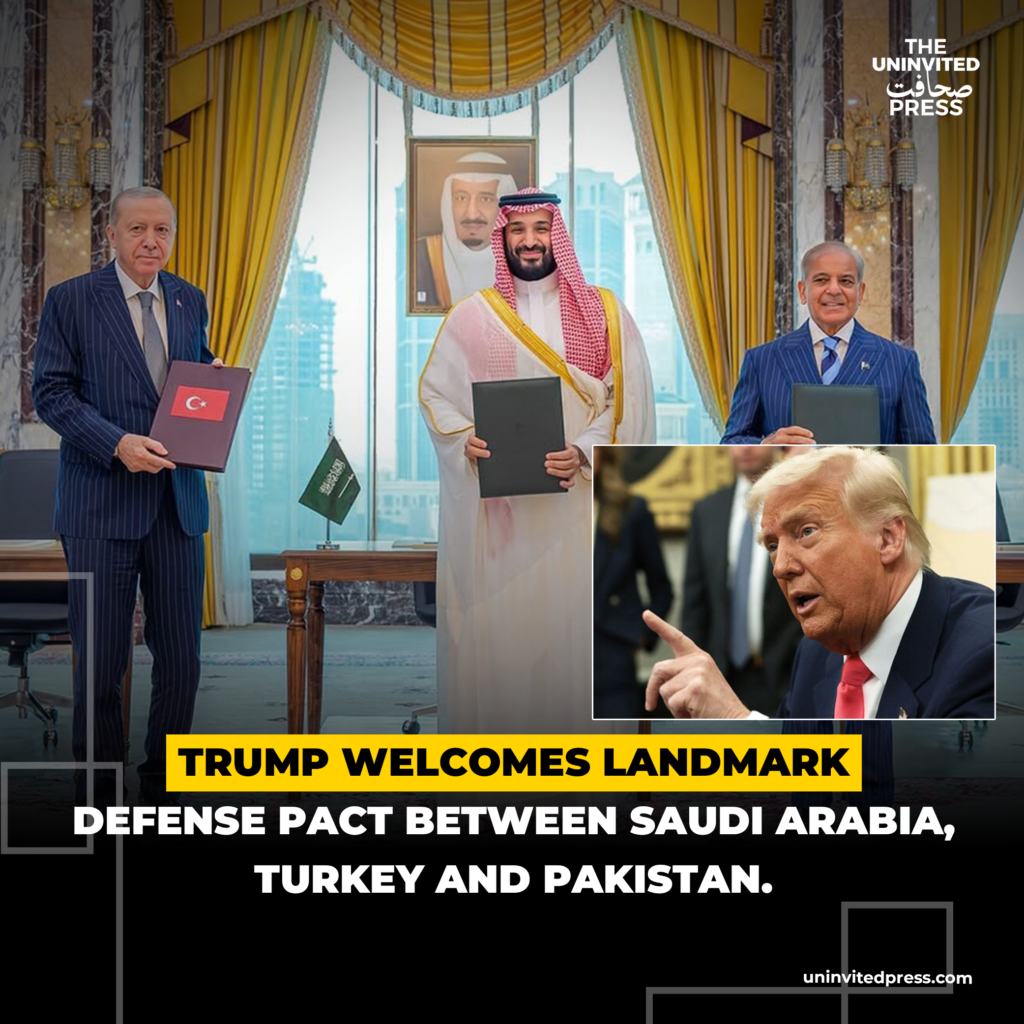
US president praises trilateral agreement amid regional turmoil, calling it an important step toward greater self-reliance in the Middle East.
US President Donald Trump has welcomed a landmark defence agreement between Saudi Arabia, Turkey and Pakistan, describing the deal as a “big, bold and important first step” toward stronger collective security in the Middle East.
In a post on his Truth Social platform on Sunday, Trump said he was “very happy to see that Saudi Arabia, Turkiye, and Pakistan have recently, and finally, signed the Makkah Joint Defense Agreement.”
“It shows how the Middle East is coming together, and how Countries will finally be able to defend themselves in a more meaningful way,” he wrote. “Congratulations to the Great Leadership of the three Nations mentioned. THIS IS A BIG, BOLD, AND IMPORTANT FIRST STEP-WOW!”
Saudi, Türkiye and Pakistan Sign Joint Defence Pact:
The Mecca Joint Defence Agreement was signed on 7 August in the holy city of Mecca by Saudi Crown Prince Mohammed bin Salman, Turkish President Recep Tayyip Erdogan and Pakistani Prime Minister Shehbaz Sharif. Under its terms, an armed attack against any one of the three states will be regarded as an attack against all three-a collective defence clause broadly comparable in principle to NATO’s Article 5.
A joint statement issued after the signing said the pact aims “to strengthen collective deterrence against any act of aggression” and to enhance defence cooperation across multiple domains. Turkish officials have described the agreement as “purely defensive in nature” and not directed against any specific country. Pakistan’s foreign ministry has similarly stressed that the deal is open to other nations willing to uphold its principles and resolve differences through peaceful means.
The agreement comes against the backdrop of heightened regional tensions, including the ongoing conflict involving the United States and Iran that has disrupted maritime traffic through critical waterways such as the Strait of Hormuz and the Red Sea. Iran-backed Houthi attacks have further complicated the security environment.
Saudi Arabia and Pakistan had already signed a separate mutual defence agreement in September 2025. The new trilateral pact expands that framework by bringing in Turkey, which possesses NATO’s second-largest army and a rapidly growing defence industry. Together, the three countries field substantial military capabilities, combining Saudi Arabia’s economic weight and strategic position, Turkey’s industrial and conventional military strength, and Pakistan’s nuclear status and longstanding security ties with Riyadh.
Saudi, Türkiye and Pakistan Strengthen Military Alliance:
Turkish Defence Ministry officials have indicated that the pact will involve the creation of political and military coordination mechanisms, joint military exercises involving land, naval and air forces, and deeper cooperation in defence technology, including unmanned systems, electronic warfare and artificial intelligence. Turkish President Erdogan has expressed hope that the alliance could expand in the future, with Egypt mentioned as a potential candidate.
Analysts note that the agreement reflects a broader push by regional powers to enhance their own security architecture at a time of uncertainty over external guarantees. While the three countries maintain longstanding relationships with the United States, the pact signals a desire for greater strategic autonomy and burden-sharing.
Trump’s endorsement aligns with his administration’s emphasis on allies taking greater responsibility for their own defence. The US president framed the development positively, portraying it as evidence that countries in the region are uniting and building more effective means of self-protection.
Pakistan has repeatedly clarified that the agreement is not aimed at any particular nation. Officials from the three signatories have emphasised their shared commitment to promoting peace, security and stability in the region and beyond.
As the Middle East continues to navigate complex and overlapping conflicts, the Mecca Joint Defence Agreement marks a significant institutional step among three of the Muslim world’s most influential powers. Whether the collective defence pledge translates into concrete operational coordination remains to be tested, but the political signal is clear: these nations intend to stand together against external aggression.