

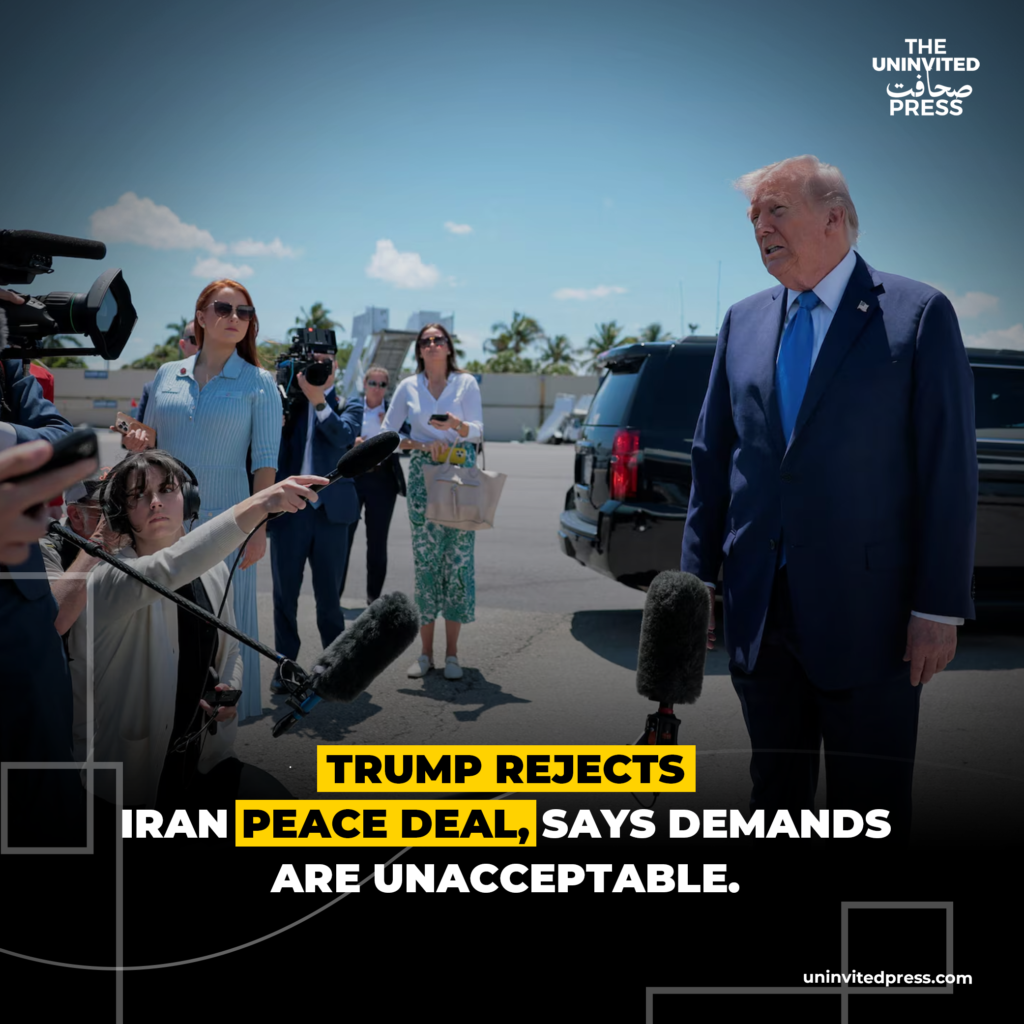
US President says Tehran’s terms fall short on key issues including nuclear ambitions, as fragile ceasefire holds amid fears of renewed escalation in the Middle East.
US President Donald Trump has dismissed Iran’s latest peace overture, stating that the proposals put forward by Tehran are unacceptable to the United States and fail to address core American concerns, particularly Tehran’s nuclear programme.
Speaking to reporters before departing for an event, Trump made clear his dissatisfaction with the new Iranian plan delivered through Pakistani mediators. “They want to make a deal, I’m not satisfied with it,” he said, without elaborating on specific sticking points.
The remarks come as the US-Iran conflict, which erupted earlier this year with Israeli and American strikes on Iranian targets, enters a delicate phase. A fragile ceasefire has been in place since early April, but diplomatic efforts to convert it into a lasting agreement have repeatedly faltered.
US-Iran Nuclear Talks Stall Over Enrichment Demands:
According to US officials, Iran has not agreed to key American “red lines,” including a complete end to uranium enrichment, dismantling of major nuclear facilities, and full transparency over its enriched uranium stockpile.
Trump has repeatedly emphasised that any deal must eliminate Iran’s nuclear weapons ambitions, a position Tehran has long rejected as an infringement on its sovereign rights to peaceful nuclear energy.
Earlier attempts at negotiations in Islamabad collapsed after marathon talks, with US Vice President JD Vance accusing Iran of refusing to accept Washington’s terms.
US-Iran Standoff Deepens Amid Fears of Escalation:
The ongoing diplomatic impasse has raised fears of renewed military action, especially as the 60-day congressional deadline for US military operations looms. Trump has hinted at considering stronger measures if talks fail, while maintaining that communication channels remain open.
Iranian officials, for their part, have accused Washington and Israel of using negotiations as cover for continued pressure and have insisted on the lifting of sanctions and security guarantees as part of any comprehensive deal.
As the Middle East continues to grapple with the aftermath of direct US-Iran confrontation-the first of its kind in decades-the failure to bridge the gap risks prolonging instability, higher oil prices, and broader regional tensions involving Israel, Hezbollah, and other actors.
Whether backchannel diplomacy can salvage a breakthrough remains uncertain, as Trump’s latest rejection signals little flexibility in Washington’s maximalist demands.