

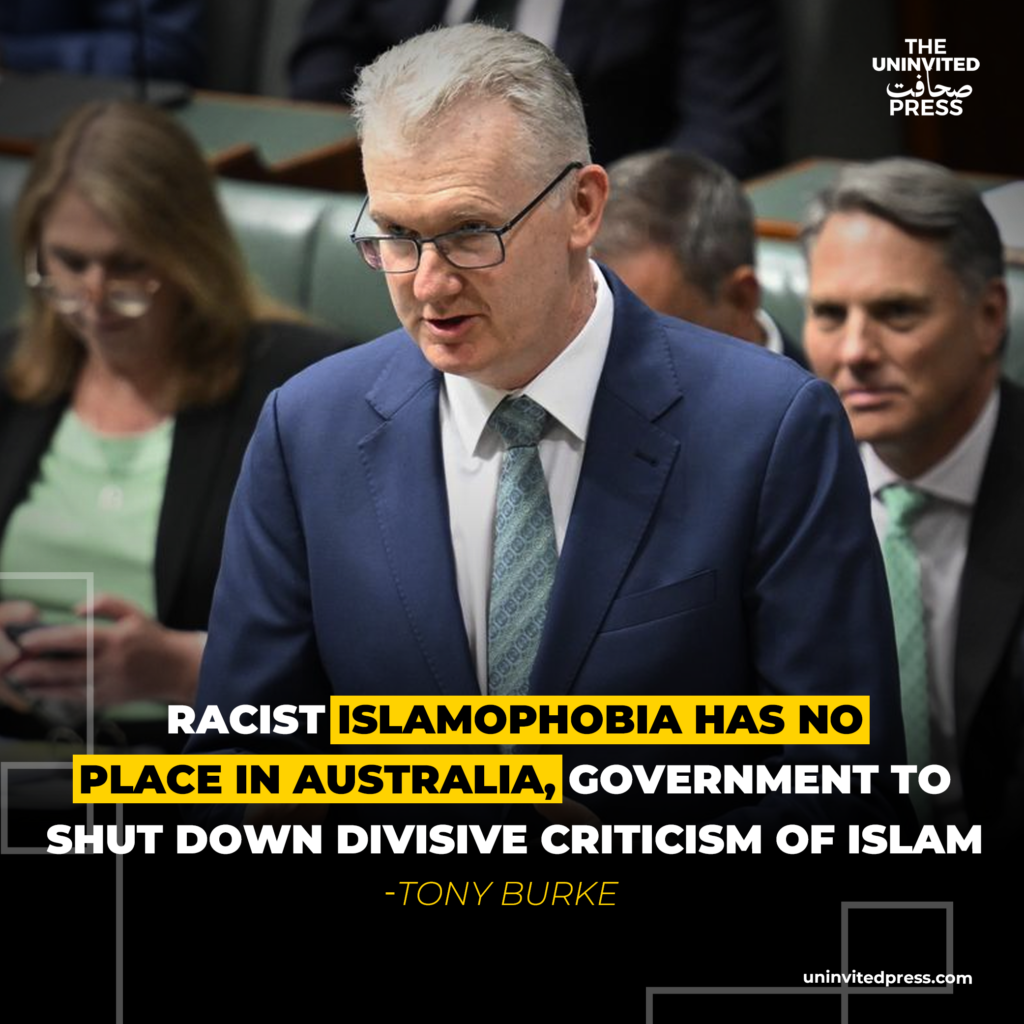
‘Racist rhetoric must stop’: Senior Labor minister sparks debate over free speech, multiculturalism and security in increasingly polarised national conversation.
Australia’s Minister for Immigration and Multicultural Affairs Tony Burke has issued a strong rebuke against what he described as rising “racist Islamophobia,” declaring it has “no place” in Australian society and signalling the government’s intent to confront divisive criticism of Islam.
Speaking in parliament, Burke emphasised that while robust debate is a cornerstone of democracy, rhetoric that crosses into racism or targets Muslims as a community undermines Australia’s multicultural fabric. “Racist Islamophobia has no place in Australia,” he stated, adding that the government would take steps to “shut down” inflammatory and divisive commentary.
The remarks come amid heightened tensions over religious and cultural issues, including protests related to the Israel-Gaza conflict, debates over immigration policy, and sporadic incidents involving Muslim communities that have been amplified in conservative media and online platforms.
Burke Defends Muslims, Rejects Hate:
Burke, a senior figure in Prime Minister Anthony Albanese’s Labor government, argued that criticism of specific policies or actions by individuals must be distinguished from blanket attacks on Islam or Muslims. He highlighted the contributions of Muslim Australians to the nation’s social and economic life and warned that unchecked divisive rhetoric fuels division and potential radicalisation on all sides.
The government has faced criticism from opposition figures and free speech advocates who argue that such statements risk conflating legitimate concerns-including integration challenges, certain cultural practices, or national security issues linked to extremism-with racism. Critics, including members of the Liberal-National Coalition, accuse Labor of prioritising political correctness over open discussion of real societal problems.
Australia’s Muslim community, numbering over 800,000 and one of the fastest-growing religious groups, has reported rising incidents of discrimination, particularly in the wake of global events in the Middle East. Community leaders have welcomed Burke’s comments as a necessary stand against hate, while calling for stronger anti-vilification laws and better protection for mosques and individuals.
Burke's Remarks Spark Political Divide:
The controversy reflects broader fault lines in Australian politics. Successive governments have promoted multiculturalism as a core strength, yet debates over immigration levels, asylum policies, and cultural integration have intensified in recent years. High-profile incidents, including terror-related arrests and protests featuring inflammatory slogans, have kept the issue in the spotlight.
Opposition voices have pushed back, arguing that concerns about Islamist extremism, parallel societies, or the compatibility of certain interpretations of Islam with Australian values are not inherently racist but rooted in observable events both domestically and internationally. They accuse the government of attempting to stifle debate under the guise of fighting Islamophobia.
Civil liberties groups, meanwhile, urge caution on both sides. While condemning genuine hate speech and violence, they warn against government overreach that could limit legitimate criticism of religion, ideology, or foreign-influenced activities.
Burke’s intervention comes as the Albanese government navigates sensitive foreign policy balances-maintaining strong ties with traditional allies while managing relations with Muslim-majority countries and addressing domestic community concerns.
As Australia prepares for future elections, the role of religion, immigration, and national identity in public discourse is likely to remain contentious. Burke’s remarks signal a firm governmental stance against what it sees as rising prejudice, but they also risk deepening political polarisation.
Muslim community organisations have called for concrete measures, including enhanced education programmes, interfaith initiatives, and stricter enforcement of existing anti-discrimination laws. Whether the government’s approach will foster greater cohesion or fuel accusations of selective censorship remains to be seen in a country that prides itself on both diversity and open debate.