

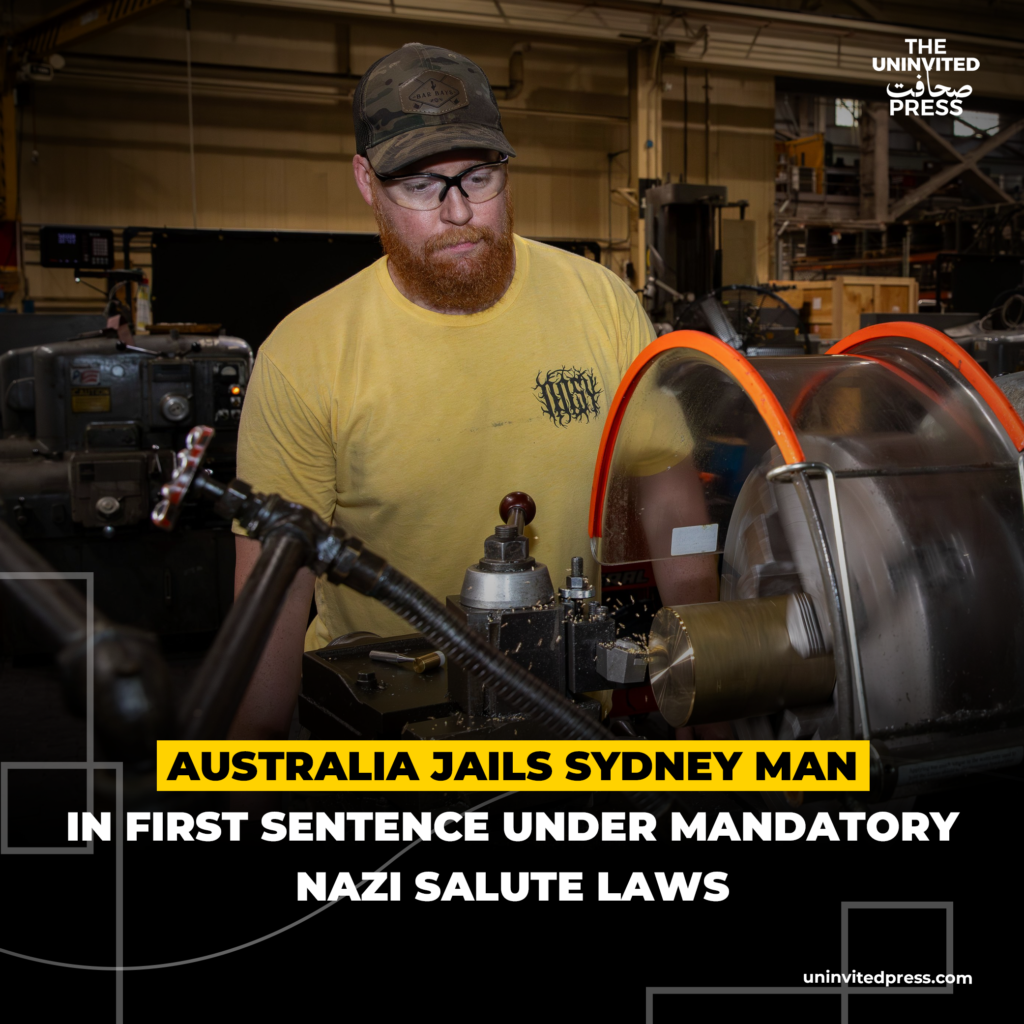
Nathan Ballesty sentenced to three years after performing the banned gesture and posting violent online threats targeting the prime minister and other politicians.
A Sydney man has been sentenced to three years in prison, becoming the first person jailed under Australia’s mandatory minimum sentencing laws for performing a Nazi salute.
Nathan Ballesty, 28, from the Northern Beaches suburb of Beacon Hill, was sentenced on Friday in the New South Wales District Court. Judge Phillip Mahony imposed a three-year term with a non-parole period of 18 months, backdated to January when Ballesty was remanded in custody. He will be eligible for parole in May 2027. The sentence includes the mandatory minimum 12 months’ imprisonment for the Nazi salute offence introduced in February 2025.
Ballesty pleaded guilty to one count of performing a Nazi salute under section 80.2H(1) of the Criminal Code, six counts of using a carriage service to menace, harass or offend, and one count of contravening a police order by refusing to provide passwords to his devices for weeks.
Sydney Man Jailed Over Nazi Salute and Threats:
The Australian Federal Police’s National Security Investigations team began examining him in December 2025 after an online post in which he called for the kidnapping of Prime Minister Anthony Albanese. A search of his home uncovered Nazi paraphernalia, including a uniform, hat, far-right literature and a copy of Adolf Hitler’s Mein Kampf, along with electronic devices. Investigators found violent messages directed at Albanese and Home Affairs Minister Tony Burke, as well as a recording of a video call in which Ballesty performed the Nazi salute.
He was initially granted conditional bail that prohibited the use of encrypted communication platforms. In January 2026 he breached that condition, leading to the revocation of bail and his remand in custody. Further charges relating to offensive online posts targeting federal parliamentarians were laid in March. He entered guilty pleas in May.
In sentencing remarks, Judge Mahony described Ballesty as a loner who had embraced an online community of like-minded people. He called the offending “corrosive to social cohesion” and noted that neo-Nazi material Ballesty shared risked shaping “young, vulnerable minds.” The judge observed that the community was grieving after the events of Bondi and that Ballesty had embraced the violent killing of immigrants as well as antisemitism and Islamophobia. He characterised the conduct as showing a “violent disdain” for parliamentarians and said it was “highly non-compassionate.”
Ballesty’s parents provided a letter of support outlining his lifelong struggle with mental health issues and social isolation. They described him as a kind, gentle and empathetic person and expressed regret that they had not recognised sooner the risks of his growing dependence on the internet. They said he had embraced Christianity while in prison and was “deeply remorseful and determined to live according to the values of his faith.” Ballesty himself submitted a letter admitting serious errors, apologising for causing offence and expressing remorse.
Australia Enforces Mandatory Nazi Salute Jail Term:
Judge Mahony accepted that Ballesty was remorseful but said the testimonials about his character were difficult to reconcile with the nature of his crimes.
The mandatory minimum sentence for performing a Nazi salute or displaying certain hate symbols formed part of amendments to Australia’s hate crime laws passed in early 2025. The changes were introduced amid a documented rise in antisemitic incidents and far-right extremism, including high-profile attacks and online radicalisation. Performing the Nazi salute in public had been banned earlier, but the February 2025 reforms made a 12-month jail term mandatory in applicable cases.
The AFP established dedicated National Security Investigations teams in October 2025 to target individuals and groups assessed as posing a high level of harm to social cohesion, including those directing threats at high office holders and federal parliamentarians.
Ballesty’s case marks the first application of the mandatory minimum regime. Earlier prosecutions for Nazi salutes under previous laws had typically resulted in fines or short non-custodial outcomes, with one prior short prison sentence later subject to appeal processes in Victoria.
The sentencing underscores the Australian government’s stated determination to confront public displays of Nazi symbolism and online extremism that threaten social cohesion, while also highlighting ongoing debates about the balance between free expression, mental health considerations and the need to deter hate-based offending.