

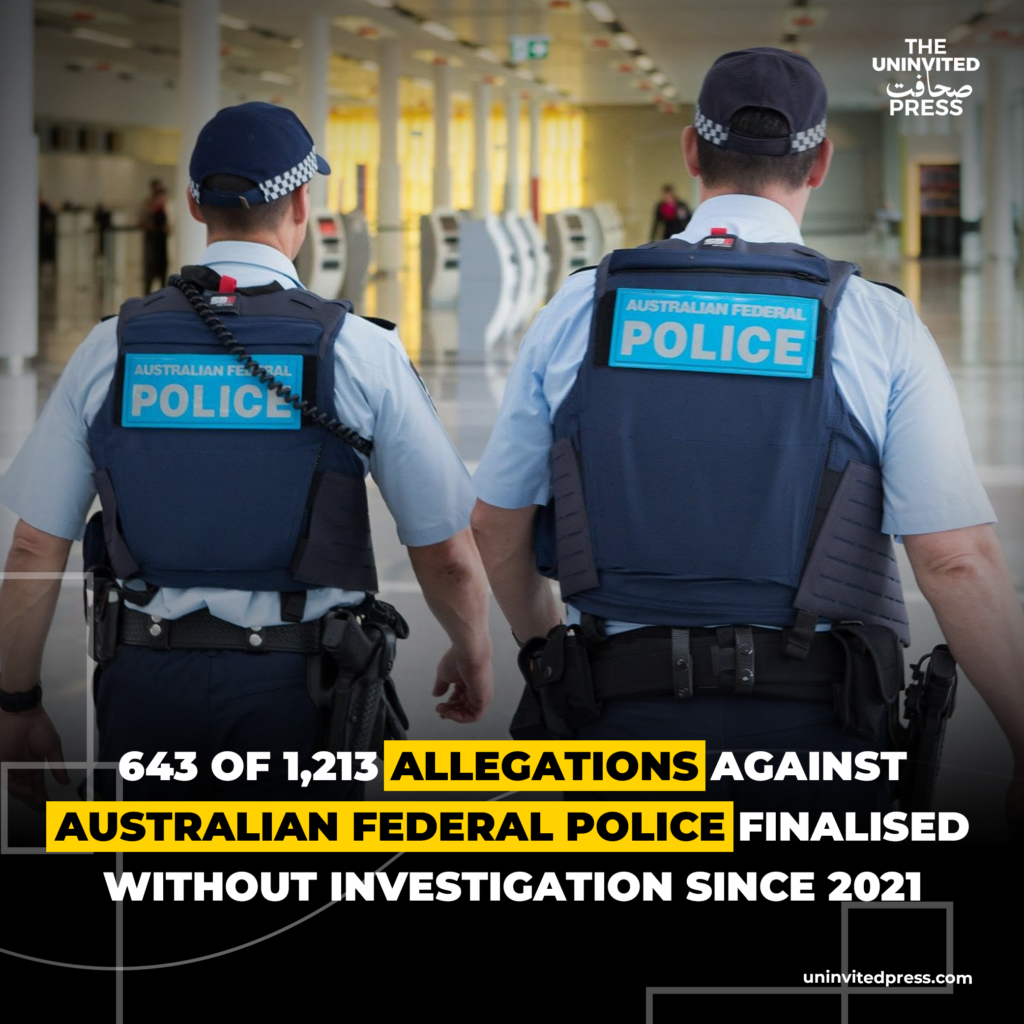
Senator Lidia Thorpe calls the figures a “protection racket” after data from a racism inquiry show 643 of 1,213 cases finalised under the commissioner’s discretionary powers.
The Australian Federal Police (AFP) finalised more than half of all misconduct allegations against its officers without investigation over a five-year period, according to figures obtained through a parliamentary inquiry into racism against Indigenous Australians and released on Friday.
The force received 1,213 allegations of misconduct in the period ending 30 June 2026. Of those, 643 were dismissed under section 40TF of the Australian Federal Police Act, which gives the commissioner broad discretion to decide that no further action is required. Only 63 allegations were established, 215 were not established, and 283 remained ongoing.
AFP Faces Scrutiny Over 643 Closed Allegations:
Independent Senator Lidia Thorpe, whose office secured the data, described the numbers as staggering. “This is 643 allegations closed under the commissioner’s broad discretion powers, with no transparent explanation of why,” she said. “They show why we need an independent body to investigate police misconduct and end the protection racket. The public do not trust cops to investigate cops. We need a better system.”
Section 40TF allows the AFP commissioner (or delegates) to discontinue a matter if further investigation is deemed unwarranted, if action has already been taken, if the allegation is more than 12 months old, or in certain other circumstances. Critics argue the provision has been used at scale, effectively short-circuiting scrutiny of police conduct.
The release of the figures coincides with longstanding concerns raised by the Commonwealth Ombudsman about the AFP’s complaints-handling system. In an annual report examining AFP conduct and practice issues published in August, the Ombudsman identified critical discrepancies between body-worn camera footage and official reports relating to section 40TF decisions. It also found the force was not consistently creating and maintaining records to demonstrate that the use of the discretion was reasonable and compliant with the law.
“These investigative deficiencies led to the dismissal of serious allegations under section 40TF without appropriate consideration of whether the application of force used was reasonable, necessary, and proportionate in the circumstances,” the Ombudsman reported. The watchdog recommended a mandatory requirement not to use the powers to dismiss matters in which use of force is the primary issue, along with comprehensive record-keeping. The AFP accepted the record-keeping recommendation in full and accepted the first recommendation only in principle, saying decisions should depend on the individual situation.
Calls Grow for Independent Police Oversight in Australia:
Thorpe has called on the federal government to establish an independent national police oversight body, citing models in the United Kingdom and Canada. “The Commonwealth has the power to legislate for this. What is missing is the political will,” she said. She also demanded that the AFP explain to parliament why the 643 allegations were discontinued and indicated she would pursue the issue at Senate Estimates hearings in October.
The data emerge against a backdrop of rising misconduct allegations within the AFP in recent years. Earlier reporting showed alleged conduct issues climbing sharply, with serious (Category 3) matters increasing substantially. At the same time, the proportion of finalised allegations established as breaches has fallen, while the use of the section 40TF discretion has grown. Successive Ombudsman reviews have flagged repeated problems with complaint categorisation, communication with complainants, and the quality of investigations.
The figures were obtained in the context of a parliamentary inquiry into racism, hate and violence directed at First Nations people. That inquiry, referred by the Minister for Indigenous Australians, has examined systemic issues affecting Aboriginal and Torres Strait Islander communities, including interactions with police. Thorpe and other advocates have long argued that the lack of independent external investigation of police misconduct undermines accountability, particularly in cases involving Indigenous Australians.
This to adds pressure on Australia’s federal policing framework. While the AFP maintains internal professional standards processes and is subject to oversight by the Commonwealth Ombudsman and, in corruption matters, the National Anti-Corruption Commission, critics maintain that police investigating police remains structurally flawed. Thorpe’s call for a fully independent national body reflects a broader debate about whether existing mechanisms deliver the transparency and public confidence required of a modern law-enforcement agency.