

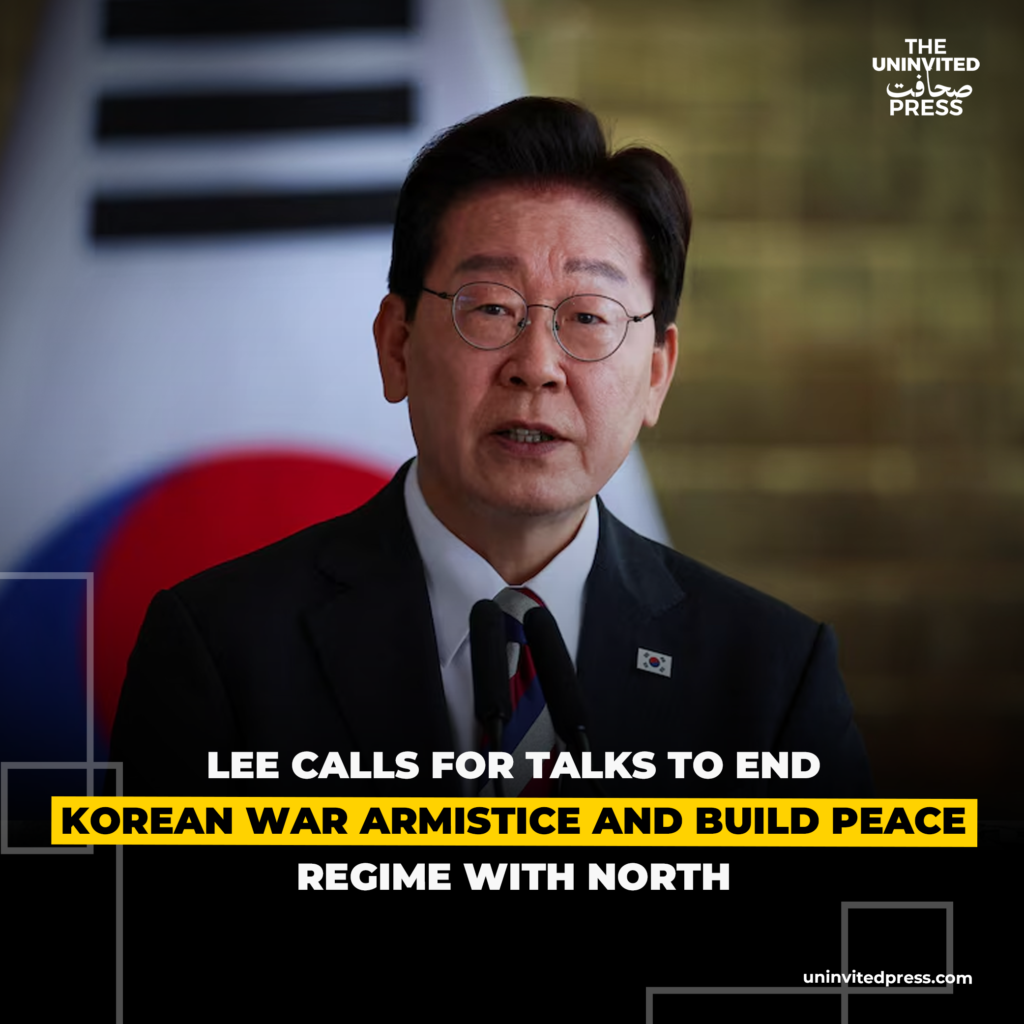
President proposes dialogue to replace decades-old ceasefire with lasting peace framework and address Pyongyang’s nuclear advances on Liberation Day.
South Korean President Lee Jae-myung on Saturday called for direct talks with North Korea to formally end the 1950-53 Korean War and replace the long-standing armistice with a “peace regime,” marking a renewed push for engagement on the divided peninsula.
Speaking at a ceremony commemorating the 81st anniversary of Korea’s liberation from Japanese colonial rule, Lee urged the two Koreas to “put down our intentions to threaten each other and begin discussions to end the long-running war as the directly involved parties.” He said the process could also include practical discussions on measures to halt the advancement of North Korea’s nuclear capabilities.
“I will embark on a journey to end the war and replace the unstable armistice system with a peace regime,” Lee said, emphasising mutual respect, an end to unnecessary confrontation, and the pursuit of peaceful coexistence and shared growth. He pledged that Seoul would establish mechanisms to manage tensions, build multilayered safeguards against escalation, and take preemptive steps to ease military friction.
A technical state of war since 1953:
The Korean War, which killed millions and devastated the peninsula, ended with an armistice agreement rather than a formal peace treaty. As a result, the two Koreas remain technically at war more than seven decades later, divided by a heavily fortified Demilitarized Zone and locked in a cycle of military drills, missile tests and political hostility.
Lee’s proposal builds on principles he outlined after taking office in June 2025: respect for North Korea’s political system, rejection of unification by absorption, and a commitment to avoid hostile acts. His administration has shifted away from the harder line of his predecessor, focusing more on dialogue and tension reduction than on maximum pressure for denuclearisation.
North Korea has so far rebuffed these overtures. Leader Kim Jong Un has formally abandoned the goal of reunification, described the South as its “most hostile” state, and ordered strengthened frontline defences. Pyongyang has also deepened military and political ties with Russia while declaring its nuclear status “irreversible.” It has criticised South Korea’s plans for nuclear-powered submarines and denounced joint United States-South Korea military exercises as provocations.
Lee Pushes for Korean War Peace Talks:
Lee suggested that formal talks to end the war could open space to discuss curbing the expansion of North Korea’s nuclear arsenal. Analysts note that previous attempts at engagement-most notably the 2018-2019 summits involving then-South Korean President Moon Jae-in, US President Donald Trump and Kim-produced temporary diplomatic openings but ultimately failed to produce lasting denuclearisation or a peace treaty.
A formal peace regime would require the involvement of other key parties, including the United States and China, both of which were signatories to the 1953 armistice. Any shift away from the current security architecture would also need to address the US-South Korea military alliance, the presence of American troops in the South, and North Korea’s demands for security guarantees.
Lee framed the initiative as part of a broader vision for stability in Northeast Asia, arguing that peace on the peninsula could contribute to regional cooperation and progress toward a world free of nuclear weapons. He stressed the need for a “multilayered security system” to prevent crises and escalation while comprehensively assessing the security environment around the Korean Peninsula.
North Korea has remained largely silent on Lee’s latest appeal. Its state media has previously dismissed South Korean engagement efforts as insincere while highlighting its own military modernisation and strategic partnerships. The timing of Lee’s speech coincides with heightened tensions ahead of planned US-South Korea military drills, which Pyongyang has already criticised.
Whether the call produces any concrete dialogue remains unclear. Inter-Korean relations have been frozen for years, with almost no official communication channels functioning. Previous South Korean administrations that pursued engagement faced domestic political backlash when breakthroughs proved elusive, while hardline approaches have also failed to alter North Korea’s strategic course.
For now, Lee’s Liberation Day address signals a continued commitment to diplomacy even in the face of North Korean intransigence. “By inducing a positive response from the North, I will create a stable Korean Peninsula,” he said, positioning peaceful coexistence-not confrontation-as the foundation for any future relationship between the two Koreas.
The proposal underscores both the enduring fragility of the Korean Peninsula’s security architecture and the persistent difficulty of transforming a 73-year-old armistice into a durable peace.