

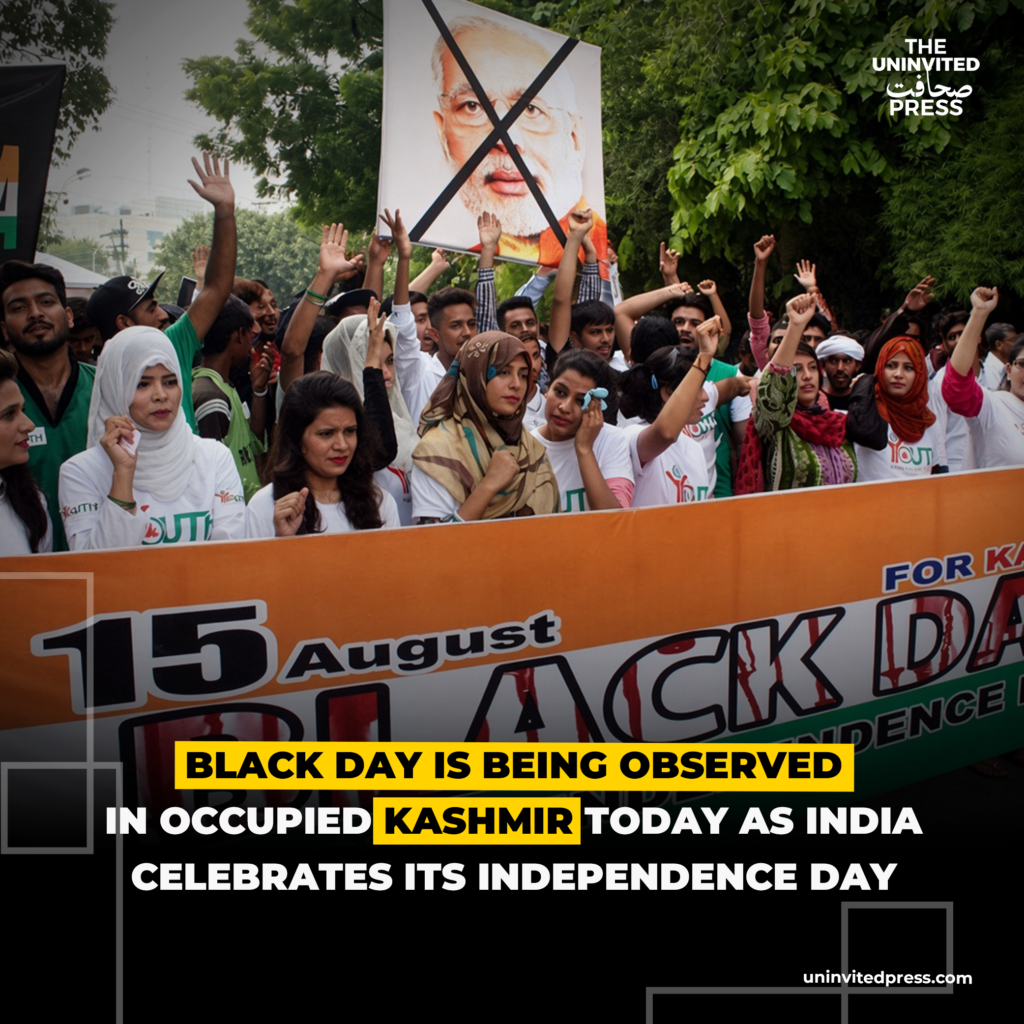
Pro-freedom groups in Indian-administered Kashmir call for peaceful protests against what they describe as occupation, while security is tightened across the region.
As India celebrated its 79th Independence Day on Saturday with flag-hoisting ceremonies, military parades and patriotic events across the country, pro-freedom leaders and parties in Indian-administered Jammu and Kashmir urged residents to observe the day as “Black Day.”
The All Parties Hurriyat Conference (APHC) and other groups issued statements from Srinagar calling on people to mark August 15 with peaceful protests, black flags and symbolic gestures of dissent. They framed the day as a reminder of what they call India’s “forcible occupation” of the disputed territory since 1947 and a rejection of New Delhi’s celebrations in a land they say remains under military control against the will of its people.
“On August 15, Kashmiris will record peaceful protest against Indian occupation and draw the international community’s attention to the human rights situation in the occupied territory and to their right to self-determination,” APHC leaders said in statements reported by Kashmir Media Service. They urged the global community to press for a resolution based on United Nations Security Council resolutions that call for a plebiscite to determine the region’s future.
The Democratic Freedom Party and other groups echoed the call, arguing that successive Indian governments have denied Kashmiris political freedom, restricted civil liberties and pursued policies aimed at altering the region’s demographic character, particularly after the 2019 revocation of Article 370, which had granted Jammu and Kashmir special autonomous status within India.
Heightened security and competing narratives:
Indian authorities maintained a heavy security presence across the region, with intensified checks, surveillance and restrictions on movement in parts of the Kashmir Valley, as is routine around national days. Official functions, including flag-hoisting and cultural programmes, proceeded under tight arrangements. In recent years, Indian officials and some local groups have organised “Tiranga” (national flag) rallies and public events to project normalcy and national integration, a shift from earlier periods when pro-Pakistan displays were more visible on August 14.
India maintains that Jammu and Kashmir is an integral part of the country. New Delhi has repeatedly described the 2019 constitutional changes as a step towards greater development, investment and equal rights for residents, while rejecting the characterisation of the region as “occupied.” Indian officials point to declining militancy, improved infrastructure and participation in elections as evidence of progress, though critics argue that restrictions on political activity, internet shutdowns and the detention of leaders continue to limit open expression.
Pakistan, which administers a portion of the former princely state and claims the rest, has long supported the Kashmiri right to self-determination and routinely highlights human rights concerns in the Indian-administered side. Pakistani media and officials amplified the Black Day calls, describing the day as a symbol of resistance.
Kashmir’s Black Day: Unresolved Dispute Continues:
The observance of August 15 as Black Day by pro-freedom groups stems from the unresolved status of the former princely state of Jammu and Kashmir after the 1947 partition of British India. The Hindu ruler, Maharaja Hari Singh, signed an instrument of accession to India amid an uprising and tribal incursions from Pakistan. Indian troops arrived on 27 October 1947-a date many Kashmiris and Pakistanis mark separately as Black Day or Invasion Day. The resulting war left the territory divided by a Line of Control that remains heavily militarised.
UN Security Council resolutions from the late 1940s and early 1950s called for a ceasefire and a plebiscite, but the vote never took place. Decades of conflict, including an armed insurgency that erupted in 1989, have claimed tens of thousands of lives. Human rights organisations have documented allegations of extrajudicial killings, enforced disappearances, torture and restrictions on freedoms on both sides of the Line of Control, though the scale and nature of abuses remain contested.
The 2019 abrogation of Article 370 and the reorganisation of the state into two union territories intensified the dispute. Pro-freedom and mainstream Kashmiri parties marked the anniversary of that decision on 5 August as another “Black Day,” demanding restoration of statehood and special status. India rejects these characterisations and says the changes have brought the region into the national mainstream.
On Saturday, diaspora groups in cities such as London, Brussels and elsewhere were expected to hold solidarity events, as they have in previous years, carrying black flags and calling for international intervention. Within the region, the atmosphere remained tense, with many residents navigating the dual pressures of official celebrations and calls for protest under heavy security.
The Black Day observance underscores the enduring political and emotional divide over Kashmir. While India marks its freedom from colonial rule, for many in the Valley the day serves as a platform to reassert claims of unfinished decolonisation and the unmet promise of self-determination. Whether the calls translate into widespread public action or remain largely symbolic depends on the level of restrictions and the willingness of residents to risk confrontation.
As ceremonies unfolded in New Delhi and other Indian cities, the competing narratives in Kashmir once again highlighted how the region’s unresolved status continues to cast a long shadow over South Asia’s most protracted territorial dispute.