

Emergency alerts sound in the Saudi capital for a third consecutive night as cross-border attacks intensify following strikes on Yemen’s Hodeidah port.
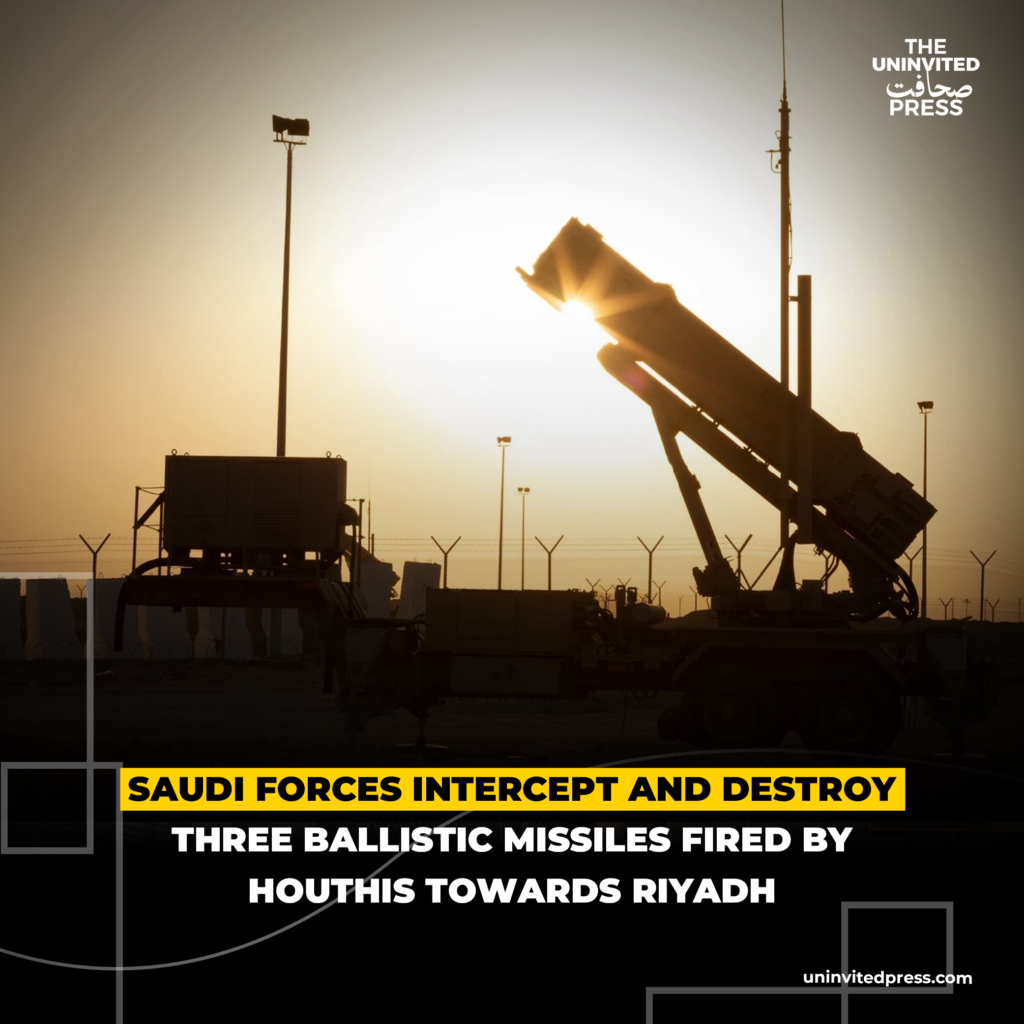
The Saudi-led coalition supporting Yemen’s internationally recognised government said on Saturday that its air defences had intercepted and destroyed three ballistic missiles fired by Yemen’s Houthi rebels towards Riyadh.
Coalition spokesman Major General Turki al-Maliki announced the interceptions early on Saturday, shortly after Saudi Arabia’s civil defence agency issued an “aerial threat” alert for the capital. Residents reported hearing explosions, and witnesses described seeing a projectile streak across the sky trailing smoke before a loud bang. Civil defence later lifted the alert, saying the danger had passed.
The attack marked the second Houthi attempt on Riyadh in a matter of days. On Thursday, a strike damaged the Public Investment Fund (PIF) tower-the headquarters of Saudi Arabia’s sovereign wealth fund and the capital’s tallest skyscraper-causing material damage to several floors and nearby buildings. No injuries were reported in that incident.
It was the third consecutive night that Saudi authorities issued and then quickly cancelled emergency alerts for Riyadh. Civil defence had sounded multiple warnings across the kingdom in the preceding 24 hours, including in areas south of the capital and near the Yemeni border. Hours after the Riyadh interceptions, the coalition said it had also destroyed a drone fired towards southern Saudi Arabia.
Tensions Rise Following Strikes on Hodeidah:
The latest exchanges followed a sharp rise in hostilities on Friday. The coalition said it had carried out a “special operation” against the Houthi-held Red Sea port of Hodeidah and targeted military sites in the Yemeni capital, Sanaa. Al-Maliki said the Hodeidah strikes hit facilities used for smuggling weapons and ballistic missiles.
Yemen’s internationally recognised government defended the action, accusing the Houthis of using the port to receive smuggled Iranian weapons and support military operations.
The Houthis responded by claiming attacks across Saudi Arabia, including towards Riyadh. They threatened Saudi Red Sea ports such as Jeddah, warned airlines that Saudi airspace was “unsafe,” and said they had targeted a power station and other sites in the south.
The United Nations said it was following the escalation “with concern,” warning that continued fighting could disrupt vital humanitarian supply routes into Yemen.
Yemen Conflict Escalates Amid Wider Regional Tensions:
The exchanges form part of a broader intensification of the war in Yemen. A fragile truce that began in 2022 largely held until fighting flared again this year. Saudi Arabia and its allies have backed Yemen’s internationally recognised government against the Iran-aligned Houthis since intervening in 2015.
The latest fighting has unfolded against the backdrop of a wider regional confrontation involving Iran. The Houthis have repeatedly framed their attacks on Saudi Arabia as responses to coalition operations inside Yemen.
Saudi officials have condemned the targeting of civilian and economic infrastructure, asserting the kingdom’s right to defend its territory and residents. The Houthis, for their part, continue to present their missile and drone campaigns as legitimate resistance against the Saudi-led intervention.