

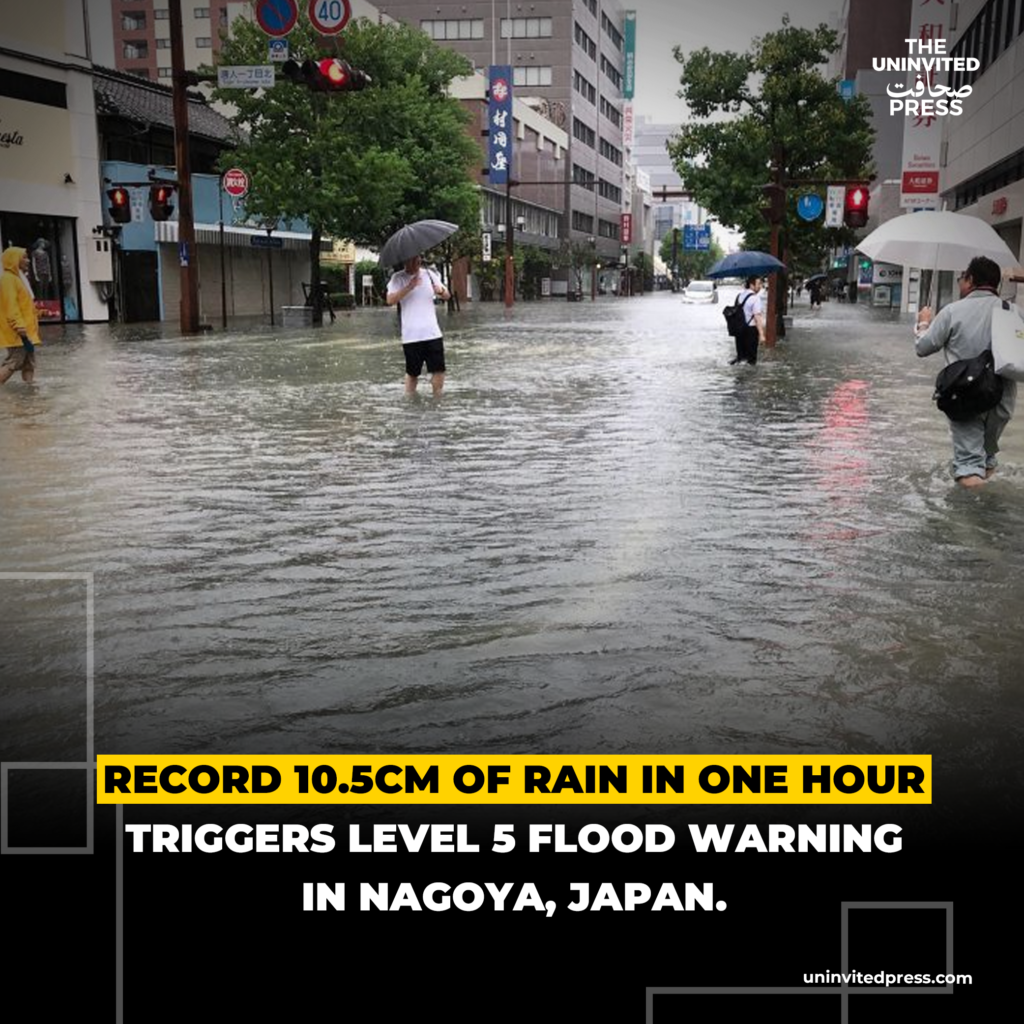
Torrential downpour exceeds historic Tokai rains of 2000, forcing mass evacuations and paralysing transport across central Japan as rivers threaten to overflow.
A record-breaking downpour dumped 10.45 centimetres (104.5mm) of rain in a single hour on Japan’s industrial hub of Nagoya on Tuesday, prompting authorities to issue the highest-level flood warning and order nearly two million people to evacuate as streets turned into rivers and public transport ground to a halt.
Nagoya Hit by Record-Breaking Floods:
The Japan Meteorological Agency recorded the extreme rainfall in Nagoya’s Chikusa Ward between 3:53pm and 4:53pm local time, surpassing the previous one-hour record of 97mm set during the devastating Tokai heavy rains of September 2000. That earlier disaster left about 70,000 homes flooded and claimed 10 lives across Aichi and Gifu prefectures. Officials said the latest deluge was driven by a linear precipitation band that formed over western Aichi Prefecture and the Mino region of Gifu Prefecture under the influence of a stalled autumn rain front.
At 6:20pm, the meteorological agency and the Ministry of Land, Infrastructure, Transport and Tourism jointly issued a Level 5 special flood warning-the most severe on Japan’s five-tier scale-for the Shonai River system that runs through Nagoya and neighbouring areas. The warning covered 14 municipalities, including Nagoya and Seto in Aichi Prefecture and Tajimi and Toki in Gifu Prefecture. Water levels on the Yada River, a tributary of the Shonai, had already reached the point at which flooding was considered likely or already occurring.
Nagoya city authorities responded by issuing Level 5 Emergency Safety Measures for districts along the Kanare, Yada and Ueda rivers, later expanding the order. By early evening, evacuation instructions covered approximately 200 million residents-roughly the city’s entire population-urging people to move immediately to higher ground or designated shelters. Around 1,500 people had sought refuge in the city’s 289 opened evacuation centres by 7pm, while Aichi Prefecture reported about 2,700 people in shelters overall. Four people were injured across the prefecture, all with minor injuries.
In the busy Sakae shopping district, water rose to knee height, forcing pedestrians to hitch up trousers and skirts to cross flooded intersections. Cars stalled in underpasses, and water poured into underground shopping arcades and railway tracks, submerging platforms at stations including Chikusa. Social media footage showed vehicles partially submerged and residents wading through brown water. “I finished shopping and stepped outside to find the road underwater. I was shocked,” a 78-year-old housewife from Showa Ward told local media. “I don’t know when the bus will come. The way it rains these days is extreme and frightening-maybe because of global climate change.”
Record Rain Disrupts Nagoya:
Transport networks collapsed under the weight of the rain. The Tokaido and Sanyo Shinkansen lines suspended services for about two hours on some sections. JR Central and Meitetsu lines halted operations on multiple routes, while Nagoya’s subway and city buses were fully suspended for a time. Thousands of commuters were stranded at major terminals during the evening rush hour. Two nationally managed underpasses in the region were closed after flooding, and local authorities advised residents to avoid driving in low-lying areas.
Meteorological officials held a joint press conference warning that further linear precipitation bands could form through Wednesday evening, keeping flood and landslide risks elevated. “It is necessary to ensure your safety by moving to higher ground that is less prone to flooding,” said Takuya Hosomi, director of the agency’s Forecast Division. River managers noted that while water levels on the Shonai system showed signs of stabilising later in the evening, they remained dangerously high.
The extreme rainfall forms part of a broader pattern of intensifying weather events across Japan in recent years, with scientists linking more frequent and intense downpours to a warming climate. For residents of Nagoya-Japan’s fourth-largest city and a major manufacturing centre-the sudden inundation revived painful memories of the 2000 floods while underscoring the growing challenge of urban resilience in the face of climate extremes.
As the rain eased overnight and some warnings were gradually downgraded, authorities continued to urge caution. Cleanup operations began in flooded districts, and transport services were expected to resume gradually on Wednesday.