

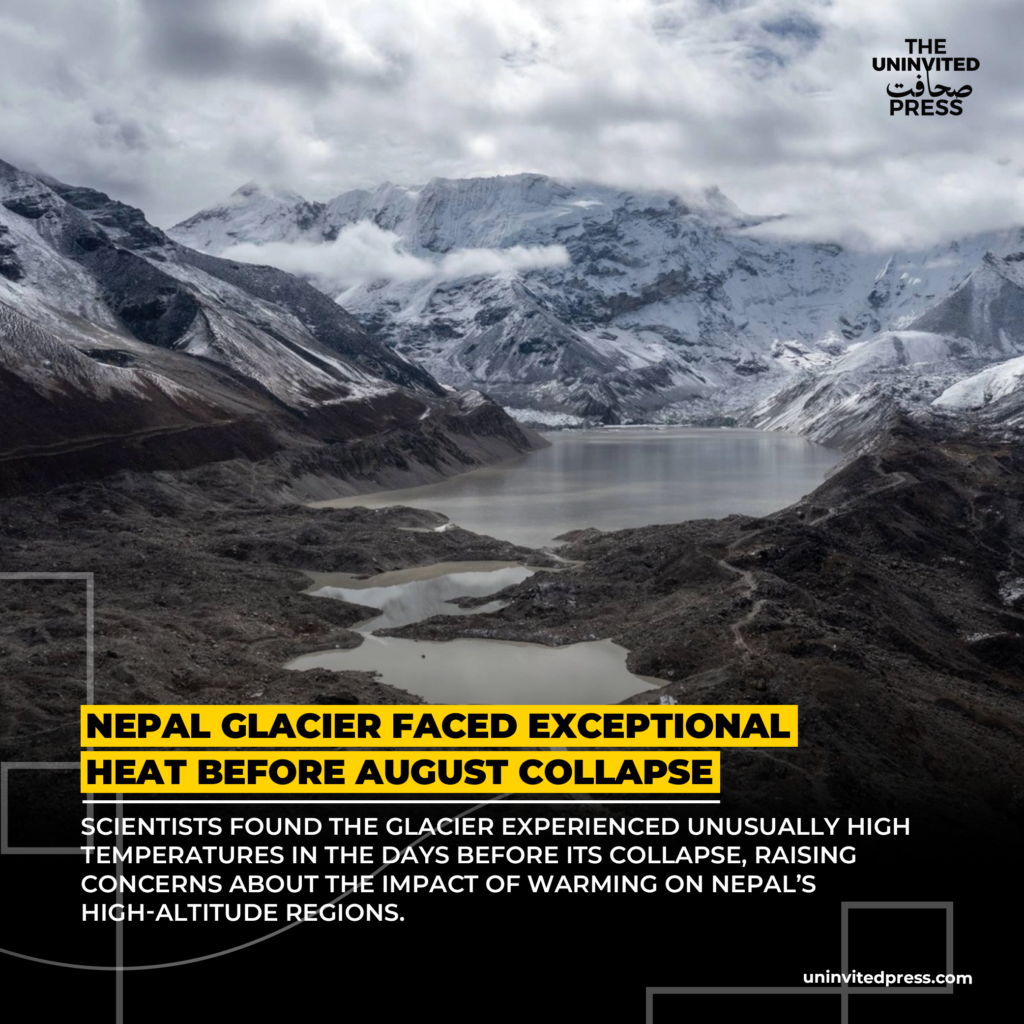
Scientists find unusually high temperatures in the days preceding the disaster that triggered deadly floods, heightening concerns over climate impacts on the Himalayas.
A Himalayan glacier in northern Nepal experienced exceptionally high temperatures in the days before its collapse on 26 August, according to new analysis by climate scientists, raising fresh alarms about the vulnerability of high-altitude regions to global warming.
Record Heat at Glacier Site:
Researchers estimated that average temperatures at the glacier site, located at about 5,200 metres (17,060 feet) on the north face of Langtang Lirung near the Nepal-China border, reached around 5 degrees Celsius between 21 and 26 August. Such warmth is highly unusual for the altitude and time of year. In more than 55 years of records, temperatures at the location during the same late-August period had never exceeded 4.0C.
The data was reconstructed by Robert Rohde, chief scientist at the independent Berkeley Earth organisation in California, using climate models and readings from high-altitude weather stations. At the collapse site, average temperatures over that six-day window have risen by approximately 1.8C since the mid-20th century. Without the additional heat attributed to human-caused climate change, Rohde calculated that a comparable temperature pattern “would probably occur only once in a few thousand years.”
The collapse of a large section of rock and ice sent a cascade of debris and water surging down the mountainside into the Lhende Khola, a tributary of the Bhote Koshi River. The resulting flash floods devastated communities on both sides of the Nepal-China border, killing hundreds of people and leaving thousands missing. The disaster also damaged infrastructure, including hydropower facilities and the main highway linking Nepal and Tibet.
Himalayan Heat Fuels Mountain Collapse:
French climatologist Valerie Masson-Delmotte, a leading expert on the cryosphere, said the extreme heat could help explain the event. “These hot conditions can also explain permafrost thaw and combined slope and glacier collapse,” she noted. Permafrost acts as a natural “ice cement” that stabilises rock faces; its degradation weakens mountain structures and increases the risk of sudden failures.
The Langtang region experienced its fourth-hottest summer on record in 2026, according to analysis of data from Europe’s Copernicus observatory dating back to 1970. Scientists have long warned that the Hindu Kush Himalaya region is warming faster than the global average, accelerating glacier retreat, permafrost thaw and the formation of unstable glacial lakes.
While researchers caution that no direct causal link between the heatwave and the specific collapse has yet been firmly established, the findings add to growing evidence that rising temperatures are destabilising high-mountain environments. The Himalayas, often called the “Third Pole” for their vast ice reserves, provide water for nearly two billion people downstream. Experts say events like the August disaster highlight the escalating risks to communities living in or below these fragile zones.
As rescue and recovery efforts continue weeks after the floods, the new temperature analysis underscores the urgent need for better monitoring of high-altitude glaciers and improved early-warning systems across the region. For Nepal and its neighbours, the combination of exceptional heat and catastrophic collapse serves as a stark reminder of how rapidly a warming climate is reshaping the world’s highest mountains.