

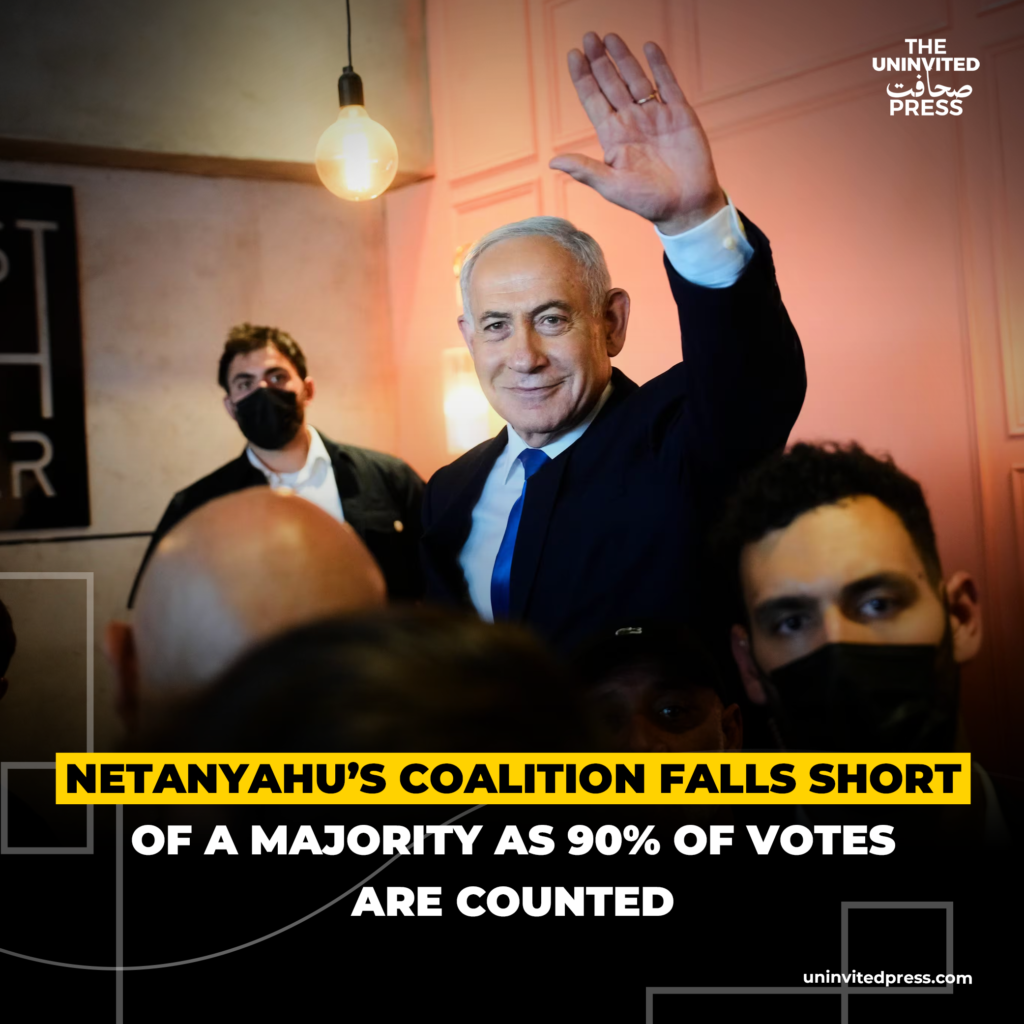
Right-wing bloc projected at 53 seats and opposition at 48, with Arab parties reaching historic high of 19 in Israel’s fragmented election.
Israeli Prime Minister Benjamin Netanyahu’s right-wing and religious coalition is projected to fall short of a parliamentary majority, according to partial results with approximately 90 percent of votes counted in Tuesday’s general election.
With nearly 90 percent of ballots tallied by the Central Elections Committee, Netanyahu’s bloc-comprising Likud, Shas, United Torah Judaism, Otzma Yehudit and Religious Zionism-was on course for 53 seats in the 120-member Knesset. The main opposition alliance led by former military chief Gadi Eisenkot’s Yashar party, along with B’Yachad, the Democrats and Yisrael Beytenu, stood at 48 seats. Arab-led parties, the Joint List and Ra’am, were projected to win a combined 19 seats-nearly double their previous representation and an all-time high.
Neither major Jewish-led bloc has reached the 61 seats required to form a government. Netanyahu’s grouping lost roughly 15 seats compared with its previous strength in the outgoing Knesset. Likud remained the largest single party with around 26 seats, followed by Yashar with about 21.
Israel Faces Coalition Deadlock After High-Turnout Election:
The results point to a protracted period of coalition negotiations. Netanyahu is expected to continue as caretaker prime minister while President Isaac Herzog decides whom to task with forming a government. Both Netanyahu and Eisenkot have said they will attempt to build a governing coalition.
Arab parties’ strong showing has positioned them as potential kingmakers. However, most Jewish parties across the spectrum have previously ruled out relying on Arab lists for a majority, complicating any path for the opposition to unseat Netanyahu. Analysts note that a minority government, a broader unity arrangement, or even a return to the polls remain possible outcomes.
Voter turnout reached approximately 77.7 percent, the highest in more than two decades. Final results are still pending the counting of several hundred thousand “double-envelope” absentee ballots from soldiers, diplomats and other voters, which could slightly alter the seat distribution.
Israel Faces Political Uncertainty After Election:
Tuesday’s vote was Israel’s first national election since the Hamas-led attacks of 7 October 2023 and the subsequent multi-front wars involving Gaza, Lebanon and Iran. Netanyahu, Israel’s longest-serving prime minister, campaigned on security and continuity, while Eisenkot’s camp emphasised change and accountability for the failures surrounding the October 2023 assault.
The projected outcome leaves Israel facing political uncertainty at a time of ongoing regional tensions. Netanyahu’s reduced bloc reflects voter dissatisfaction, yet the opposition’s inability to secure a clear alternative majority underscores the deep fragmentation of the Israeli political landscape. Coalition talks are expected to dominate the coming weeks, with implications for domestic policy, the judiciary, and Israel’s approach to the Palestinians and the wider Middle East.