

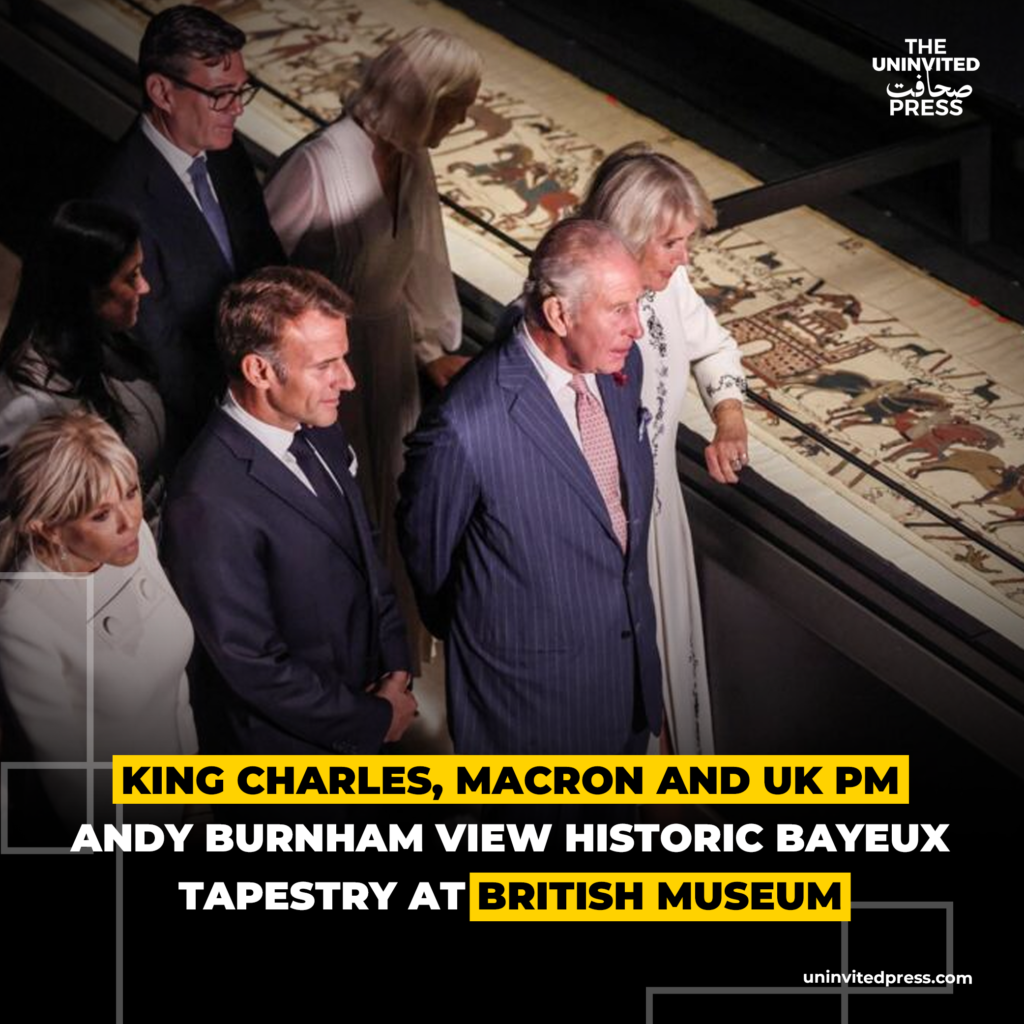
Historic 11th-century embroidery returns to Britain for first time in nearly 1,000 years as leaders stress shared history and renewed partnership.
Britain’s King Charles III, French President Emmanuel Macron and newly installed UK Prime Minister Andy Burnham stood side by side on Wednesday evening before one of Europe’s most iconic artefacts: the Bayeux Tapestry. The nearly 1,000-year-old embroidery, which vividly chronicles the Norman Conquest of England in 1066, has returned to British soil for the first time since its creation, on loan from France for a major exhibition at the British Museum.
Accompanied by Queen Camilla, Brigitte Macron and Burnham’s wife Marie-France van Heel, the leaders walked the full 70-metre (230-foot) length of the fragile linen masterpiece in a private viewing. Curators guided them through key scenes, including the coronation of Harold Godwinson and the disputed depiction of his death by an arrow at the Battle of Hastings. The atmosphere was one of measured ceremony mixed with light-hearted cross-Channel banter.
King Charles and Macron Celebrate Historic Anglo-French Ties:
King Charles, speaking partly in French, described the loan as “a precious symbol of trust at a time when trust seems sadly to be in short supply between nations.” He called the tapestry “70 metres of memory and artistry” and the “best possible symbol” of the “entente amicale” between Britain and France. Quoting Shakespeare’s The Tempest, he added: “What is past is prologue,” framing the shared history as a foundation for future cooperation.
Macron, for his part, said the two countries could forge a bond “as close as the threads of this thousand-year-old embroidery.” He noted that the idea of a loan had been discussed for years, with the first British request dating back to 1931, and joked that the eventual agreement represented “something of a speed record.”
Burnham, whose first meeting with the French president came on this occasion, called the tapestry’s return “a landmark moment in the history of our two nations.” He quipped that it offered “an elaborate, 70-metre reminder of Britain’s biggest defeat” and joked about a northern leader travelling south to claim a crown-a wry nod to his own recent political path. The prime minister also highlighted a nationwide “Bayeux Around Britain” programme that will take digital versions of the story to communities across the UK.
The tapestry, thought to have been embroidered in England shortly after the events it depicts, has resided in Bayeux, Normandy, for centuries. Its temporary home at the British Museum follows delicate diplomatic negotiations. France agreed to the loan while the tapestry’s permanent display space undergoes refurbishment. In return, the British Museum is sending significant Anglo-Saxon and Viking artefacts, including treasures from Sutton Hoo, to institutions in Normandy. The embroidery was transported under high security in July and is insured for approximately 960 million euros ($1.1 billion).
Bayeux Tapestry Exhibition Opens in London:
The exhibition opens to the public on 10 September 2026 and is scheduled to run for about 10 months, until mid-2027. Demand has already been intense, with tickets selling rapidly.
The visit carried clear diplomatic weight. Macron is the first major European leader to travel to Britain since Burnham took office in July 2026. The two are due to hold formal talks at 10 Downing Street on Thursday, with issues including migration and broader post-Brexit cooperation expected to feature. For both governments, the public display of amity around a shared cultural treasure offered a carefully staged counterpoint to past frictions.
The Bayeux Tapestry remains a remarkable historical document. Stitched in coloured wool on linen, its 58 scenes move from political intrigue and oath-taking to invasion, battle and the suffering of ordinary people. It records the last successful conquest of England and the moment when Norman rule began to reshape the language, law and aristocracy of the British Isles. Nearly a millennium later, the same object has become a vehicle for leaders to speak of continuity, trust and partnership.
As the lights dimmed in the museum’s exhibition space and the embroidered figures of Norman knights and Anglo-Saxon warriors stretched into the distance, the message from the three principals was consistent: history binds Britain and France, and the present moment requires them to weave that history into closer practical cooperation. The tapestry itself, after its long absence, will now be seen by hundreds of thousands of visitors before returning to Normandy-a temporary homecoming that both sides hope will outlast the exhibition.