

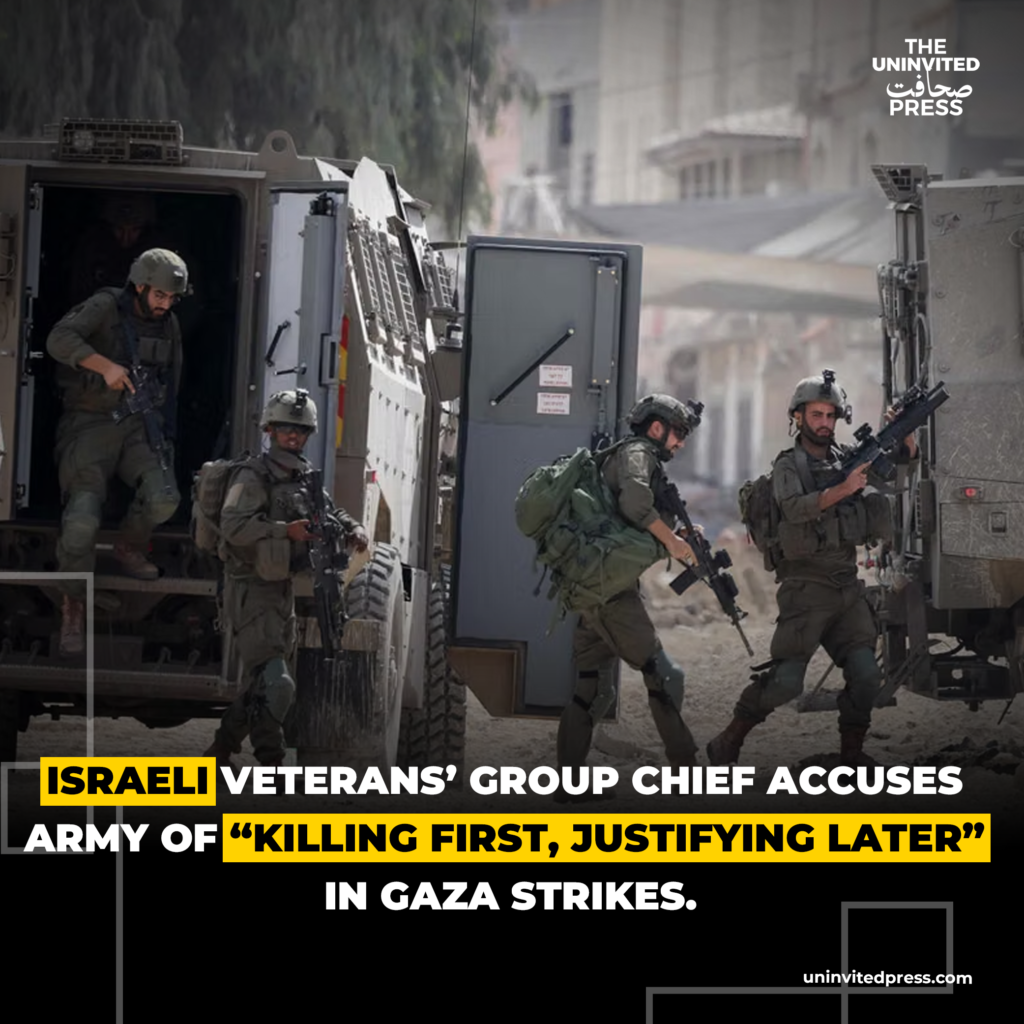
Breaking the Silence director Nadav Weiman says military uses ‘retrospective incrimination’ to link civilian deaths to Hamas after strikes.
The head of a prominent Israeli veterans’ organisation has accused the Israeli military of systematically killing first in Gaza and only afterwards constructing justifications for the deaths, describing a pattern of “retrospective incrimination” that he says is used to portray civilian casualties as legitimate targets.
Nadav Weiman, executive director of Breaking the Silence, made the remarks in an interview with media. He said Israeli forces and officials routinely seek to establish links between those killed and Hamas or Palestinian Islamic Jihad after strikes have already taken place, particularly in high-profile incidents that draw international scrutiny.
“First we shoot, we kill, and then we think and try to find a reason why it happened,” Weiman stated. He rejected the idea that detailed target identification routinely precedes attacks that result in large numbers of civilian deaths. “I don’t think that the tank that fired the tank shells at the hospital had a booklet with 25,000 Hamas members and looked photo after photo and said, ‘Ah, there are Hamas members over there,’” he added.
Israeli Veterans Allege Retroactive Justifications for Gaza Strikes:
Weiman pointed to specific cases, including the strike on Nasser Hospital and the killing of 15 paramedics in Rafah, as well as air strikes that have caused three-digit civilian death tolls. In such instances, he said, the Israeli military’s spokesperson is left needing to explain the actions to the international community and identify supposed targets after the fact.
According to Weiman and corroborating accounts collected by Breaking the Silence, intelligence personnel later gather names of the dead and search for any possible connection to armed groups-whether a family link, proximity to a building alleged to belong to Hamas, or claims that a victim once received a salary from such an organisation. These connections are then used to reframe the victims as militants.
The organisation, founded by former Israeli soldiers to document alleged abuses in the occupied Palestinian territories, has collected hundreds of testimonies from those who served in Gaza since the escalation that began in October 2023. Weiman said nearly 200 soldiers who fought in the territory have broken their silence and spoken to the group about the reality of operations on the ground.
Breaking the Silence has previously described reckless rules of engagement combined with retroactive justification as a near-automatic tool used both to legitimise lethal force and to avoid genuine investigations. A whistleblower connected to the group told media outlets that when high-casualty strikes or attacks on sensitive sites such as hospitals and schools create a public relations crisis, the military seeks to reclassify those killed as terrorists to improve the narrative for international audiences.
Israel has consistently rejected such accusations. The military maintains that it targets military objectives, operates in accordance with international law, and takes feasible precautions to minimise civilian harm. It has denied carrying out unlawful strikes and only seeking justification afterwards, insisting assessments are not made in retrospect.
Israeli Veterans Raise Concerns Over Gaza War Conduct:
The claims come against the backdrop of a war that has caused catastrophic loss of life and destruction in Gaza. Palestinian health authorities report tens of thousands of deaths, a significant proportion of them women and children, amid widespread devastation of civilian infrastructure. Israel launched its campaign following the 7 October 2023 Hamas-led attacks that killed about 1,200 people in Israel and took more than 250 hostages.
Critics, including human rights organisations and some Israeli veterans, argue that the scale of civilian casualties, the use of heavy munitions in densely populated areas, and the classification of many of those killed as militants raise serious questions under international humanitarian law. Supporters of the military campaign maintain that Hamas’s embedding of fighters and infrastructure among civilians makes distinction extremely difficult and that the group bears primary responsibility for the civilian toll.
Weiman’s comments add to a body of testimony from Israeli soldiers and officers that has emerged over the course of the conflict, describing environments in which rules of engagement were loose, commanders exercised wide discretion, and the distinction between combatants and civilians often collapsed on the ground. Breaking the Silence has long argued that such practices reflect systemic issues rather than isolated failures.
As international pressure continues over the conduct of the war and the humanitarian crisis in Gaza, the veterans’ group’s latest intervention underscores the internal dissent that exists within Israeli society over the methods employed by the army. Whether these accusations prompt meaningful investigation or policy change remains unclear, given the military’s firm rejection of the claims and the continued prioritisation of operational security by Israeli authorities.