

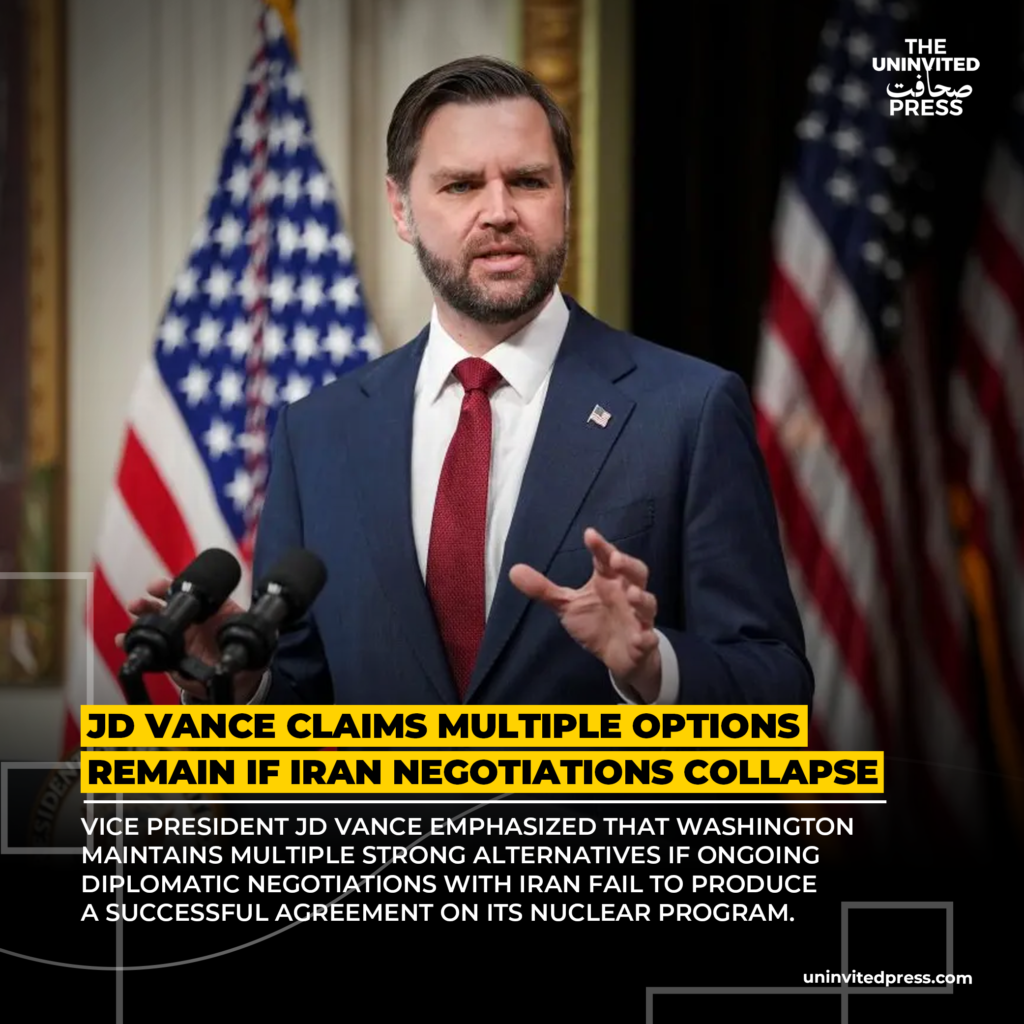
Vice President signals Washington’s readiness with alternatives as diplomatic efforts with Tehran face uncertainty.
US Vice President JD Vance has stated that Washington maintains several robust alternatives should ongoing negotiations with Iran over its nuclear programme fail to yield a successful agreement.
In pointed remarks, Vance emphasised the United States’ strong negotiating position, underscoring that diplomacy is not the only path forward in dealing with Tehran’s nuclear ambitions.
“Multiple options remain”
Vance’s comments come at a critical juncture in US-Iran relations, as indirect or direct talks-mediated through various channels-attempt to address concerns over Iran’s uranium enrichment levels, ballistic missile programme, and regional proxy activities.
While stopping short of detailing every contingency, Vance’s statement is widely interpreted as keeping maximum pressure on Iran while leaving diplomatic doors open. Analysts suggest the Vice President’s remarks serve both to reassure domestic hawks and send a clear signal to Tehran that the US is not solely reliant on negotiations.
Vance outlined alternative options:
According to context from the administration’s position, the “multiple strong options” likely include:
- Enhanced sanctions: Further tightening economic restrictions targeting Iran’s oil exports, financial networks, and Revolutionary Guard-linked entities.
- Military posturing: Increased naval presence in the Gulf, expanded joint military exercises with Israel and Gulf allies, and potential pre-positioning of assets.
- Support for regional partners: Deepening security cooperation with Israel, Saudi Arabia, and other Gulf states, including advanced weapons systems and intelligence sharing.
- Covert operations and cyber measures: Continued use of intelligence and cyber capabilities to disrupt Iran’s nuclear infrastructure (widely believed to have been employed in the past).
- Diplomatic isolation: Rallying broader international coalitions, including European partners and possibly China/Russia influence, to increase pressure on Tehran.
- Maximum pressure campaign revival: Reimposing and expanding the “maximum pressure” strategy used in previous administrations if talks collapse entirely.
Vance stressed that these alternatives are not preferred but remain readily available, aiming to prevent Iran from achieving nuclear breakout capability.
US Weighs Next Steps on Iran:
The remarks reflect the Trump administration’s (or current US leadership’s) dual-track approach: pursuing diplomacy where possible while maintaining credible threats of escalation. Iran has consistently denied seeking nuclear weapons, insisting its programme is for peaceful purposes, while accusing the US and Israel of sabotage and aggression.
The situation remains fluid, with regional dynamics-including the Israel-Iran shadow war and tensions in the Gulf-adding layers of complexity to any potential deal or breakdown.
As negotiations continue, all eyes will be on whether diplomatic efforts can bridge the significant gaps or if Vance’s “multiple options” will be put to the test.