

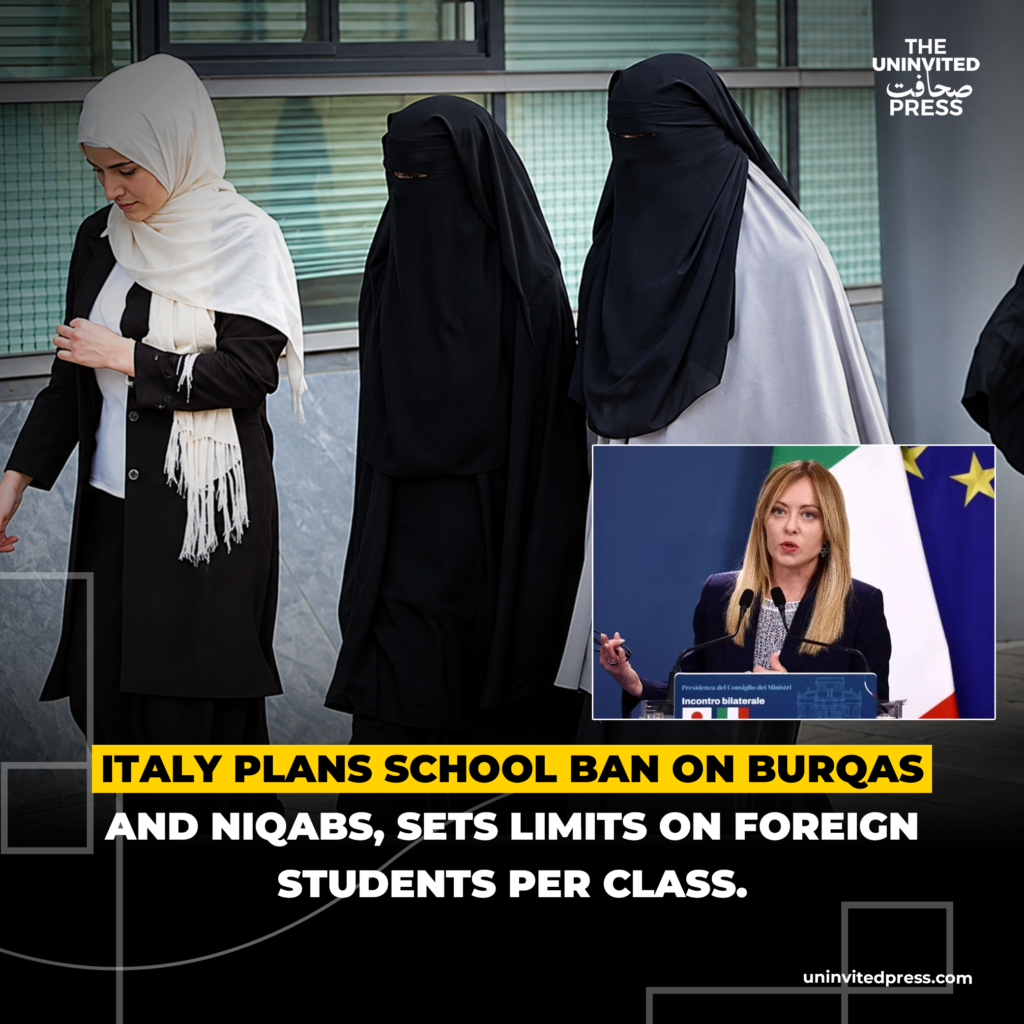
Prime Minister Giorgia Meloni announces planned measures requiring some migrant parents to learn Italian, framing the steps as essential for integration and gender equality.
Italian Prime Minister Giorgia Meloni has announced that her government will soon introduce legislation to ban face-covering garments such as the burqa and niqab in schools, set a legal maximum on the number of foreign students allowed in each classroom, and require parents of foreign pupils facing serious integration difficulties to learn Italian.
Speaking on Sunday at the Fenix youth festival organised by the youth wing of her Brothers of Italy party in Rome, Meloni said a measure would be presented to a Cabinet meeting to enshrine these rules in law.
“A measure will soon be presented to a Cabinet meeting to legally establish a maximum number of foreign students per class. It also requires parents of foreign students facing serious difficulties integrating into the school system to learn Italian and bans burqas and niqabs in schools,” she said.
Meloni Defends School Integration and Face-Covering Ban:
Meloni argued that large concentrations of pupils who do not speak Italian hinder genuine integration. “If there is only one child in a class who doesn’t understand Italian, that child will likely be able to learn the language and integrate quickly with the help of classmates and teachers. However, if the number of children who don’t understand the language becomes large-or even the majority-that is no longer integration; it is neglect,” she added.
On the face-covering ban, she insisted: “You must go to school with your face uncovered, and in Italy no one, in the name of a real or supposed tradition, can decide that a young woman must hide herself. Equality between men and women is non-negotiable. It is non-negotiable on our streets, and it is non-negotiable in our schools.”
Meloni did not specify the precise numerical cap on foreign students. An existing 2010 ministerial circular already recommends that non-Italian pupils should not normally exceed 30 percent of a class, particularly those with limited Italian language skills. Critics and school administrators have long noted that the guideline has been difficult to enforce, especially in neighbourhoods with high migrant populations where local enrolment patterns make redistribution challenging. Education Minister Giuseppe Valditara had previously signalled plans to strengthen enforcement of the 30 percent threshold.
Students who are not Italian citizens make up about 11.6 percent of those enrolled in Italian schools-roughly 12 in every 100 pupils-according to the Fondazione ISMU research institution. The proportion is higher in primary schools and in northern regions such as Lombardy.
Italy Tightens Immigration and School Integration Rules:
The announcement comes amid ongoing debates in Italy and across Europe over immigration, cultural integration, citizenship rules and the visibility of religious symbols. Meloni’s right-wing government has made migration control a central theme. Italy, due to its Mediterranean location, has long been a primary arrival point for migrants and asylum seekers crossing from North Africa.
Similar restrictions on full-face coverings already exist in several European countries, including France, Belgium and Austria, often justified on grounds of public security, secularism or gender equality. Italy currently has more limited rules, with earlier court interpretations allowing full-face coverings for religious reasons provided identity can be verified when required.
School directors and opposition figures have questioned the practicality of a strict cap. Some note that schools are required to accept local children and that forcing redistribution could disrupt communities or prove logistically unworkable in areas where foreign-born or foreign-citizen pupils form a majority. Human rights and migrant advocacy groups have previously criticised such measures as potentially discriminatory or as stigmatising Muslim communities, though formal reactions to Meloni’s latest announcement were still emerging.
Once approved by the Cabinet, the package would require parliamentary approval to become law. The proposals form part of a broader political push by Meloni’s administration on identity, education and immigration issues ahead of future electoral contests.