

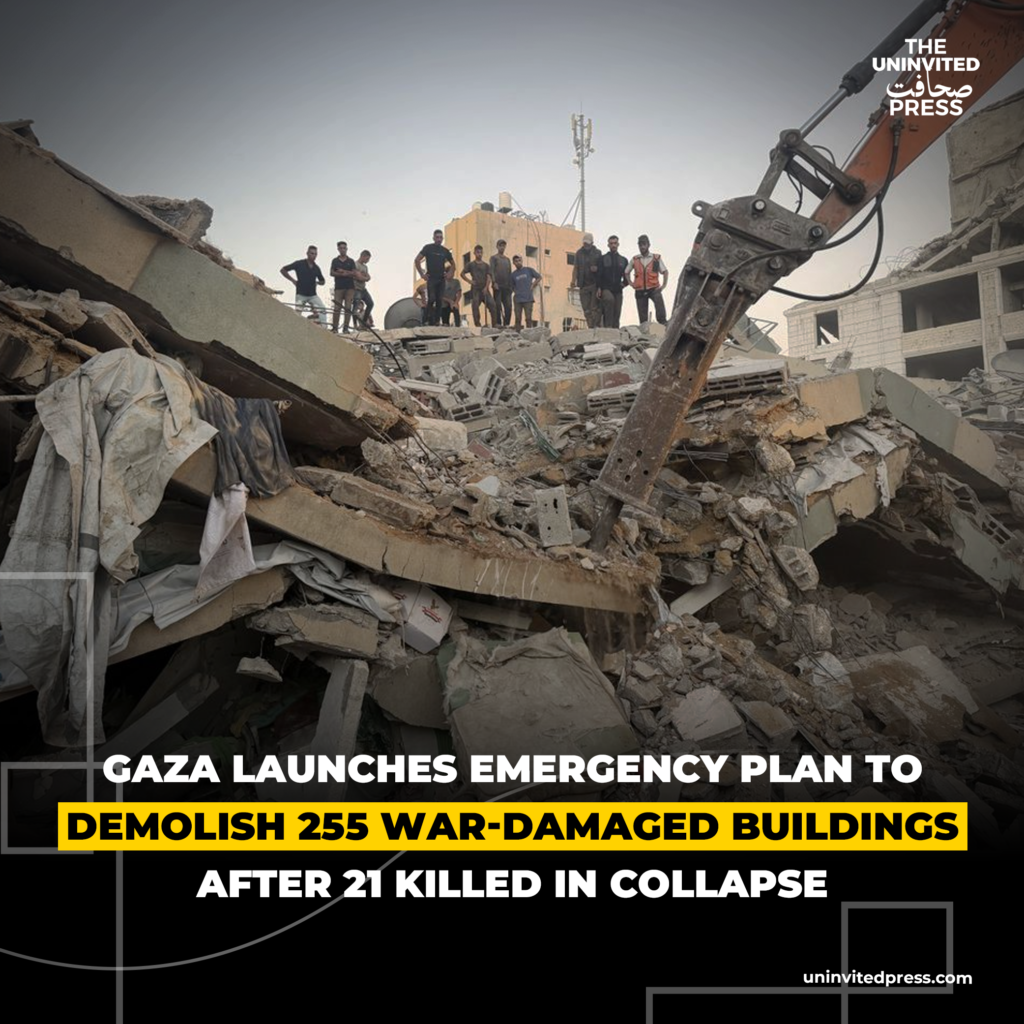
Authorities prioritise evacuation of structures at imminent risk following deadly incident in Gaza City, as thousands remain trapped in unsafe housing nearly a year into fragile ceasefire.
Gaza authorities have announced an urgent emergency plan to evacuate and demolish 255 buildings severely damaged during the war that are deemed at imminent risk of collapse, days after a residential structure gave way and killed 21 Palestinians.
Gaza Plans Urgent Action Over War-Damaged Buildings:
The Government Media Office said the plan, led by the Ministry of Public Works and Housing in coordination with local institutions and United Nations bodies, follows a series of structural failures across the enclave. It comes in direct response to the collapse on Wednesday of the six-storey Al-Saada building in the Tal al-Hawa area of Gaza City, which claimed 21 lives, including several children, and left dozens injured.
Palestinian Civil Defence teams recovered the bodies and rescued 45 people from the rubble of the building, which had been housing more than 100 displaced residents. Officials said the structure had been weakened by earlier Israeli strikes and had been visibly unstable for some time. Rescue efforts were hampered by a severe shortage of heavy machinery and equipment.
“We don’t have the needed equipment. Despite that, rescue teams did a heroic job,” said Mahmoud Basal, spokesperson for the Palestinian Civil Defence Service.
According to Gaza’s Health Ministry, at least 61 Palestinians have died in collapses of war-damaged buildings since the ceasefire took effect. The Public Works and Housing Ministry has classified approximately 3,000 structures as dangerous or at risk of collapse, while Civil Defence estimates put the number of buildings posing a direct threat at around 2,000. UN assessments have previously identified hundreds of structures at immediate risk.
Gaza Identifies 255 Buildings at Immediate Risk of Collapse:
The emergency plan involves immediate field measures, including placing warning signs around hazardous buildings, identifying families still living inside them, and prioritising demolition of the most critically unstable ones. Authorities stressed that the effort faces major obstacles: funding shortages, a lack of heavy machinery caused by Israeli restrictions on dual-use items, and insufficient land or alternative shelter for displaced families.
Widespread destruction has left the vast majority of Gaza’s more than two million residents with few options. An estimated 80 percent or more of structures across the Strip were damaged or destroyed during the war that began in October 2023. Reconstruction has barely begun nearly a year after the ceasefire, with Israel maintaining tight controls on the entry of construction materials and prefabricated housing units. Many families continue to live in cracked, partially collapsed buildings or overcrowded tents because safer alternatives are unavailable.
UN officials and local authorities have repeatedly warned that the coming winter rains could accelerate further collapses, turning already fragile structures into even greater dangers. Residents have often refused to leave damaged buildings without guarantees of alternative accommodation, citing the inadequacy of tent camps.
The latest plan underscores the depth of the housing crisis that persists long after major fighting ended. While the 255 buildings targeted for immediate action represent the most urgent cases, officials acknowledge that thousands more remain compromised, leaving large numbers of civilians exposed to ongoing risk in the absence of meaningful reconstruction and unrestricted access for essential equipment and materials.