

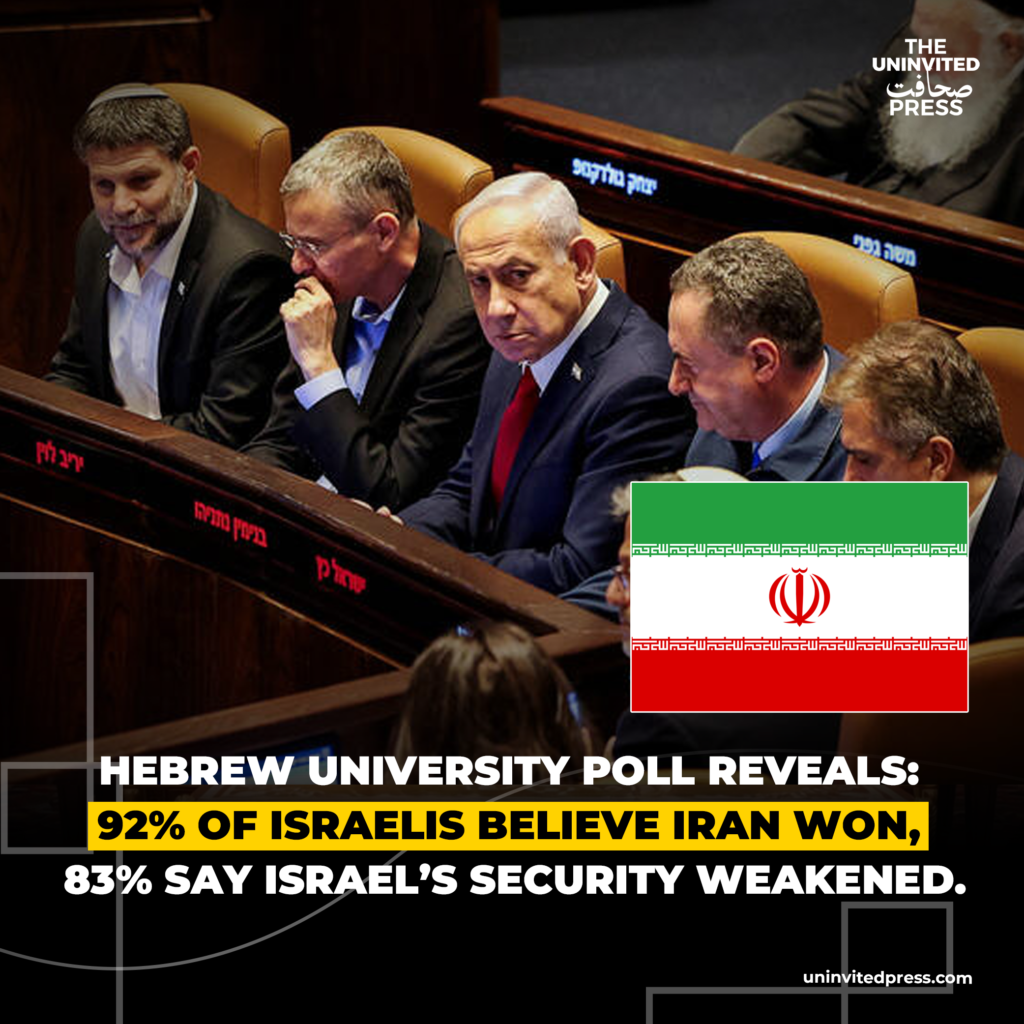
Hebrew University survey reveals deep disillusionment over US-brokered deal and perceived weakening of Israel’s security position.
A new poll conducted by the Hebrew University of Jerusalem has exposed widespread pessimism among Israelis following the recent military confrontation with Iran and the subsequent diplomatic agreement between Tehran and Washington.
According to the survey, published on Sunday, 92.1 percent of respondents believe Iran emerged as the victor from the six-week campaign and the US-mediated deal, while 82.9 percent say the conflict has weakened Israel’s long-term security. Additionally, 86 percent expressed a negative view of the overall outcome.
The poll, carried out between June 17 and 20 in collaboration with the Agam Institute, surveyed 3,644 respondents and reflects a significant crisis of confidence in Prime Minister Benjamin Netanyahu’s government’s handling of the Iran file.
Setback for Israeli strategy:
The findings come after Israel, with apparent US backing, launched strikes aimed at crippling Iran’s nuclear programme and ballistic missile capabilities. Israeli officials had framed the campaign as a decisive blow against Tehran’s regional influence and a step toward regime destabilisation.
Instead, the US-Iran agreement-which includes elements of a ceasefire involving Israel and Hezbollah in Lebanon-has been widely perceived within Israel as a diplomatic victory for Iran, allowing it to preserve core elements of its nuclear infrastructure and military posture while avoiding deeper concessions.
Analysts note that the poll underscores a growing domestic backlash against Netanyahu, who faces accusations of overpromising on security gains while alienating key international partners and failing to achieve stated strategic objectives.
Israel Poll Highlights Iran Deal Divide:
The survey highlights a stark divergence in perceptions between Israeli public opinion and the narrative pushed by parts of the Israeli and US leadership. While some Western officials have hailed the deal as a de-escalatory measure, many in Israel see it as a dangerous precedent that strengthens Iran’s “axis of resistance”-including Hezbollah, Hamas, and the Houthis-at a time when Israel continues its military operations in Gaza and faces ongoing tensions on multiple fronts.
The poll also suggests that a majority of Israelis (56 percent, according to related reporting) believe the outcome creates conditions that could facilitate an end to the war in Gaza, though this comes amid deep scepticism about long-term security gains.
New Poll Highlights Leadership Crisis in Israel:
Opposition figures and security experts within Israel have seized on the results to intensify calls for accountability. The data indicates that public trust in the government’s Iran strategy has eroded significantly, potentially complicating efforts to sustain military pressure or negotiate from a position of strength.
For Palestinians and other regional actors, the poll may be seen as validation of Iran’s resilience in the face of Israeli-US military pressure, further complicating the already volatile dynamics across the Middle East.
As negotiations between Iran and the US continue in Switzerland, the Hebrew University findings paint a picture of an Israeli society grappling with the gap between official rhetoric and perceived strategic reality. Whether this disillusionment translates into political shifts inside Israel remains to be seen, but it signals a challenging period ahead for Netanyahu’s coalition.