

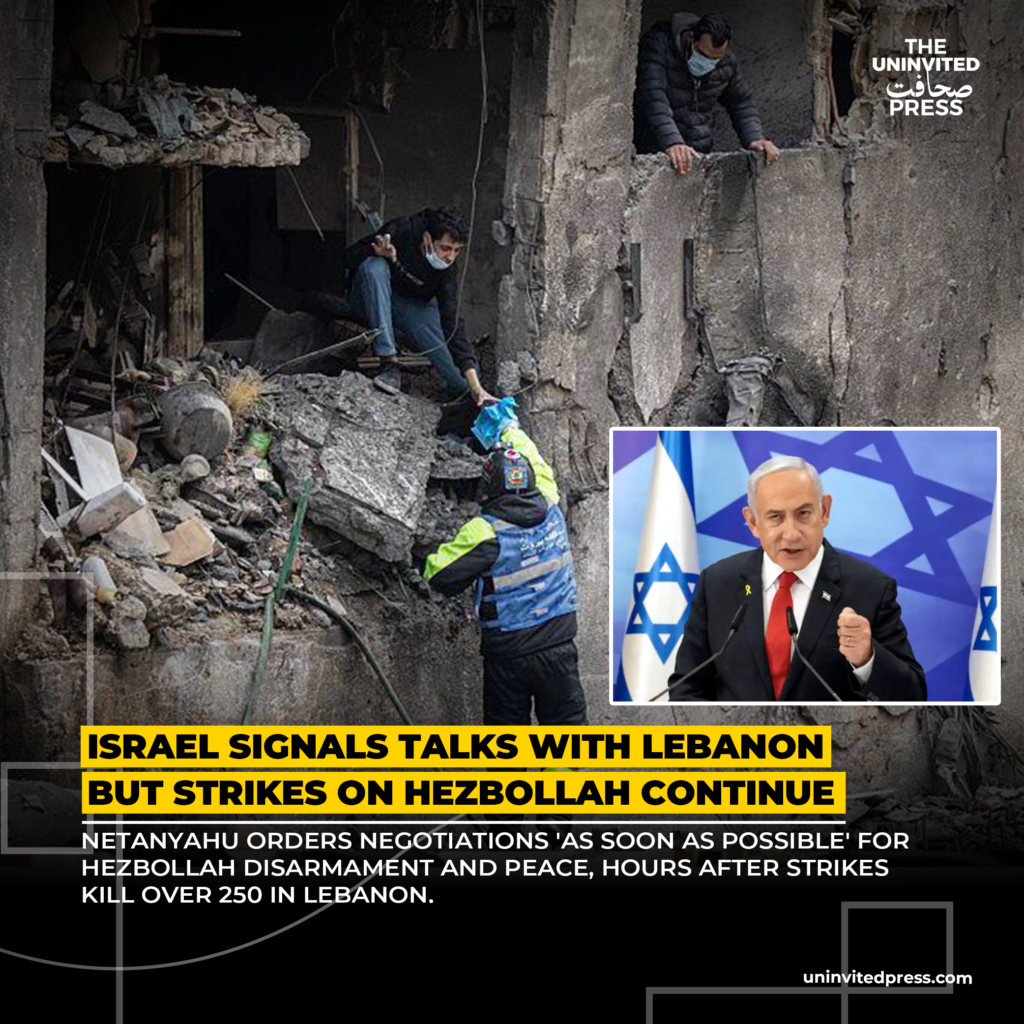
Netanyahu orders direct negotiations on disarmament and peace hours after deadly bombardment kills over 250 in Lebanon.
Israeli Prime Minister Benjamin Netanyahu has instructed his government to begin direct negotiations with Lebanon “as soon as possible,” focusing on the disarmament of Hezbollah and the establishment of peaceful relations between the two countries. The announcement came on Thursday, just hours after Israeli forces launched one of the heaviest waves of airstrikes on Lebanon in the ongoing conflict, killing at least 250 people and wounding more than 1,100 others.
The strikes, described by Lebanese officials as the deadliest single day in the recent escalation, targeted areas across Beirut, southern Lebanon, and the Bekaa Valley. Civil defence and health ministry figures reported significant casualties in residential and commercial districts, with plumes of smoke rising over the capital. Israel described the operation as a precise campaign against Hezbollah military sites and command centres.
Despite the diplomatic overture, Netanyahu made clear there would be no ceasefire in Lebanon. “We are continuing to strike Hezbollah with force, precision, and determination,” he stated, adding that operations would persist “wherever necessary” until Israeli security is restored. Israeli officials insisted the fragile US-Iran ceasefire does not extend to the Lebanese front.
Israel-Lebanon Talks Amid Rising Tensions:
The move towards talks follows repeated calls from Lebanese officials for dialogue, but comes against a backdrop of deep scepticism. A Lebanese government source indicated Beirut would require a truce before engaging in substantive negotiations. Hezbollah lawmakers have rejected direct talks between Lebanon and Israel, while Iran has condemned the strikes as a violation that could undermine broader ceasefire efforts.
The timing is particularly sensitive. The US and Iran recently agreed to a two-week ceasefire, with Washington and Israel maintaining that Lebanon and Hezbollah were excluded from the deal. European leaders and the UN have warned that continued Israeli operations risk unravelling the fragile pause, especially as Hezbollah has responded with rocket fire into northern Israel.
Netanyahu’s office said the proposed negotiations would address two main goals: disarming Hezbollah-a long-standing Israeli demand-and laying the groundwork for normalised relations. US officials have indicated that the State Department may host initial discussions next week.
Severe damage across the area:
Rescue teams continued searching through rubble in Beirut and other affected areas on Thursday. Images from the scene showed rescue workers in high-visibility vests pulling survivors and bodies from collapsed buildings, while displaced families surveyed the damage to homes and infrastructure.
Lebanese health authorities reported that the overall death toll from the conflict since its intensification has surpassed 1,700, including many civilians. Humanitarian groups have raised concerns over the scale of destruction and the displacement of hundreds of thousands.
Israel has justified the strikes as necessary to degrade Hezbollah’s capabilities and prevent attacks on its northern border. The group, backed by Iran, has been engaged in cross-border exchanges with Israel for weeks, with both sides accusing the other of escalation.