

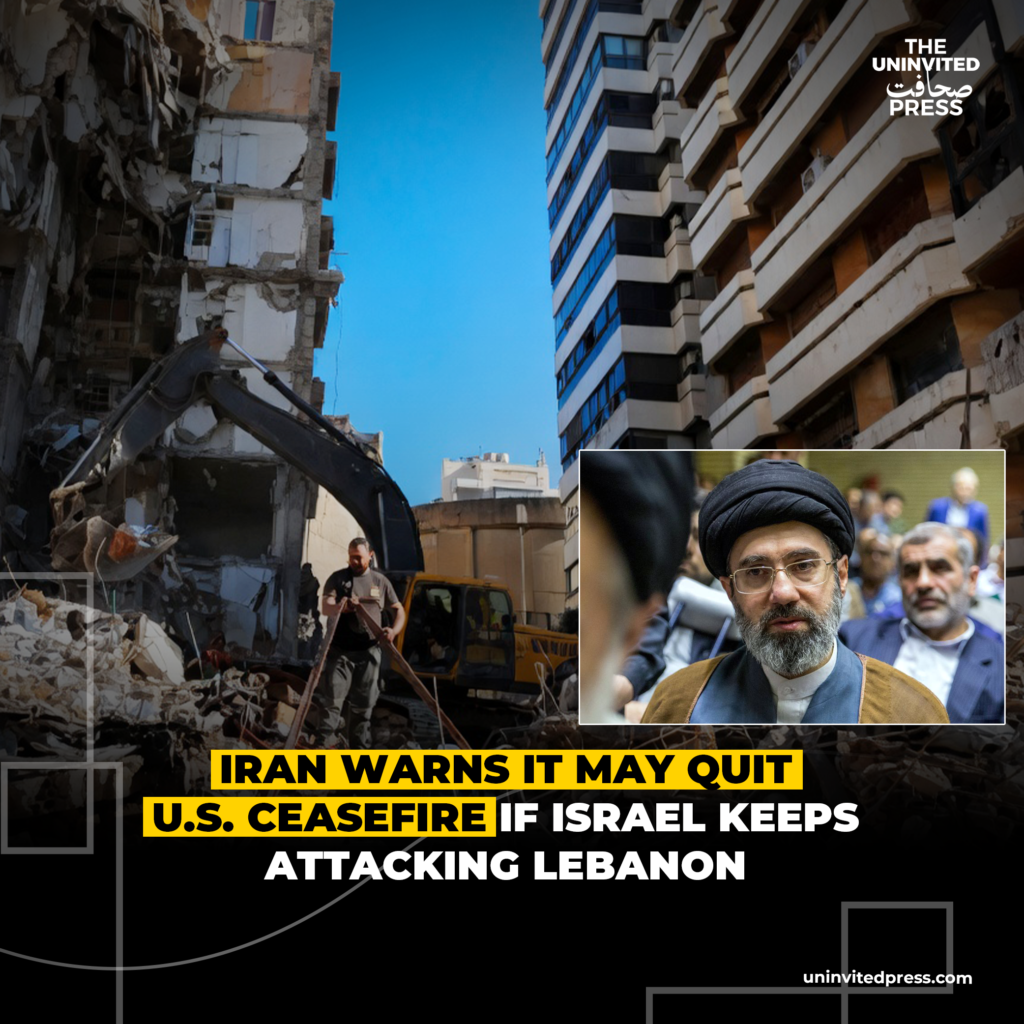
Tehran accuses Washington of failing to honour key conditions of the fragile two-week truce, as massive Israeli strikes kill hundreds in Beirut and raise fears of wider regional collapse.
Iran has issued a stark warning that it could withdraw from its newly agreed two-week ceasefire with the United States if Israeli attacks on Lebanon persist, describing the strikes as a “grave violation” of the deal.
A senior security source told Iran’s Tasnim news agency on Wednesday that Tehran is assessing the possibility of exiting the agreement should the “Zionist regime” continue its breaches through operations against Hezbollah in Lebanon.
The warning came hours after Israel launched one of its largest waves of airstrikes on Lebanon, killing at least 182 to over 250 people and wounding hundreds more in densely populated areas of Beirut and southern regions. Lebanese officials and rescue teams described scenes of widespread destruction, with rescue operations continuing amid rubble in residential neighbourhoods.
Iranian President Masoud Pezeshkian and Foreign Minister Abbas Araghchi have insisted that a halt to Israeli aggression in Lebanon was one of the key conditions in Tehran’s 10-point proposal that formed the basis of the ceasefire. Araghchi stated that the US “must choose between ceasefire or continued war via Israel,” adding that Washington cannot have both.
Ceasefire Dispute Deepens as Iran, US and Israel Clash Over Scope:
The US and Israel maintain that the ceasefire, announced late Tuesday, applies only to direct hostilities between Iran and the US/Israel and does not cover Israel’s separate campaign against Hezbollah in Lebanon. Israeli Prime Minister Benjamin Netanyahu described the fighting in Lebanon as “a separate skirmish,” while US officials, including President Donald Trump, echoed that position.
Iran, backed by Pakistani mediators who helped broker the deal, argues that the truce should encompass broader regional de-escalation, including Lebanon. Tehran has accused the US of violating multiple clauses, including through alleged drone incursions and refusal to accept limited Iranian uranium enrichment in any final agreement.
In response to the Lebanese strikes, Iran temporarily closed the Strait of Hormuz again, disrupting tanker traffic and sending fresh shockwaves through global energy markets. Iranian officials later signalled a partial reopening but warned of further measures if attacks continue.
Israeli Strikes Threaten Fragile Ceasefire and Regional Stability:
The latest Israeli bombardment-which Israel said targeted Hezbollah infrastructure-has intensified the suffering in Lebanon, already reeling from months of conflict, displacement and economic crisis. Hospitals in Beirut appealed for urgent medical supplies as casualty figures mounted rapidly.
UN Secretary-General António Guterres warned that ongoing strikes pose a “grave risk” to the fragile US-Iran truce, while human rights officials condemned the scale of civilian harm. Lebanese Prime Minister Nawaf Salam called for immediate international intervention to include Lebanon in any regional ceasefire framework.
Analysts say the dispute over the ceasefire’s scope highlights deep divisions that could derail planned talks in Islamabad, where US Vice President JD Vance is expected to lead negotiations with Iranian counterparts as early as Friday.
The two-week truce was intended as a cooling-off period to prevent further escalation following weeks of intense exchanges that disrupted global oil flows and raised fears of a broader war. However, with Israel pressing ahead in Lebanon and Iran threatening to walk away, diplomats fear the agreement could unravel within days.