

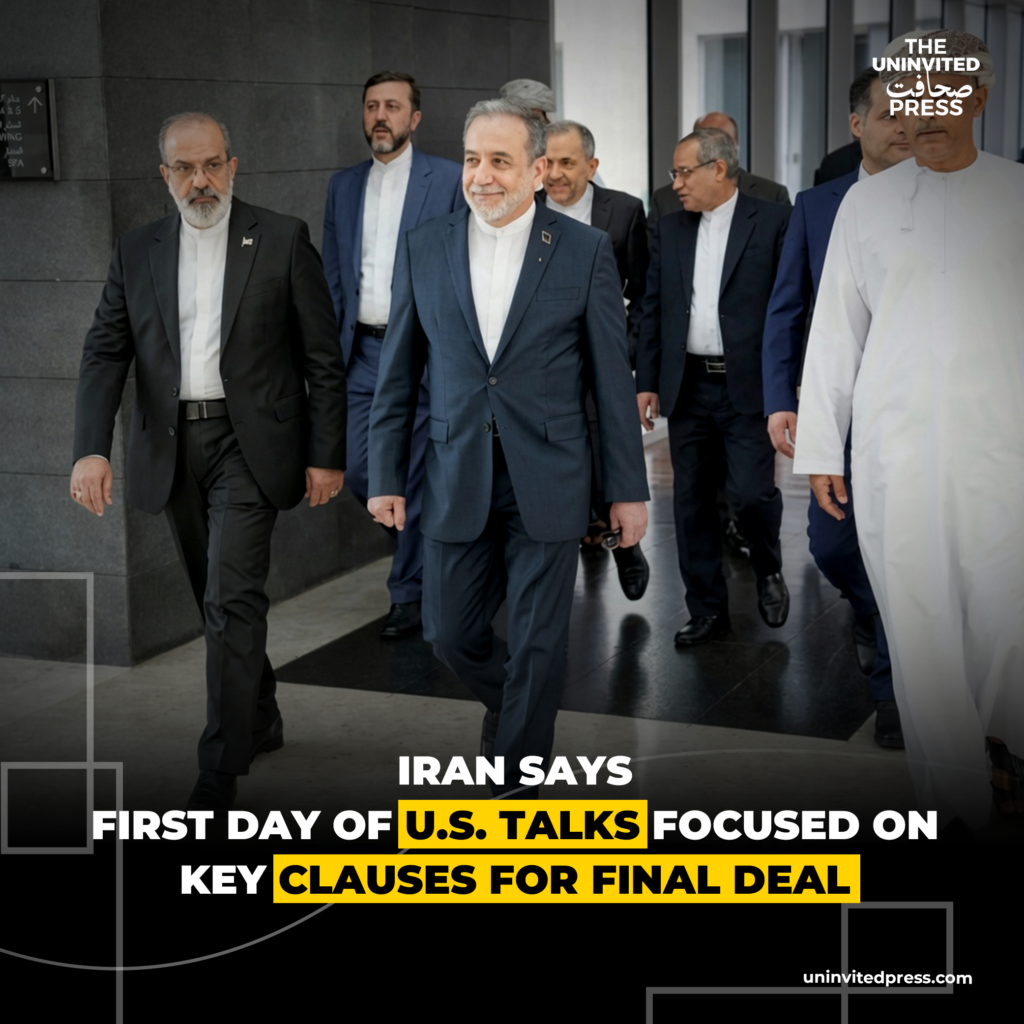
Tehran reports ‘good progress’ on implementation of interim agreement as technical negotiations continue in Switzerland amid fragile truce.
Iranian officials have said the first day of technical talks with the United States in Switzerland centred on critical clauses of their recent memorandum of understanding, paving the way for a potential final agreement.
Foreign ministry spokesperson Esmail Baghaei stated that discussions covered remaining provisions of the interim deal, oil sales, sanctions relief, and the reopening of the Strait of Hormuz. He described the initial session as productive, with “good progress” made.
Frozen Assets, Oil Sanctions Dominate US-Iran Talks:
The talks follow the signing of a 14-point memorandum of understanding aimed at ending hostilities, including in Lebanon, and reopening the vital oil waterway. Iranian negotiators emphasised the need for full implementation of key articles-particularly those related to territorial integrity, lifting of the US naval blockade, and sanctions waivers-before advancing to broader final-deal negotiations.
A member of Iran’s negotiating team told state media that the first day addressed frozen assets, oil sanctions relief, and other priority issues Tehran had conditioned the talks upon.
14 points of MOU:
- Immediate ceasefire: Permanent end to military operations on all fronts (including Lebanon). No new wars, threats, or use of force. Ensures Lebanon’s territorial integrity.
- Sovereignty and non-interference: Both sides respect each other’s sovereignty and territorial integrity; no interference in internal affairs.
- 60-day timeline: Commit to negotiating a final comprehensive deal within a maximum of 60 days (extendable by mutual consent).
- End US naval blockade: US begins lifting the naval blockade immediately; full removal within 30 days. Proportional restoration of maritime traffic.
- Reopen Strait of Hormuz: Iran ensures safe, no-charge passage for commercial vessels for 60 days. Demining and obstacle removal within 30 days. Future administration to be discussed with Oman and Gulf states per international law.
- Reconstruction fund: US and regional partners commit to a plan of at least $300 billion for Iran’s reconstruction and economic development. Mechanism to be finalized in the final deal.
- Sanctions relief: US to terminate all sanctions (UN, IAEA, unilateral primary/secondary) on an agreed schedule as part of the final deal.
- Nuclear commitments: Iran reaffirms it will not procure or develop nuclear weapons. Agreement on down-blending stockpiled enriched uranium under IAEA supervision. Further discussions on enrichment and nuclear needs in the final deal.
- Maintain status quo: Pending final deal: Iran maintains current nuclear program status; US imposes no new sanctions or additional forces in the region.
- Oil export waivers: Immediate US Treasury waivers for Iranian crude oil, petroleum products, and related services (banking, insurance, transport, etc.).
- Unfreeze assets: Make frozen/restricted Iranian funds and assets fully available. Procedures for release and use (via Central Bank of Iran) to be mutually agreed.
- Monitoring mechanism: Establish an executive body to monitor implementation of the MOU and future compliance.
- Start final negotiations: After initial implementation of key points (1, 4, 5, 10, 11), exclusive negotiations on remaining issues begin.
- UN endorsement: The final deal will be endorsed by a binding United Nations Security Council resolution.
Switzerland Talks Move Forward Despite Major Gaps:
The negotiations, hosted in Switzerland with mediation support from Qatar and Pakistan, come after a brief standoff triggered by recent statements from US President Donald Trump. Both sides have formed specialised technical working groups to address the remaining elements within a 60-day framework, which can be extended by mutual consent.
US Vice President JD Vance has been involved in the high-level discussions, with officials on both sides expressing cautious optimism while stressing that significant challenges remain, particularly regarding Iran’s nuclear programme and long-term sanctions.
The interim agreement has already allowed Iran to resume oil exports more freely and access some frozen assets, offering economic relief. However, analysts warn that translating the memorandum into a lasting deal will require compromises on enrichment limits, regional proxies, and verification mechanisms.