

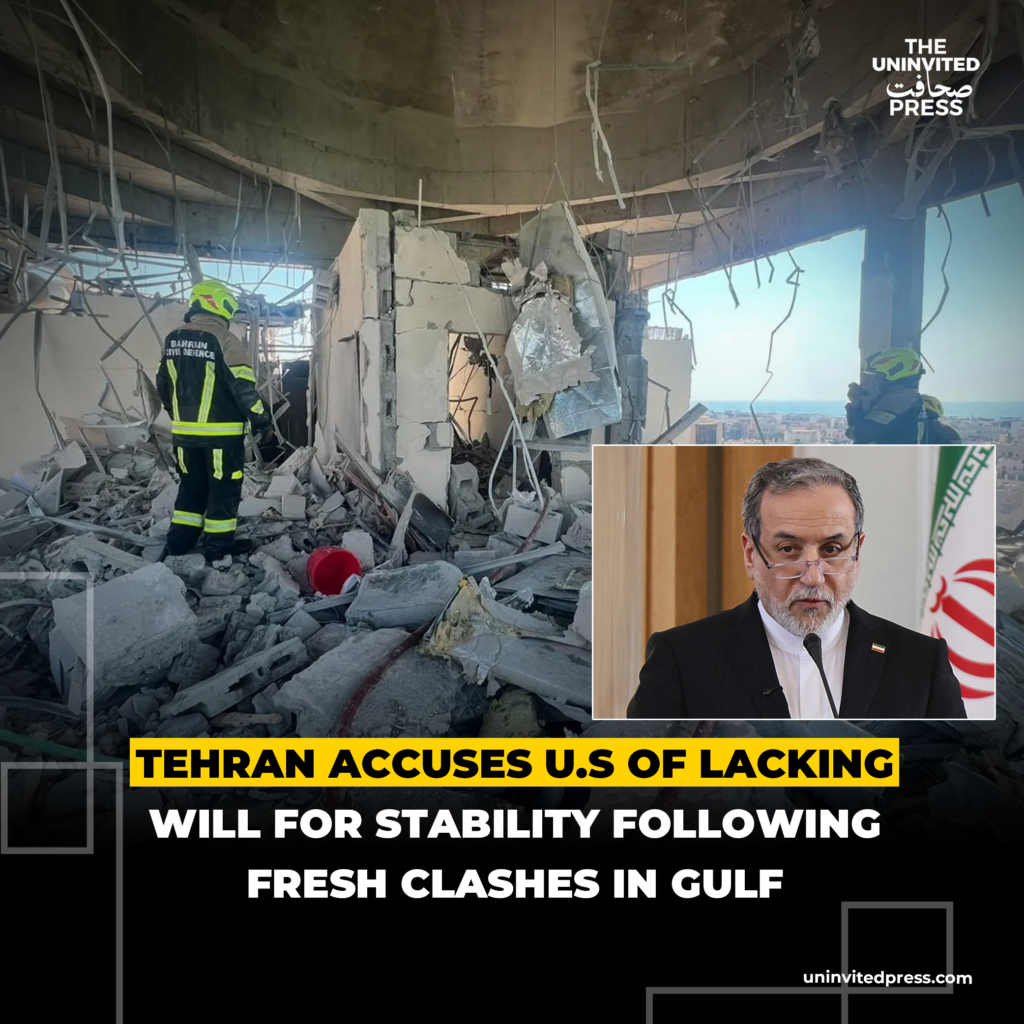
Tehran condemns Washington’s approach to regional security following reported strikes and ongoing tensions over the Strait of Hormuz.
Iran has sharply criticised the United States for what it describes as a lack of commitment to stability in the Gulf, amid fresh clashes and attacks that have heightened fears of renewed escalation in the region.
Iranian officials, including senior diplomats, pointed to recent incidents involving US-aligned Gulf states as evidence of Washington’s failure to uphold de-escalation efforts following the fragile ceasefire that ended major hostilities earlier this year.
Military Developments and Diplomatic Fallout:
Significant destruction has been reported at sites in Bahrain linked to the U.S. military presence, with Bahraini Civil Defence emergency responders surveying rubble following what authorities described as the aftermath of strikes. Iranian state media and officials have linked the incidents to broader retaliatory actions in response to what Tehran considers U.S. provocations.
Foreign Minister Abbas Araghchi has been vocal in recent statements, urging the U.S. to reconsider its military footprint in the region if it seeks safety and stability. “Leave our region if you want to be safe,” Araghchi reiterated in warnings that underscore Tehran’s position on foreign military presence.
The latest flare-ups come against the backdrop of disputes over maritime traffic in the Strait of Hormuz, a critical chokepoint for global oil supplies. Iran has asserted control over certain routes, leading to incidents involving commercial vessels and naval forces.
Ceasefire Under Pressure :
The US-Iran ceasefire, brokered after months of intense conflict that claimed high-profile casualties including former Supreme Leader Ayatollah Ali Khamenei, has faced repeated challenges. Analysts warn that mutual accusations risk unravelling diplomatic gains made in recent months.
Gulf states hosting US bases, including Bahrain and Kuwait, have condemned Iranian actions, describing them as violations of sovereignty. Meanwhile, Tehran maintains its responses are defensive and proportionate to external threats.
The war, which erupted in February with US-Israeli strikes on Iran, has left a trail of destruction across the region, disrupting economies and displacing populations. Reconstruction efforts are underway, but security concerns persist.
As funerals and mourning ceremonies for Iranian leaders continue, officials in Tehran have called for restraint from all parties during this sensitive period. International mediators, including from Oman and other regional actors, are reportedly engaged in backchannel talks to prevent further clashes.
The situation remains fluid, with the potential for renewed violence threatening global energy markets and broader Middle East stability. Observers stress the need for genuine diplomatic engagement to address underlying grievances rather than short-term military posturing.