

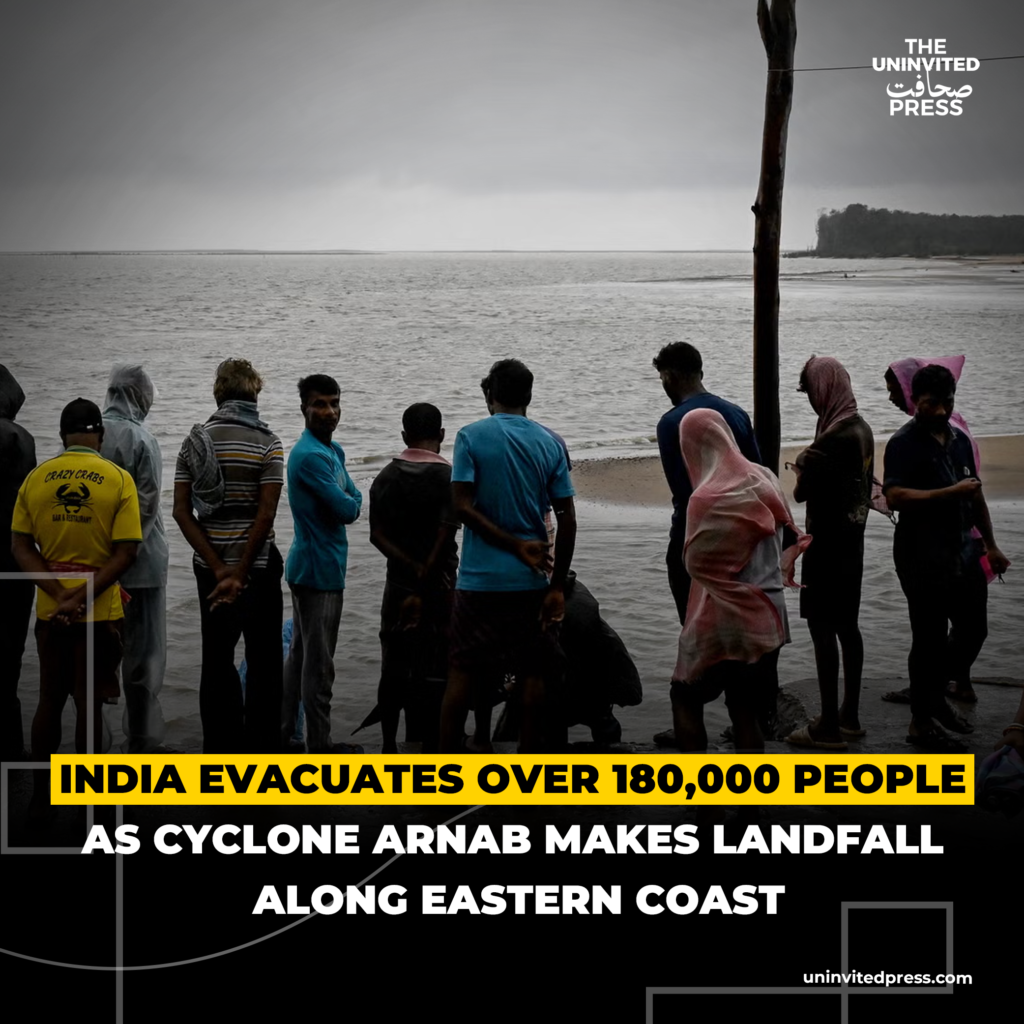
Very severe storm batters Andhra Pradesh with destructive winds and heavy rain; authorities report no fatalities so far amid widespread disruptions.
Indian authorities have evacuated more than 180,000 people from vulnerable coastal areas in Andhra Pradesh and Odisha as Cyclone Arnab, classified as a very severe cyclonic storm, made landfall on the country’s eastern coast early on Wednesday.
The India Meteorological Department (IMD) said the system crossed the Andhra Pradesh and Yanam coasts between Bapatla and Visakhapatnam, close to south of Yanam, between roughly 2am and 8am IST. Maximum sustained winds reached 125-135 kmph with gusts up to 150 kmph during the landfall process. The storm’s centre moved inland near Narsapur, about 40 km southwest of Yanam and 60 km southwest of Kakinada.
Satellite imagery from India’s INSAT-3DS weather satellite showed the cyclone’s sprawling cloud shield covering large parts of eastern and southern India as well as the Bay of Bengal.
Mass evacuations and emergency measures:
Officials moved residents from low-lying and flood-prone zones to cyclone shelters in the two states. Reports indicated tens of thousands relocated in Andhra Pradesh, with additional numbers in Odisha bringing the combined total above 180,000. More than 2,000 shelters were prepared across affected districts, and emergency alerts were sent to millions of mobile phones.
Andhra Pradesh Chief Minister N Chandrababu Naidu described protecting every life as the foremost priority and held a teleconference with thousands of officials to review the situation and direct relief efforts. No loss of life had been reported in either state as of Wednesday morning, though power supplies were disrupted, trees uprooted, and some houses damaged.
Fishermen were advised to stay ashore, and more than 30,000 boats were secured. Medical teams were deployed, and efforts focused on restoring power and communications.
Cyclone Batters Andhra Pradesh, Disrupting Transport and Power:
Heavy rainfall lashed coastal districts including Anakapalli, Visakhapatnam, Kakinada and Konaseema, with some locations recording more than 200 mm. Strong winds caused trees to fall onto highways and electricity poles to topple. Schools were closed in affected areas, dozens of trains were cancelled, and operations at airports in Andhra Pradesh were suspended.
The IMD had warned of possible total destruction of thatched houses, localised flooding, uprooting of power and communication poles, and widespread damage to standing crops. A storm surge of 1-2.5 metres above astronomical tide was expected to inundate low-lying areas around Kakinada and Yanam.
The cyclone remained practically stationary for a period during the landfall process before moving further inland and beginning to weaken, according to meteorological updates. Neighbouring regions and countries, including parts of Odisha, West Bengal, Sri Lanka and Nepal, also faced weather warnings linked to the system.
Authorities continued monitoring the situation closely, with focus shifting toward relief, restoration of essential services, and assessment of agricultural and infrastructure damage as the storm’s influence gradually diminishes.