

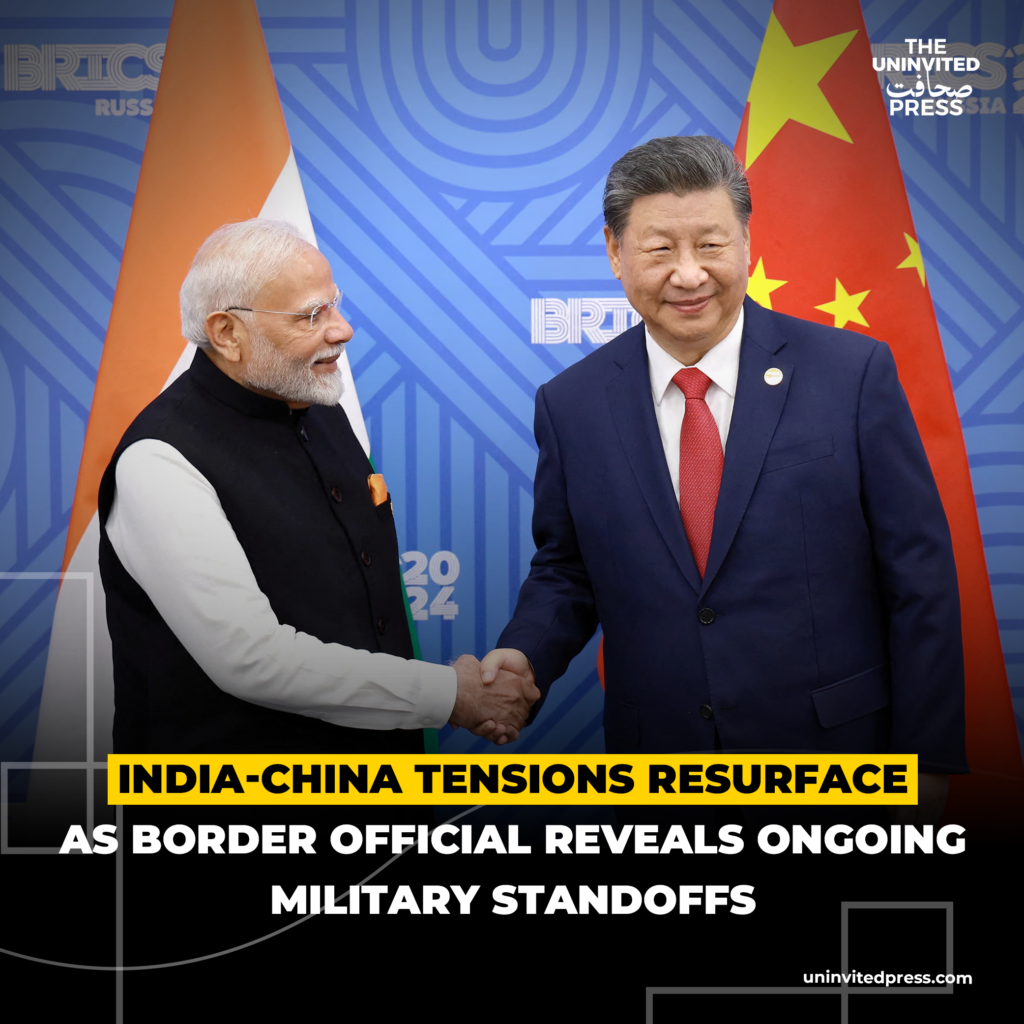
ITBP chief’s rare public confirmation of face-offs in Arunachal Pradesh tests fragile diplomatic thaw six years after deadly Galwan clash.
A fragile rapprochement between India and China is facing a fresh test after a senior Indian border official publicly confirmed that military face-offs with Chinese troops are continuing at multiple locations along the disputed Himalayan frontier in Arunachal Pradesh.
Shatrujeet Kapur, director-general of the Indo-Tibetan Border Police (ITBP), the paramilitary force responsible for guarding much of India’s frontier with China, made the remarks last week at a ceremony in Rajasthan. “In the past few days, a situation arose where face-off(s) happened at several locations in Arunachal and it still continues,” Kapur said, according to multiple Indian media reports.
According to Indian government sources cited in media reports, the latest episode traces back to late July near Taksing in Upper Subansiri district. During a routine patrol, Indian and Chinese troops encountered each other near Maja. After a brief confrontation, both sides initially withdrew. Chinese People’s Liberation Army (PLA) troops later returned in larger numbers and pitched tents approximately six to seven kilometres inside what India regards as its side of the Line of Actual Control (LAC), near the Maja company operating base.
Local groups had earlier claimed Chinese forces occupied or restricted access to several points around Taksing, including areas known as Oying in Asaphila, Paniar, Marpan, Portrang Lake and Tingdingtang. State officials had previously dismissed some of these reports as rumours, but Kapur’s statement has given them new weight.
Diplomatic Efforts Continue:
The revelations arrive at a delicate moment in bilateral relations. Over the past year and a half, New Delhi and Beijing have taken steps to stabilise ties after the deadly June 2020 clash in the Galwan Valley of eastern Ladakh, in which at least 20 Indian soldiers and an undisclosed number of Chinese troops were killed. That confrontation triggered a prolonged military standoff and a sharp deterioration in relations.
In recent months the two sides restored some patrolling arrangements in parts of Ladakh, resumed direct flights, reopened limited border trade, and held high-level diplomatic and military talks. Leaders Narendra Modi and Xi Jinping met on the sidelines of multilateral summits, signalling a desire to manage differences and prevent further escalation. Both countries have repeatedly stated that peace and tranquillity along the border are essential for the broader relationship.
Yet the LAC-the de facto border that remains largely undemarcated along roughly 3,500 kilometres of rugged terrain-continues to generate friction. India’s Ministry of External Affairs responded to Kapur’s comments by noting that “the situation in the India-China border areas gets disturbed from time to time when Chinese forces diverge from established patrolling patterns.” Spokesperson Randhir Jaiswal emphasised that both sides continue to use existing diplomatic and military mechanisms to resolve outstanding issues and avoid misunderstanding.
China, for its part, rejected any suggestion of provocative behaviour. A foreign ministry spokesperson said Chinese forces were conducting “normal patrol and control activities” in accordance with relevant bilateral agreements and were safeguarding territorial sovereignty and border stability. Beijing has long maintained that its patrols stay within its own claimed territory.
Ongoing India-China Border Tensions and Unresolved Territorial Disputes:
In Arunachal Pradesh, which China claims as part of “South Tibet,” residents and opposition politicians have voiced growing unease. Congress leaders in the state accused the Modi government of maintaining silence on the issue and claimed Chinese personnel had advanced deep into Indian-claimed areas. A senior Congress figure alleged intrusions of nearly 50 kilometres in parts of Upper Subansiri, though official confirmation of such distances has not been provided.
The ITBP chief’s public remarks are unusual. Sensitive border matters are typically handled through carefully worded statements from the foreign or defence ministries rather than serving operational officers. The subsequent political debate in New Delhi has focused on whether the government has been transparent about the extent of Chinese activity and whether the ongoing disengagement process in Ladakh has been matched by similar progress further east.
Analysts note that while neither side appears to seek a return to the large-scale mobilisation of 2020-2022, the pattern of competitive patrols, tent pitching and restricted access reflects the unresolved nature of the boundary dispute. The LAC’s ambiguity allows both armies to assert presence in grey zones, raising the risk of miscalculation in an environment where trust remains limited.
The India-China border dispute is one of the world’s longest-running. The two countries fought a brief war in 1962 and have experienced periodic skirmishes and standoffs since. Despite multiple rounds of talks over decades, they have failed to agree on a mutually acceptable alignment of the LAC, let alone a final boundary settlement.
Recent diplomatic efforts have prioritised “management” of differences rather than resolution. Military hotlines, commander-level meetings and agreements on patrolling protocols have helped prevent violence in some sectors, yet the fundamental disagreement over territory persists. China’s infrastructure build-up on its side of the frontier and India’s accelerated road and airfield construction have added a competitive edge to the standoff.
For residents of remote border villages in Arunachal Pradesh, the strategic manoeuvring has concrete consequences: restricted movement, disrupted traditional grazing and hunting patterns, and a persistent sense of insecurity. Civil society groups have repeatedly appealed for stronger protection of Indian claims and greater transparency from New Delhi.
As winter approaches in the high Himalayas, both armies will continue to maintain forward deployments. Kapur’s confirmation that face-offs “still continue” serves as a reminder that the diplomatic thaw, while real, remains incomplete and vulnerable to events on the ground.